
Dry-type and oil-immersed transformers differ significantly in capacity range, application scenarios, structure, and performance—selection depends on space, safety requirements, environmental conditions, and cost. Below is a systematic comparison and practical.
1. Capacity & Voltage Range
- Dry-Type Transformers:
- Mainly for power distribution, with most capacities ≤1600kVA and voltage levels ≤10kV (partial models up to 35kV).
- Large-capacity models are less common compared to oil-immersed types.
- Oil-Immersed Transformers:
- Cover a full capacity range (small to ultra-large) and ultra-high voltage levels.
- Suitable for high-voltage transmission: e.g., China’s under-construction 1000kV UHV test lines must use oil-immersed transformers.
2. Application Scenario Selection
| Scenario | Recommended Transformer Type | Core Reason |
|---|---|---|
| Comprehensive buildings (basements, mid-floors, roofs), densely populated areas | Dry-Type | Fireproof, explosion-proof, no oil leakage risks; no need for independent substations (saves space). |
| Outdoor temporary power (construction sites) | Oil-Immersed (often box-type) | Mature outdoor adaptation, cost-effective for temporary use. |
| Large installation space | Oil-Immersed | Larger volume is acceptable; better overload capacity for long-term operation. |
| Crowded installation space | Dry-Type | Compact structure, fits limited areas. |
| Humid and hot areas | Dry-Type (with forced air cooling) | Note: The original “oil is handy” is corrected—dry-type transformers require forced air cooling (AF) in humid and hot environments to avoid overheating. |
3. Core Structural Differences
(1) Packaging Form
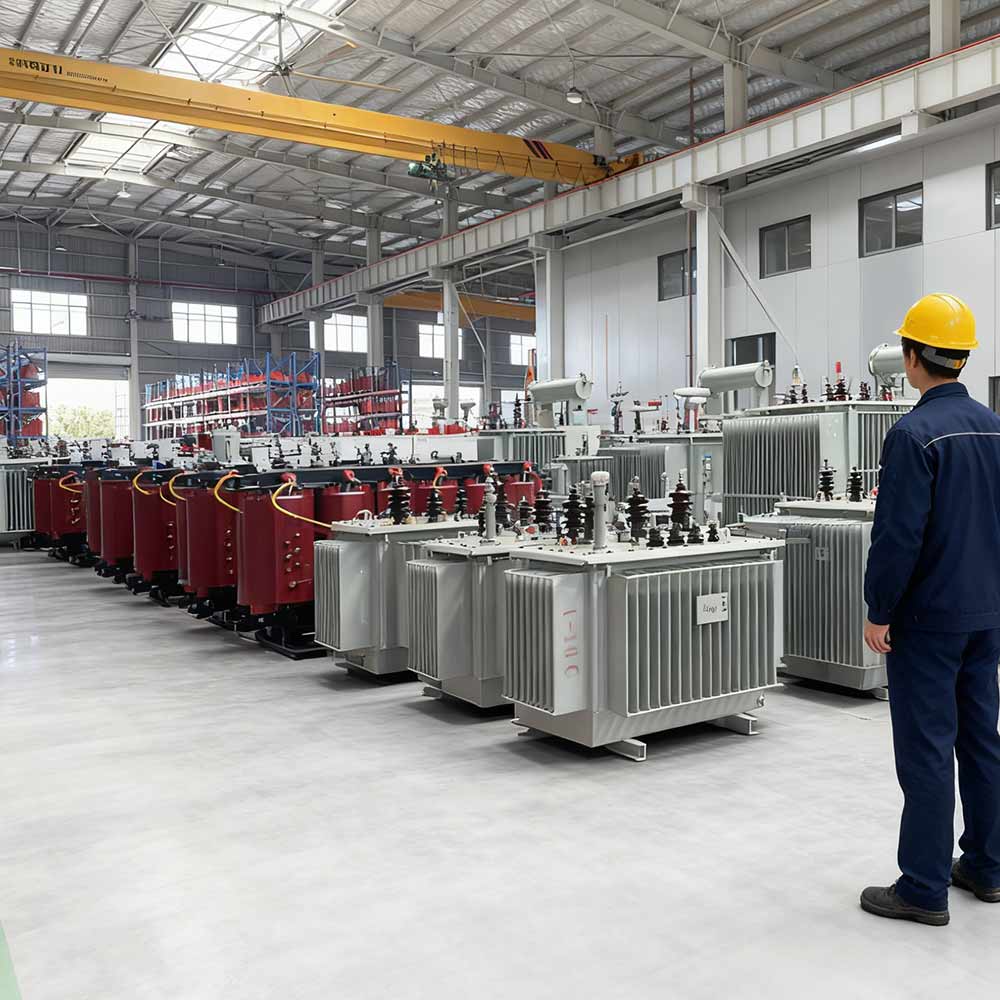
- Dry-Type: Core and windings are directly visible (no closed shell); common models include SC (epoxy cast) and SG (open type).
- Oil-Immersed: Only the outer tank is visible (core and windings sealed in insulating oil).
(2) Lead Bushing Type
- Dry-Type: Mostly use silicon rubber bushings—lightweight, moisture-resistant, suitable for indoor/outdoor with protection.
- Oil-Immersed: Mostly use porcelain bushings—high-temperature resistant, durable, adapted to harsh outdoor conditions (wind, rain, dust).
4. Insulation & Heat Dissipation Methods
- Dry-Type Transformers:
- Insulation: Epoxy resin (cast type) or insulating paper + paint (open type).
- Cooling: Natural air cooling (AN) for small capacities; forced air cooling (AF) for large capacities (boosts heat dissipation efficiency).
- Oil-Immersed Transformers:
- Insulation: Insulating oil (serves both insulation and cooling functions).
- Cooling: Insulating oil circulates internally, transferring heat to the tank and radiators for dissipation.
5. Load Capacity & Cost
- Load Capacity:
- Dry-Type: Mostly operate at rated capacity, with limited overload capability.
- Oil-Immersed: Excellent overload performance, suitable for short-term or long-term overload (adapts to fluctuating loads).
- Purchase Cost:
- Dry-Type: Significantly more expensive than oil-immersed transformers of the same capacity (epoxy casting and fireproof materials increase costs).
- Oil-Immersed: More cost-effective, with mature manufacturing technology reducing production costs.
6. Key Selection Principles
- Prioritize safety: Choose dry-type transformers in fire-sensitive or densely populated areas.
- Adapt to space: Select dry-type for small spaces, oil-immersed for large areas.
- Match environment: Use dry-type with forced air cooling in humid and hot areas; oil-immersed for outdoor harsh conditions.
- Balance cost & performance: Choose oil-immersed for cost-sensitive, large-capacity, or outdoor scenarios; dry-type for indoor, space-limited, or high-safety requirements.






OUR CERTIFICATE


OUR PROJECTS


