
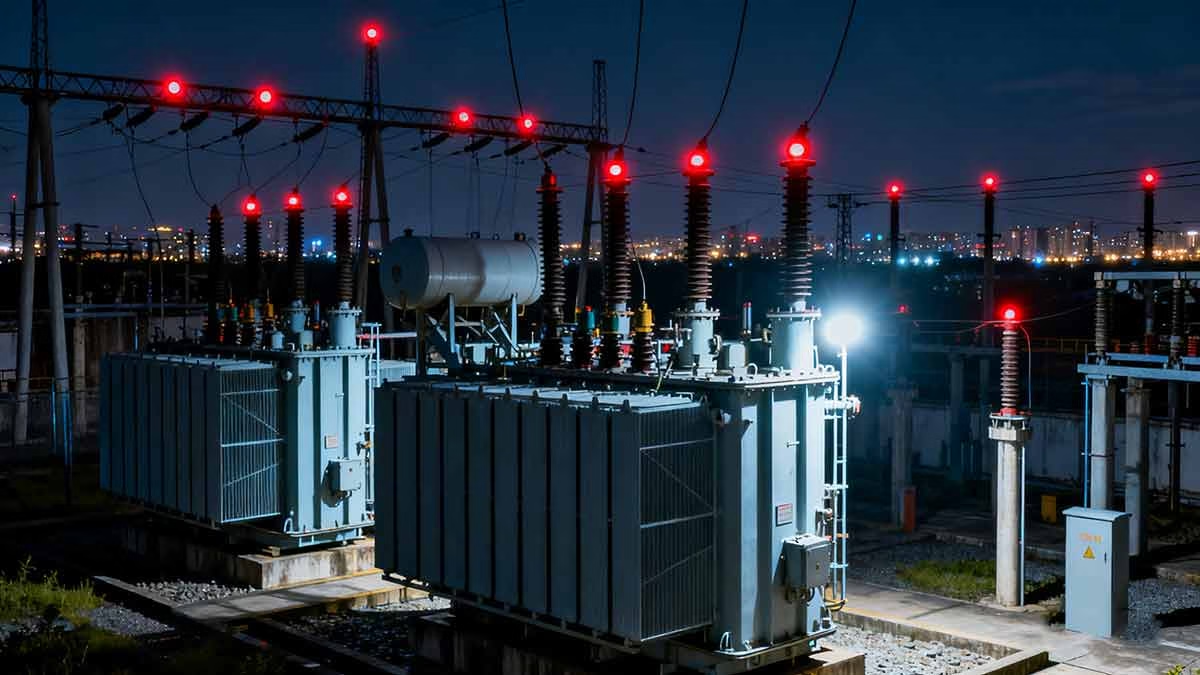
Power transformers serve as the unsung workhorses of electrical infrastructure, leveraging electromagnetic induction to adjust voltage levels across power systems. This core capability isn’t just a technical function—it’s the foundation of efficient long-distance power transmission and safe electricity use for homes, businesses, and industries worldwide.
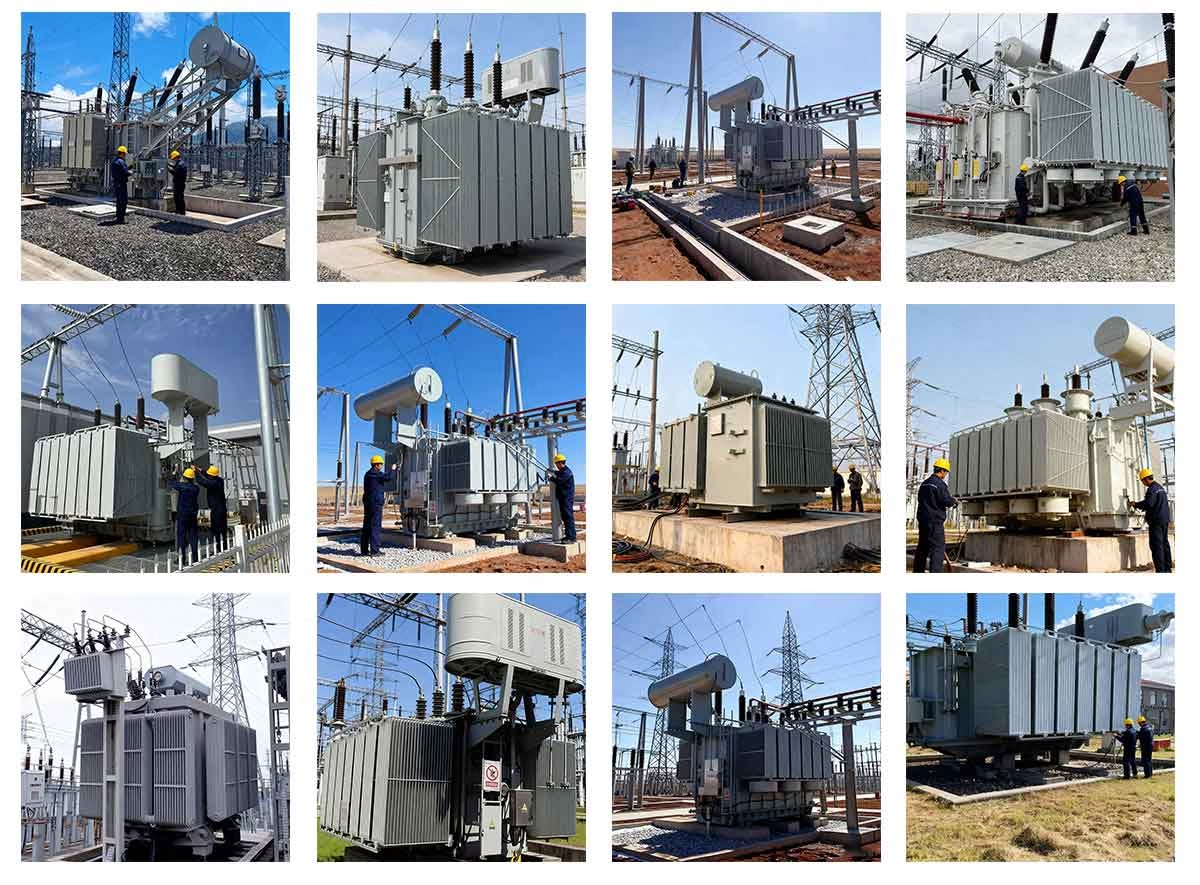
With decades of engineering experience in the power sector, we’ve witnessed how transformers shape reliable, resilient electrical grids. Below, we demystify their critical roles, from voltage conversion to grid optimization, and explore their far-reaching impact across diverse applications.
Contents
hide
Voltage Transformation: The Core Function of Power Transformers
Imagine connecting a household appliance directly to a power plant’s output—its circuits would fry instantly. Power transformers eliminate this risk by bridging the gap between high-voltage transmission and low-voltage usage, making electricity accessible and safe.
Voltage transformation is the defining purpose of power transformers: they either step up voltage for efficient long-distance transport or step down voltage to match the needs of end-users and equipment. This dual capability is what makes modern power grids flexible, scalable, and efficient.
Why Voltage Transformation Is Non-Negotiable
- Efficient Transmission: High voltage (typically 69kV–765kV) minimizes power loss during long-distance transport. For example, stepping up generator output from 25kV to 138kV reduces current flow, cutting line losses by up to 90% compared to low-voltage transmission.
- Safety & Compatibility: Most end-use equipment—from smartphones to industrial motors—requires low voltage (120V–480V) to operate safely. Transformers ensure these devices receive precisely calibrated power without risk of damage.
- System Flexibility: Different applications demand unique voltage levels: a data center’s HVAC system may need 480V, while residential lighting runs on 120V. Transformers adapt power to these varied needs seamlessly.
How Transformation Works in Practice
The magic of voltage conversion lies in electromagnetic induction and the “turns ratio” of a transformer’s coils:
- Primary Coil: Receives input voltage (e.g., 138kV from a transmission line).
- Magnetic Field Generation: Alternating current (AC) flowing through the primary coil creates a dynamic magnetic field, amplified by the transformer’s iron core.
- Secondary Coil Induction: The changing magnetic field induces a voltage in the secondary coil—its magnitude determined by the ratio of turns between the two coils.
- Turns Ratio Control: A step-up transformer (e.g., 1:10 turns ratio) boosts voltage, while a step-down unit (e.g., 10:1) reduces it. For instance, a 10,000-turn primary and 1,000-turn secondary coil steps 12kV down to 1.2kV.
Real-World Transformation Scenarios
- Power Plants: Step-up transformers boost generator output from 10kV–30kV to 69kV–500kV for cross-country transmission.
- Substations: Step-down transformers reduce 138kV to 12kV for regional distribution to neighborhoods.
- Utility Poles: Compact pad-mounted transformers further lower 12kV to 240V (residential) or 480V (small businesses).
- Industrial Facilities: Custom transformers adjust 480V to 208V for office equipment or step up 480V to 4160V for heavy machinery.
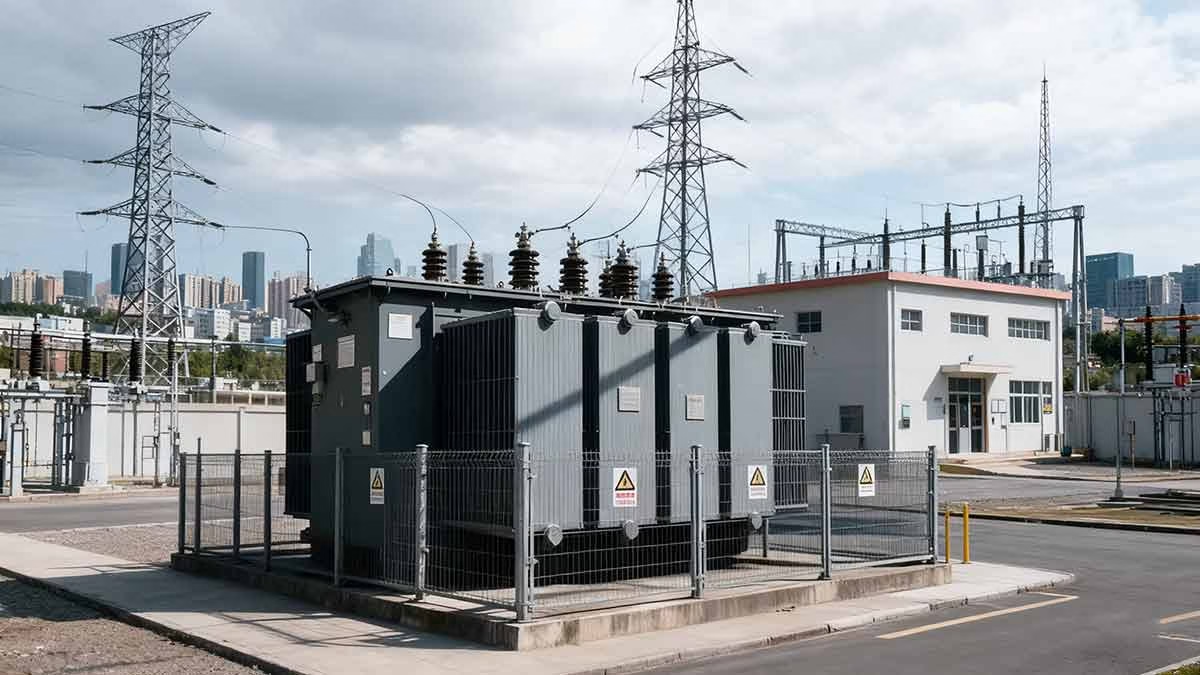
Beyond Voltage Change: How Transformers Optimize Power Transmission
While voltage conversion is their primary role, power transformers offer far more value—they are the linchpins of efficient, reliable power transmission and distribution. Their ability to minimize losses, isolate circuits, and regulate voltage makes modern grids viable, even across hundreds of miles.
Cutting Power Losses: The Economics of High-Voltage Transmission
Power loss in transmission lines follows the formula P=I2R—losses are proportional to the square of current. Transformers solve this by stepping up voltage, which reduces current for the same power load:
- A 100MW load transmitted at 12kV draws ~8,333A, resulting in significant losses.
- Stepping up to 138kV reduces current to ~695A, slashing losses by over 99%.
This efficiency isn’t just environmental—it’s economic. For a 100-mile transmission line, high-voltage transformation saves millions in annual energy costs and reduces the need for additional generation capacity.
Electrical Isolation: Safety and Performance
Transformers provide galvanic isolation between primary and secondary circuits, a critical safety feature:
- Isolates high-voltage transmission lines from low-voltage user systems, preventing electrical hazards.
- Reduces electrical noise and ground loops, protecting sensitive equipment (e.g., medical devices, data center servers).
- Limits fault propagation: if a short circuit occurs in a residential circuit, isolation prevents it from affecting the entire transmission line.
Voltage Regulation: Maintaining Stability
Grid voltage fluctuates with changing loads (e.g., morning coffee makers, evening EV charging). Transformers counter this with:
- On-Load Tap Changers (OLTCs): Adjust turns ratio while the transformer is in operation, maintaining voltage within ±1% of the rated value.
- Automatic Voltage Regulators (AVRs): Work with transformers to compensate for voltage drops during peak demand, ensuring consistent power for sensitive equipment.
Power Factor Correction: Boosting System Efficiency
Many industrial loads (e.g., motors, compressors) draw reactive power, which reduces overall grid efficiency. Some transformers are designed to:
- Absorb or supply reactive power, improving the system’s power factor (target: 0.9–1.0).
- Reduce “apparent power” (kVA) without lowering real power (kW), allowing grids to handle more loads without upgrades.
| Transformer Optimization Feature | Function | Real-World Impact |
|---|---|---|
| High-Voltage Step-Up | Reduces transmission current | 90% lower line losses for cross-country power transport |
| Galvanic Isolation | Separates circuits | Prevents fault propagation in residential neighborhoods |
| OLTC Voltage Regulation | Adjusts turns ratio dynamically | Stable voltage for data centers during peak computing hours |
| Reactive Power Support | Improves power factor | Industrial facility handles 20% more load without grid upgrades |
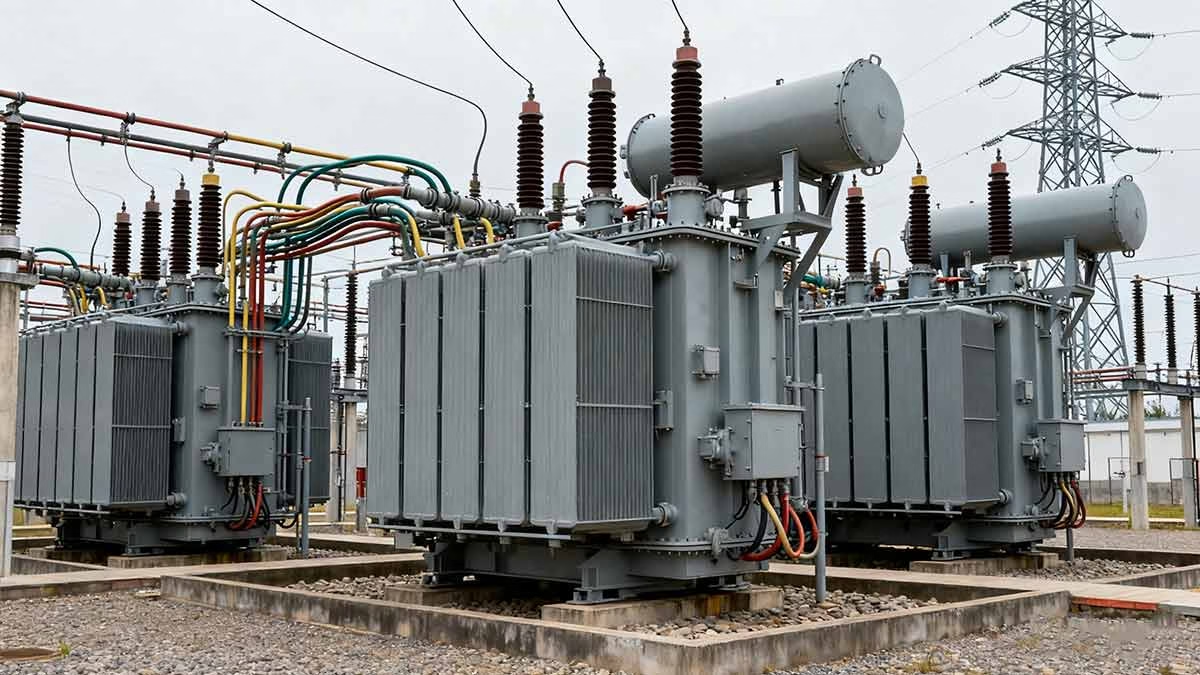
The Science of Transformation: Electromagnetic Principles Unveiled
The ability of transformers to convert voltage without moving parts or direct electrical contact hinges on two fundamental electromagnetic principles: induction and mutual inductance. These laws, discovered over two centuries ago, remain the bedrock of transformer design—refined by modern engineering for unparalleled efficiency.
Electromagnetic Induction: The Foundation
Discovered by Michael Faraday in 1831, electromagnetic induction describes how a changing magnetic field induces an electric current in a conductor. For transformers:
- Alternating current (AC) flows through the primary coil, creating a magnetic field that expands and collapses with the current’s frequency (50Hz or 60Hz).
- This dynamic field cuts through the secondary coil, inducing an electromotive force (EMF)—the “push” that drives electric current in the secondary circuit.
Faraday’s Law quantifies this effect: EMF=−NdtdΦ, where N is the number of coil turns and dtdΦ is the rate of magnetic flux change. More turns or a faster flux change result in higher induced voltage.
Mutual Inductance: Energy Transfer Without Contact
Mutual inductance is the phenomenon that allows energy to flow between the primary and secondary coils—even without physical connection:
- The primary coil’s magnetic field links with the secondary coil (coupling), transferring energy through the shared field.
- The iron core amplifies this coupling: its high magnetic permeability concentrates flux, ensuring over 99% of the primary’s magnetic field reaches the secondary (vs. ~10% without a core).
The Iron Core: Engineering for Efficiency
The transformer’s core isn’t just a structural component—it’s a precision-engineered element that minimizes energy loss:
- Material Selection: Grain-oriented silicon steel is used for most cores, as it reduces hysteresis loss (energy wasted re-magnetizing the core) by 70% compared to plain iron.
- Lamination: Cores are stacked from thin (0.25–0.35mm) insulated sheets, blocking eddy currents (circulating currents that generate heat) and cutting eddy current loss by 95%.
- Core Design: Core-type (coils wrapped around core legs) or shell-type (core surrounds coils) geometries optimize flux distribution—core-type is preferred for power transformers due to simpler manufacturing and better heat dissipation.
Practical Engineering Considerations
In real-world transformer design, we address tradeoffs to maximize efficiency:
- Core Saturation: Avoiding flux density extremes (typically 1.5T for silicon steel) prevents saturation, which distorts current and increases losses.
- Leakage Flux: Careful coil winding (e.g., concentric coils) minimizes flux that doesn’t link both coils, improving coupling efficiency.
- Insulation: High-grade materials (epoxy resin, Nomex) separate coil turns and layers, withstanding voltage spikes (e.g., lightning strikes) without breakdown.
Transformer Applications: Powering Diverse Industries
From the smallest home appliance to the largest industrial furnace, transformers are ubiquitous—tailored to meet the unique demands of every sector. Their versatility stems from customizable designs: size, voltage rating, cooling systems, and insulation all adapted to specific use cases.
Residential & Commercial Buildings
Transformers are the silent enablers of modern living and workspaces:
- Distribution Transformers: Pad-mounted or pole-mounted units (10–50kVA) step 12kV down to 240V/120V for homes, powering HVAC, EV chargers, and smart home systems. A typical 2,500 sq. ft. home with an EV charger and heat pump requires a 30kVA transformer—up from 20kVA a decade ago due to electrification.
- Commercial Transformers: Dry-type units (75–2,500kVA) power office buildings, retail centers, and hotels, supplying 480V for HVAC and 208V for lighting/IT equipment. High-rise buildings often use compact, low-noise transformers installed in basements or utility rooms.
- Specialized Commercial: Hospitals rely on isolation transformers (3–300kVA) to protect sensitive medical equipment (e.g., MRI machines) from voltage fluctuations and ground loops.
Heavy Industry
Industrial applications demand rugged, high-capacity transformers built to withstand harsh conditions:
- Steel Production: Electric arc furnaces use massive oil-filled transformers (5–100MVA) to deliver 40kA at 40V, melting scrap steel in minutes.
- Aluminum Smelting: Electrolysis processes require transformers that supply low voltage (8–12V) and extremely high current (100kA+), with specialized cooling systems to handle heat.
- Manufacturing: Variable Frequency Drive (VFD) transformers (10–500kVA) control motor speed in pumps, conveyors, and assembly lines, reducing energy use by 30–40% compared to fixed-speed systems.
Renewable Energy
Transformers are critical to integrating clean energy into the grid, addressing the variable output of wind and solar:
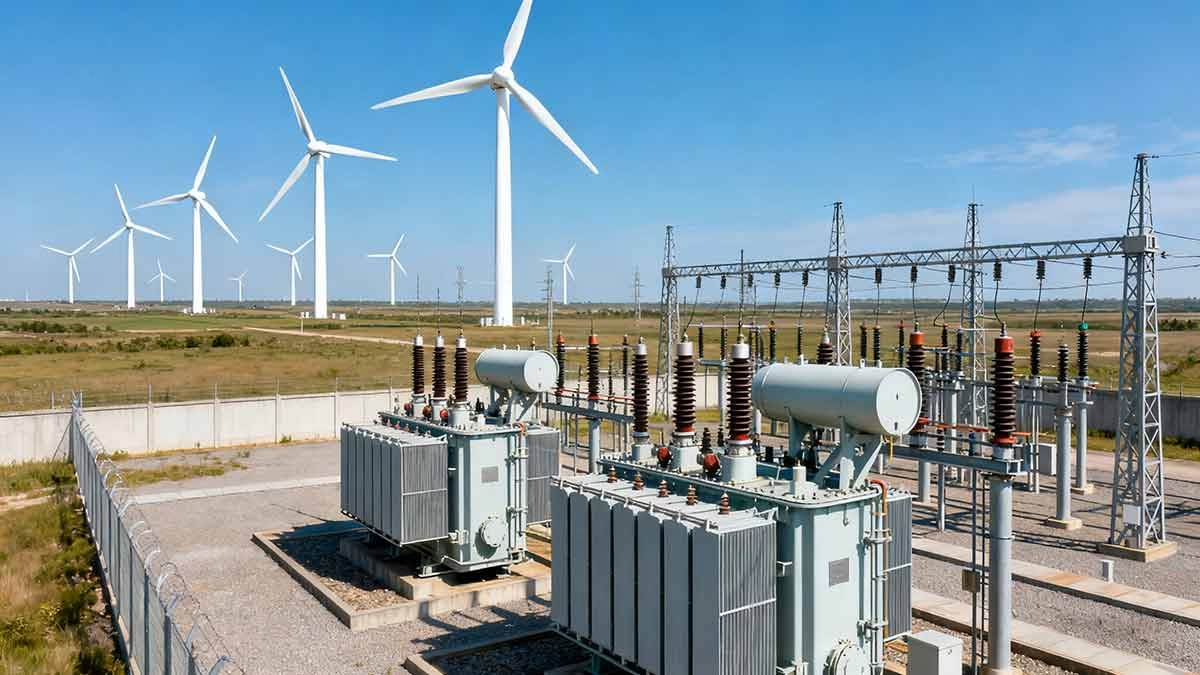
- Wind Farms: Step-up transformers (1–10MVA) boost voltage from turbines (690V) to 34.5kV for transmission, even in offshore environments with salt spray and high winds.
- Solar Farms: Inverter transformers convert DC power from solar panels to AC (12kV–34.5kV), with harmonic mitigation features to reduce grid distortion.
- Hydroelectric Plants: Large power transformers (10–500MVA) step up voltage from generators (10kV–25kV) to transmission levels, often installed in remote locations with extreme temperature variations.
| Industry Sector | Transformer Type | Key Requirements | Typical Size Range |
|---|---|---|---|
| Residential | Pad-Mounted Distribution | Compact, low-noise, weather-resistant | 10–50kVA |
| Commercial | Dry-Type | Fire-safe, space-efficient, low-noise | 75–2,500kVA |
| Heavy Industry | Oil-Filled Power | High-current, rugged, advanced cooling | 5–100MVA |
| Renewable Energy | Step-Up | Harmonic-resistant, weather-tight | 1–100MVA |
Emerging Applications
As electrification accelerates, transformers are adapting to new demands:
- EV Charging: Fast-charging stations use medium-voltage transformers (50–350kVA) to convert grid power to DC, supporting 15–350kW charging speeds.
- Microgrids: Modular transformers enable standalone power systems for remote communities, military bases, and disaster zones, switching seamlessly between grid and renewable sources.
Enhancing Grid Stability & Efficiency: Transformers as Grid Enablers
Modern power grids face unprecedented challenges: growing demand, variable renewable energy, and aging infrastructure. Power transformers rise to these challenges, acting as active grid stabilizers that ensure reliability, efficiency, and resilience.
Voltage Stability: The Grid’s “Pressure Regulator”
Voltage fluctuations can damage equipment, trigger blackouts, and reduce efficiency. Transformers maintain stability through:
- On-Load Tap Changers (OLTCs): Adjust turns ratio in real time (up to 32 taps) to counter voltage drops during peak demand (e.g., evening EV charging) or surges from renewable energy.
- Reactive Power Support: Transformers’ magnetizing current supplies reactive power, preventing voltage collapse in high-load areas. For example, a 100MVA transformer can provide 20Mvar of reactive power, stabilizing voltage in a residential neighborhood.
Power Flow Management
As grids integrate more distributed energy (solar, wind), power flow becomes bidirectional—transformers manage this complexity:
- Phase-Shifting Transformers (PSTs): Adjust the phase angle between primary and secondary voltage, controlling power flow direction and reducing congestion on overloaded lines.
- Load Balancing: Strategically placed transformers distribute load across the grid, preventing overheating in critical lines and extending infrastructure life.
Fault Isolation & System Resilience
Transformers limit the impact of grid faults (e.g., short circuits, lightning strikes):
- Galvanic Isolation: Prevents faults in one part of the grid from spreading to others. A short circuit in a residential circuit won’t affect the transmission line feeding the neighborhood.
- Inrush Current Mitigation: Modern transformers use controlled switching or core materials with low remanence, reducing inrush current (up to 10x rated current) during startup—preventing voltage dips that disrupt sensitive equipment.
Renewable Energy Integration
Transformers are the bridge between variable renewable energy and the grid:
- Bidirectional Power Handling: Support two-way flow, allowing excess solar/wind power to feed back into the grid.
- Harmonic Mitigation: K-rated transformers withstand non-linear currents from solar inverters and wind turbines, reducing grid distortion and overheating.
- Voltage Ride-Through: Maintain operation during voltage sags (common with wind turbulence), ensuring uninterrupted renewable energy delivery.
The Future of Grid-Ready Transformers
As grids evolve into smart, decentralized systems, transformers are becoming more advanced:
- Smart Transformers: Equipped with IoT sensors and communication modules, they transmit real-time data on load, temperature, and health—enabling predictive maintenance and grid optimization.
- Solid-State Transformers (SSTs): Replace traditional iron cores with power electronics, offering faster switching, smaller size, and compatibility with DC grids (critical for EVs and energy storage).
- Energy Storage Integration: Transformers connect battery storage systems to the grid, enabling peak shaving (storing power during low demand, releasing during peaks) and enhancing grid resilience.
Conclusion
Power transformers are far more than voltage converters—they are the backbone of modern electrical systems, enabling efficient transmission, safe usage, and grid stability. From powering a home’s EV charger to integrating gigawatts of renewable energy, their versatility and reliability make them indispensable to our electrified world.
As technology advances, transformers continue to evolve—becoming smarter, more efficient, and better equipped to meet the demands of a decarbonized future. Whether in residential neighborhoods, industrial facilities, or remote renewable energy sites, these unsung heroes will remain critical to building a more reliable, efficient, and sustainable power grid.