
Contents
hide
Understanding On Load Tap Changer (OLTC): Core Definition & Fundamental Principles
This section establishes the foundational definition of OLTC and clarifies its core role in mitigating voltage instability in power systems.
Voltage volatility stands as a pervasive challenge in medium and high-voltage power networks, driven by dynamic load shifts, renewable energy intermittency, and long-distance transmission constraints. An On Load Tap Changer (OLTC) is a specialized electromechanical switching component integrated into power transformers, engineered to adjust the transformer’s turns ratio and output voltage while the unit remains fully energized and supplying continuous power to connected loads.
Unlike conventional voltage adjustment methods that require transformer de-energization, OLTC eliminates service interruptions during tap changes, making it a cornerstone component for maintaining grid stability. This device directly addresses the impracticality and financial burden of shutting down transformers for routine voltage corrections, a scenario that would disrupt critical power delivery to residential, commercial, and industrial consumers alike.
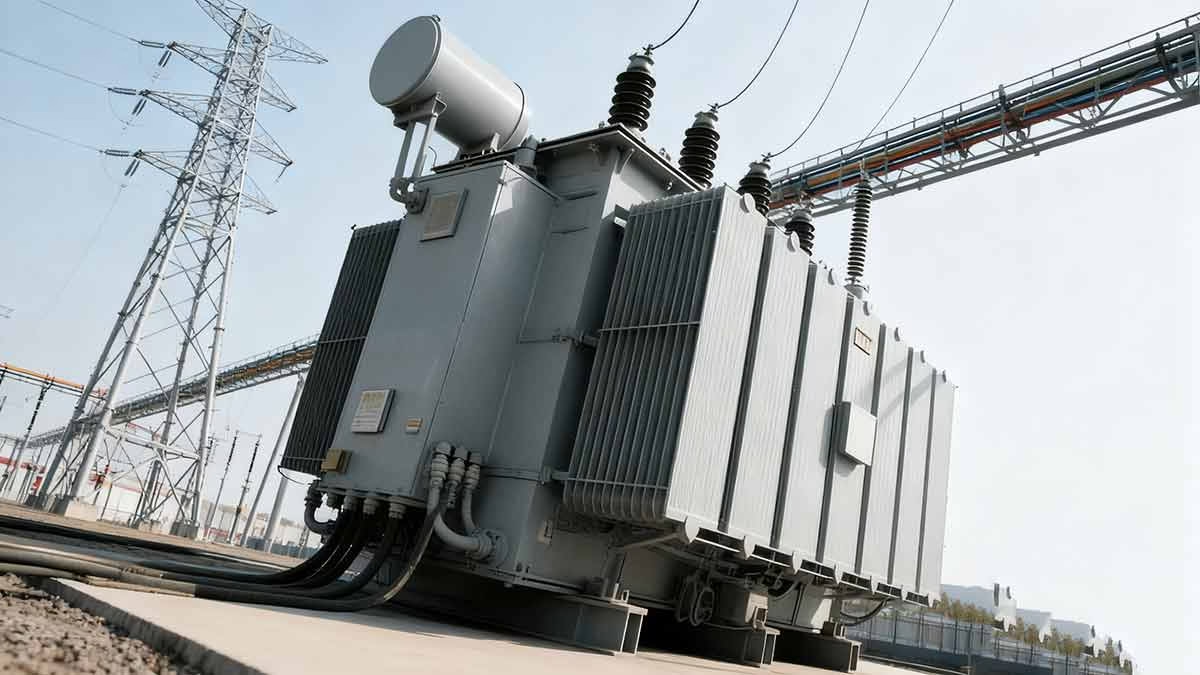
The core functionality of OLTC revolves around three fundamental objectives:
• Regulating output voltage to align with predefined grid standards amid system fluctuations
• Preserving an uninterrupted power supply during the entire tap adjustment process
• Protecting the transformer and downstream electrical equipment from voltage-related damage
At its essence, the OLTC modifies the number of active winding turns on the transformer (typically the high-voltage winding) to alter the voltage transformation ratio. Each tap position corresponds to a specific turns ratio, allowing precise calibration of output voltage to counteract deviations caused by load variations, reactive power imbalances, or grid topology changes. This real-time adjustment capability distinguishes OLTC as an irreplaceable component for modern power transformers deployed in demanding operational environments.
Key International Standards Governing OLTC and Transformer Voltage Regulation
This section outlines the global regulatory frameworks that define voltage limits and performance criteria for OLTC-equipped transformers.
Standardization is paramount to ensuring the interoperability, safety, and consistent performance of OLTC and power transformers across international power networks. Leading global standardization bodies have developed comprehensive guidelines that establish voltage thresholds, design requirements, and operational parameters for OLTC integration, with IEC and IEEE serving as the primary authoritative bodies.
IEC Standards for OLTC and Transformer Voltage Regulation
The International Electrotechnical Commission (IEC) provides the most widely adopted global standards for power transformers and OLTC systems, forming the basis for transformer design and operation in most regions outside North America.
The pivotal standard governing OLTC and voltage regulation is IEC 60076, a multi-part series dedicated to power transformers. This standard specifies critical parameters, including:
• Rated voltage definitions and permissible continuous voltage deviations
• Tolerance levels for short-term overvoltage and undervoltage conditions
• Insulation coordination requirements compatible with OLTC operation
• Thermal performance constraints during voltage adjustment cycles
IEC 60076 mandates that transformers equipped with OLTC must sustain continuous operation within a ±5% deviation from the rated voltage under normal operating conditions, with short-term deviations allowed up to ±10% provided thermal and loading limits are not exceeded. Complementary standards such as IEC 60038 (standard voltage levels for power systems) and IEC 60071 (insulation coordination for electrical equipment) further refine the operational framework for OLTC, ensuring alignment between grid voltage specifications and transformer design.
IEEE and ANSI Standards for North American Applications
In North America and regions following U.S. industrial practices, IEEE and ANSI standards define the regulatory landscape for OLTC and transformer voltage management.
Key standards include:
• IEEE C57.12.00: Establishes general requirements for liquid-immersed power transformers, including OLTC integration and voltage regulation performance
• IEEE C57.12.01: Outlines design and operational criteria for dry-type transformers with OLTC systems
• ANSI C84.1: Defines two primary voltage ranges (Range A and Range B) for power systems, setting the acceptable voltage variation limits that OLTC systems must maintain
These standards ensure that OLTC-equipped transformers meet regional grid requirements, with strict guidelines for voltage regulation accuracy, mechanical durability, and safety performance. Compliance with these standards is a prerequisite for utility adoption and manufacturer warranty validation in North American markets.
European Regional Standards and Grid Code Compliance
European power systems integrate IEC standards with EN (CENELEC) specifications and national grid codes to create a layered regulatory framework for OLTC operation.
European standards harmonize IEC voltage limits with regional grid operational requirements, defining:
• Utility-specific voltage tolerance bands for transmission and distribution networks
• Responsibilities of transmission system operators (TSOs) and distribution system operators (DSOs) in voltage regulation
• Compatibility requirements for cross-border power transmission involving OLTC-equipped transformers
This harmonized approach ensures that OLTC systems perform consistently across interconnected European grids, supporting seamless power exchange while adhering to regional safety and performance mandates.
The Indispensable Value of Standard Service Voltage Ranges for OLTC-Equipped Transformers
This section explains the critical importance of adhering to standard voltage ranges and how OLTC systems enable compliance with these parameters.
Standard service voltage ranges are not arbitrary benchmarks; they are scientifically derived parameters that safeguard transformer integrity, optimize operational efficiency, and ensure the longevity of electrical assets. OLTC systems are specifically designed to maintain transformer operation within these ranges, making their alignment with standard voltage limits a critical factor in overall power system performance.
Safeguarding Transformer Insulation Integrity
Adherence to standard voltage ranges is the primary measure for preserving the lifespan of transformer insulation systems, and OLTC is the key enabler of this protection.
Transformer insulation materials are engineered to withstand specific electrical stress levels associated with standard voltage deviations. Operating within these defined ranges ensures:
• Electrical field stresses remain within the safe design limits of insulation materials
• Partial discharge activity is minimized to levels that do not accelerate material degradation
• Insulation aging follows predictable thermal life cycles, maximizing the transformer’s service life
Even minor, persistent voltage deviations outside standard ranges accelerate insulation breakdown exponentially. OLTC’s continuous voltage regulation capability prevents these deviations, directly extending the operational lifespan of the transformer and reducing the need for costly premature replacements.
Preventing Core Saturation and Efficiency Losses
Standard voltage ranges maintain the transformer core in its optimal operational linear region, a function directly supported by precise OLTC voltage control.
Transformer magnetic cores are optimized for rated voltage and frequency conditions. When voltage exceeds standard limits:
• Magnetic flux density increases non-linearly, leading to core saturation
• No-load losses rise sharply, reducing overall transformer efficiency
• Excessive noise and vibration occur, causing mechanical stress on core components
By keeping voltage within standard ranges, OLTC ensures the core operates within its linear magnetic range, preserving designed efficiency levels and minimizing mechanical wear. This not only reduces energy waste but also lowers operational noise and maintenance requirements for the transformer core.
Ensuring Thermal Stability and Cooling System Performance
Voltage regulation via OLTC is essential for maintaining thermal stability within the transformer’s designed cooling parameters.
Voltage deviations directly impact transformer thermal performance:
• Overvoltage increases core losses, leading to elevated operating temperatures
• Undervoltage requires higher current levels to deliver equivalent power, increasing winding heat generation
OLTC’s ability to correct voltage deviations ensures that winding, core, and insulating fluid temperatures remain within design limits. This preserves the effectiveness of the transformer’s cooling system, prevents thermal aging of critical components, and avoids the risk of overheating-related failures.
Supporting Downstream Equipment Performance and Grid Compliance
OLTC-maintained standard voltage ranges protect connected electrical assets and ensure compliance with grid regulatory requirements.
Transformers serve as the primary voltage regulation point for downstream loads, including industrial machinery, commercial electronics, and residential appliances. Operating within standard voltage ranges:
• Prevents overheating, torque loss, and malfunction in electric motors and variable frequency drives
• Ensures reliable operation of protective relays, control systems, and sensitive electronic equipment
• Guarantees compliance with grid code voltage quality mandates, avoiding regulatory penalties
For critical infrastructure such as data centers, hospitals, and manufacturing facilities, this level of voltage stability is non-negotiable, and OLTC is the primary technology that delivers this reliability.
Severe Risks of Operating Transformers Beyond Standard Voltage Thresholds
This section details the cumulative and catastrophic risks associated with operating OLTC-equipped transformers outside standardized voltage limits.
While short-term voltage fluctuations are unavoidable in power systems, prolonged operation beyond standard voltage thresholds imposes severe, irreversible damage to transformers and compromises entire grid stability. These risks are well-documented in industry research and form the basis for strict voltage regulation requirements enforced by OLTC systems.
Accelerated Insulation Degradation and Dielectric Failure
Extended operation outside standard voltage ranges causes exponential aging of transformer insulation, a risk that OLTC systems are designed to eliminate.
When voltage exceeds IEC and IEEE-defined limits:
• Electrical stress on insulation materials increases disproportionately to voltage deviation
• Partial discharge activity intensifies, creating microscopic defects in insulation structures
• Moisture migration and chemical degradation of insulating fluids and solid materials accelerate
• Dielectric breakdown risk rises significantly, potentially leading to catastrophic transformer failure
Insulation damage caused by chronic voltage deviation is irreversible, and many transformer failures attributed to “natural aging” are ultimately traced back to prolonged operation outside standard voltage ranges. OLTC’s proactive voltage regulation eliminates this primary failure mode, making it a critical risk-mitigation component.
Core Saturation and Mechanical Component Failure
Overvoltage conditions push transformer cores into saturation, resulting in progressive mechanical and thermal damage that OLTC prevents.
Core saturation from excessive voltage triggers a cascade of detrimental effects:
• Sharp increases in no-load losses generate localized hot spots in core laminations
• Increased magnetic forces cause excessive vibration, loosening core clamping structures
• Acoustic noise levels rise beyond acceptable limits, indicating structural stress
• Eddy current losses in metallic components increase, leading to thermal degradation
These effects weaken the transformer’s mechanical integrity over time, requiring expensive repairs or complete replacement. By maintaining voltage within standard ranges, OLTC prevents core saturation and preserves the structural stability of the transformer.
Reduced Operational Efficiency and Increased Lifecycle Costs
Operating outside standard voltage ranges erodes transformer efficiency and drives up total cost of ownership, a challenge resolved by effective OLTC utilization.
Voltage deviations outside standard limits directly impact economic performance:
• Elevated core and copper losses increase energy consumption over the transformer’s lifespan
• Frequent corrective maintenance and component replacements raise operational expenses
• Premature asset failure requires capital expenditure for new transformer procurement
• Non-compliance with energy efficiency regulations may result in financial penalties
OLTC’s precise voltage regulation ensures that transformers operate at their designed efficiency levels, minimizing energy waste and reducing long-term lifecycle costs for utilities and industrial operators.
Grid-Wide Stability Disruptions and Service Interruptions
Voltage non-compliance in OLTC-equipped transformers creates ripple effects across the entire power grid, risking widespread service disruptions.
When transformers operate outside standard voltage ranges:
• Voltage quality issues propagate through distribution networks, affecting multiple consumers
• Protective relay systems may malfunction, leading to unnecessary outages or failure to isolate faults
• Interconnected grid segments experience synchronization challenges, compromising overall network stability
• Critical infrastructure loses reliable power, resulting in significant operational and financial losses
These grid-wide impacts highlight the critical role of OLTC in maintaining not just individual transformer performance, but the stability of the entire power delivery ecosystem.
Operational Mechanisms of On Load Tap Changer (OLTC) in Power Transformers
This section breaks down the internal working principles of OLTC, explaining the sequential processes that enable safe, uninterrupted tap changes.
The operational efficiency of OLTC stems from a precisely engineered sequence of electromechanical actions designed to switch tap positions without opening the load circuit or creating short-circuit conditions. This complex mechanism ensures seamless voltage adjustment while maintaining continuous power delivery.
Core Components of an OLTC System
Every OLTC system comprises four interdependent core components that work in tandem to facilitate safe tap changing.
• Selector Mechanism: Pre-selects the next tap position before the switching operation begins, ensuring the target winding tap is ready for connection
• Diverter Switch: Manages the transfer of load current between the outgoing and incoming tap positions, preventing circuit interruption
• Transition Elements: Consists of resistors or reactors that momentarily carry load current during the switch, limiting circulating currents and avoiding arcing
• Actuation System: Typically a motor-driven mechanism that controls the physical movement of switching components, with manual override capabilities for emergency scenarios
These components are housed in a sealed compartment (often separate from the main transformer oil chamber) to prevent contamination and ensure reliable operation over extended periods.
Step-by-Step OLTC Tap Change Process
The OLTC executes tap changes through a standardized, repeatable sequence that prioritizes safety and continuity.
- The automatic voltage regulator (AVR) detects a voltage deviation from the setpoint and signals the OLTC actuation system to initiate a tap change.
- The selector mechanism engages and locks the next pre-determined tap position, preparing it for current transfer.
- The diverter switch activates, redirecting load current through the transition resistors or reactors to maintain circuit continuity.
- The switch completes the transfer of current from the old tap to the new tap position, with transition elements limiting circulating currents during the crossover.
- The actuation system resets, and the AVR verifies that the output voltage has returned to the acceptable range, concluding the operation.
This entire sequence occurs in milliseconds, ensuring that connected loads experience no noticeable interruption in power supply during the tap change.
OLTC vs. Off-Circuit Tap Changer: A Comprehensive Comparative Analysis
This section provides a detailed side-by-side comparison of OLTC and off-circuit tap changers, highlighting key differences in functionality and application.
Selecting the appropriate tap changer technology requires a clear understanding of the operational differences between OLTC and off-circuit tap changers. The table below outlines the critical distinctions that define their ideal use cases in power systems.
| Feature | On Load Tap Changer (OLTC) | Off-Circuit Tap Changer |
|---|---|---|
| Load Operation Capability | Performs tap changes while the transformer is fully loaded and energized | Requires complete transformer de-energization for tap adjustments |
| Power Supply Continuity | Maintains 100% uninterrupted power delivery during operation | Causes a full service interruption during tap changes |
| Voltage Regulation Style | Delivers continuous, real-time, and often automated voltage regulation | Provides manual, infrequent voltage adjustments for fixed operational conditions |
| Mechanical Complexity | High complexity with precision-engineered switching and transition components | Low complexity with simple mechanical switching mechanisms |
| Cost Profile | Higher initial capital investment and specialized maintenance requirements | Lower upfront cost and minimal maintenance needs |
| Primary Application Scope | Medium and high-voltage transmission transformers, large distribution transformers, and critical infrastructure units | Small distribution transformers, residential supply units, and applications with infrequent voltage adjustment needs |
| Automation Compatibility | Fully compatible with AVR, SCADA, and remote monitoring systems | Limited to manual operation with no native automation integration |
This comparison confirms that OLTC is the only viable solution for applications where continuous power supply and dynamic voltage regulation are non-negotiable requirements, while off-circuit tap changers serve cost-effective roles in low-demand, small-scale distribution scenarios.
Applications of On Load Tap Changer (OLTC) Across Global Power Systems
This section identifies the key industrial and utility sectors where OLTC-equipped transformers are essential for operational success.
OLTC technology is deployed across a diverse range of power system applications, selected based on the need for continuous voltage regulation and grid stability. The primary operational environments for OLTC include:
• Transmission Substations: High-voltage transmission transformers rely on OLTC to regulate voltage across long-distance power lines, compensating for line losses and load fluctuations
• Large Distribution Substations: Urban and regional distribution networks use OLTC to maintain consistent voltage for densely populated areas with highly variable load profiles
• Industrial Power Systems: Heavy manufacturing facilities, chemical plants, and processing facilities utilize OLTC to stabilize voltage for sensitive production machinery and variable industrial loads
• Renewable Energy Integration Points: Solar and wind farm substations employ OLTC to mitigate voltage fluctuations caused by renewable energy intermittency, ensuring grid compatibility
• Critical Infrastructure Facilities: Data centers, hospitals, airports, and telecommunication hubs depend on OLTC to guarantee uninterrupted, stable power for mission-critical operations
OLTC is rarely implemented in small, low-voltage distribution transformers due to cost and complexity constraints, where off-circuit tap changers sufficiently meet basic voltage adjustment needs.
Maintenance & Reliability Optimization for On Load Tap Changer (OLTC)
This section outlines best practices for OLTC maintenance to ensure long-term performance and minimize operational risks.
As an electromechanical component, OLTC requires proactive maintenance to preserve its functionality and extend its service life. Proper maintenance protocols address the mechanical wear, insulating fluid quality, and operational performance of the OLTC system.
Key maintenance practices include:
• Regular inspection of switching components for signs of wear, arcing, or mechanical misalignment
• Periodic analysis of OLTC compartment insulating oil to monitor contamination, moisture content, and dielectric strength
• Scheduled lubrication of mechanical actuation components to prevent friction-related failures
• Calibration of voltage regulation controls to ensure accurate tap positioning and voltage response
• Implementation of condition monitoring sensors to track operational parameters and detect early signs of malfunction
Adherence to these maintenance practices, aligned with IEC and IEEE guidelines, ensures that OLTC systems operate reliably for decades, maximizing the return on investment for transformer assets.
Advanced Control & Automation Technologies for Modern OLTC Systems
This section explores the cutting-edge technologies integrated into contemporary OLTC designs for enhanced performance and grid integration.
Modern OLTC systems have evolved beyond basic voltage regulation, incorporating advanced automation and digital control technologies to align with smart grid initiatives.
Integrated Control Systems
Next-generation OLTC units feature sophisticated control ecosystems that optimize voltage regulation performance:
• Automatic Voltage Regulators (AVR) with Adaptive Algorithms: Adjust tap positions based on real-time grid conditions, load profiles, and historical data
• Line Drop Compensation: Compensates for voltage losses in distribution feeders, ensuring consistent voltage at the point of consumption
• Coordination with Reactive Power Compensation Devices: Works in tandem with capacitor banks and reactors to optimize overall grid power quality
Remote Monitoring and Smart Grid Integration
Digital connectivity transforms OLTC into a smart grid component, enabling remote operation and data-driven maintenance:
• SCADA System Integration: Allows utilities to monitor tap position, voltage levels, and OLTC health from centralized control centers
• IoT-Enabled Condition Sensors: Track temperature, vibration, and oil quality, transmitting real-time data for predictive maintenance
• Remote Tap Control: Enables operators to initiate manual tap changes remotely during grid emergencies or maintenance events
These technological advancements enhance OLTC functionality, making it an integral part of modern smart grid infrastructure and improving overall power system resilience.
Frequently Asked Questions About On Load Tap Changer (OLTC)
This section addresses the most common industry questions about OLTC, providing clear, authoritative answers for engineering and operational professionals.
Q1: What is the primary purpose of an On Load Tap Changer (OLTC)?
The core purpose of an OLTC is to adjust the turns ratio and output voltage of a power transformer while the unit remains energized and supplying load, maintaining continuous power delivery and stabilizing grid voltage within international standard limits.
Q2: Where is an OLTC typically installed on a transformer?
OLTCs are predominantly installed on the high-voltage winding of transformers, as this configuration features lower current levels, reduced switching stresses, and more compact component sizing compared to low-voltage winding installation. In oil-immersed transformers, OLTCs are housed in a dedicated, sealed oil compartment to prevent cross-contamination with the main transformer insulation system.
Q3: What are the primary types of OLTC designs?
The two dominant OLTC designs are resistor-type and reactor-type units. Resistor-type OLTCs use transition resistors to limit circulating currents during tap changes and are the most widely used in utility applications. Reactor-type OLTCs utilize inductive reactors for current limiting and are employed in specific high-power industrial and transmission scenarios. Modern designs may also incorporate vacuum interrupters to minimize arcing and extend maintenance intervals.
Q4: How does OLTC impact the overall lifespan of a power transformer?
OLTC extends transformer lifespan by maintaining voltage within standard ranges, reducing insulation stress, preventing core saturation, and minimizing thermal aging. While OLTC itself is a mechanical component subject to wear, proper maintenance ensures its reliable operation, and the voltage protection it provides far outweighs the minimal maintenance requirements, resulting in a net increase in transformer service life.
Q5: Can OLTC systems operate manually in emergency situations?
Yes, all industrial-grade OLTC systems are equipped with manual override mechanisms. These manual controls allow operators to initiate tap changes or lock the unit in a fixed position during automated system failures, grid emergencies, or maintenance procedures, ensuring operational flexibility and safety.
Conclusion: The Central Role of OLTC in Modern Power Infrastructure
This concluding section summarizes the indispensable role of OLTC in contemporary power systems and its future relevance.
The On Load Tap Changer (OLTC) stands as an irreplaceable component in medium and high-voltage power transformers, addressing the fundamental challenge of voltage instability in modern power systems. By enabling continuous, uninterrupted voltage regulation, OLTC ensures grid reliability, protects critical electrical assets, reduces operational costs, and maintains compliance with international standards.
As global power systems evolve with increased renewable energy integration, smart grid deployment, and growing demand for reliable power delivery, the importance of OLTC technology will only intensify. Advancements in automation, condition monitoring, and digital control will further enhance OLTC performance, solidifying its position as a cornerstone of efficient, stable, and resilient power infrastructure for decades to come. For power engineers, grid operators, and asset decision-makers, a comprehensive understanding of OLTC is essential for optimizing transformer performance, mitigating operational risks, and ensuring the sustainable delivery of high-quality electrical power across global networks.