
Have you ever stopped to wonder how electricity travels hundreds of miles from power plants to your home, or why plugging in a phone charger doesn’t fry your device? The answer lies in one of the most critical yet underappreciated inventions of the electrical age: the electrical transformer. A transformer is a device that adjusts electrical voltage without changing the frequency of the power supply, acting as the backbone of power transmission and distribution. It steps up voltage for efficient long-distance travel (minimizing energy loss) and steps it down to safe levels for homes, businesses, and industrial use—making it indispensable for a reliable global power grid.
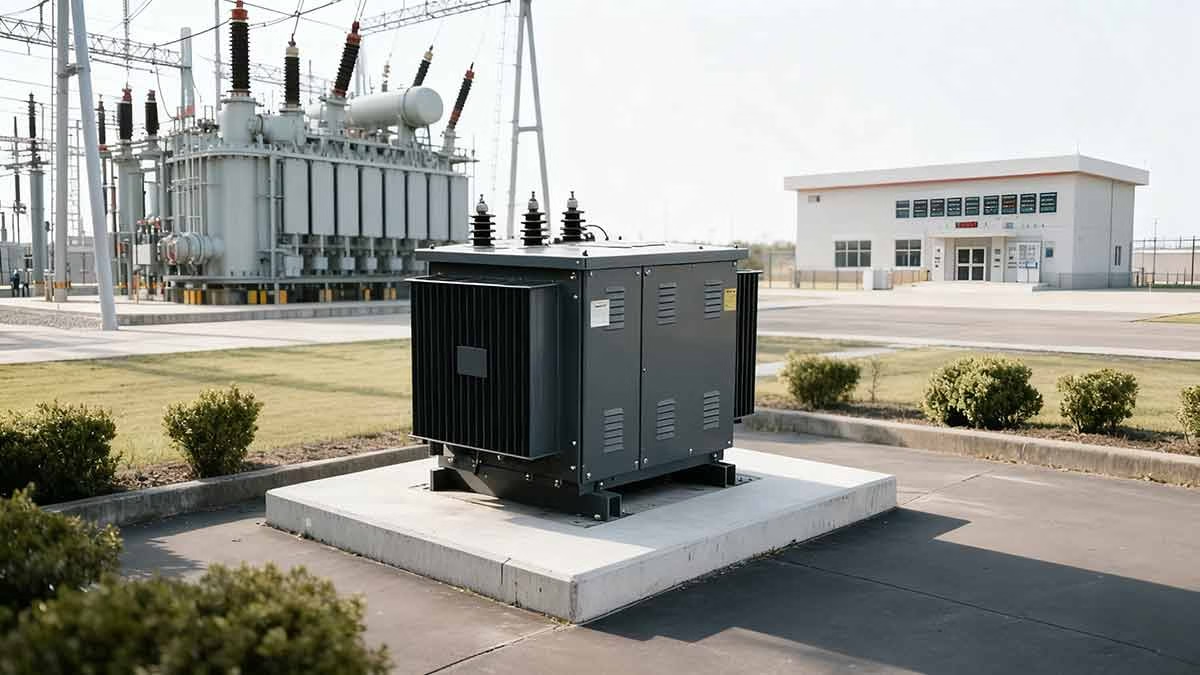
After decades of working with transformers—from installing massive substation units to testing compact distribution models—I’ve developed a deep appreciation for how these devices shape our daily lives. They’re everywhere: atop utility poles in suburban neighborhoods, inside industrial facilities, and at the heart of renewable energy projects like solar farms and wind parks. Let’s explore the inner workings, real-world applications, and evolving technology of electrical transformers to understand why they’re so vital to our modern electrified world.
Contents
hide
Electrical Transformer Fundamentals: How Voltage Conversion Works at Its Core
Ever plugged in an appliance bought overseas only to have it malfunction? That’s a classic case of voltage mismatch. Transformers solve this problem by leveraging basic electromagnetic principles to convert voltage precisely. But how does this seemingly complex process actually work?
At its core, every electrical transformer operates on the principle of electromagnetic induction. It consists of two coils of wire (called the primary and secondary windings) wrapped around a magnetic core. When alternating current (AC) flows through the primary winding, it creates a constantly changing magnetic field. This field then induces a voltage in the secondary winding—with the ratio of wire turns in the two coils determining whether the voltage is increased (stepped up) or decreased (stepped down).
The Science Behind Induction
Electromagnetic induction isn’t just a textbook concept—it’s the driving force behind every transformer’s operation. Here’s a breakdown of the key principles, grounded in real-world experience:
- Faraday’s Law: This fundamental law of electromagnetism states that a changing magnetic field will induce an electromotive force (voltage) in a nearby conductor. I vividly remember demonstrating this in a workshop years ago: moving a magnet near a coil of wire caused a voltmeter to spike, proving the law in action.
- Alternating Current (AC): Unlike direct current (DC), AC reverses direction periodically, creating the changing magnetic field needed for induction. Without AC, transformers simply wouldn’t work—which is why AC became the standard for power grids worldwide.
- Mutual Induction: This is the specific phenomenon where the magnetic field from one coil (the primary) induces voltage in a second coil (the secondary). In my work designing transformers for solar projects, we optimize this mutual induction to maximize efficiency, especially when converting low-voltage solar power to grid-compatible levels.
The Turns Ratio: Key to Voltage Transformation
The number of turns in the primary and secondary windings—known as the turns ratio—dictates how much the voltage changes. Here’s how it translates to real-world use:
- Step-Up Transformers: When the secondary winding has more turns than the primary, voltage increases. For example, a solar farm I worked on used a 1:120 turns ratio to boost 380V from solar panels to 45kV for long-distance transmission.
- Step-Down Transformers: When the secondary winding has fewer turns, voltage decreases. The pole-mounted transformers in residential areas typically use a 100:1 ratio to reduce 12kV grid voltage to 120/240V for household use.
- Isolation Transformers: When the primary and secondary windings have the same number of turns, voltage remains unchanged. These are critical in sensitive settings like hospitals, where electrical isolation protects patients and medical equipment from power surges.
Core Types and Materials: Optimizing Magnetic Performance
The magnetic core plays a vital role in focusing the magnetic field and minimizing energy loss. Over the years, I’ve worked with various core designs and materials, each suited to specific applications:
- Laminated Steel Cores: The most common type, made of thin steel sheets stacked together to reduce eddy current losses (wasted energy from circular currents in the core). These are ideal for standard power transformers.
- Toroidal Cores: Shaped like a donut, these cores offer higher efficiency and lower noise than laminated cores. I used toroidal cores in a compact transformer project for a data center, where space and quiet operation were top priorities.
- Ferrite Cores: Made of ceramic-based magnetic material, ferrite cores excel at high-frequency applications like electronic devices and renewable energy inverters. They’re lightweight and efficient, though less suited for high-power grid use.
- Amorphous Metal Cores: A newer innovation, these cores are made of non-crystalline metal alloys. I helped implement amorphous cores in a municipal distribution project a few years back—they reduced core losses by 60% compared to traditional steel cores, leading to significant long-term energy savings.

Transformers in Action: Powering Transmission and Distribution Networks
Have you ever driven past a power substation and wondered what those massive metal boxes do? They’re transformers, working tirelessly to ensure electricity travels efficiently from power plants to your light switches. Without them, long-distance power transmission would be impractical—most of the energy would be lost as heat in the wires. Let’s take a look at how transformers operate at every stage of the power delivery process.
Step-Up Transformers: Launching Power on Its Journey
Power plants (whether coal, hydro, nuclear, or renewable) generate electricity at relatively low voltages—typically between 10kV and 30kV. To send this power hundreds of miles through transmission lines, we need to step up the voltage to 115kV, 230kV, 345kV, or even 765kV. Here’s why:
- Reduced Current: Higher voltage means lower current (thanks to the power formula P = V × I). Lower current reduces energy loss due to resistance in the transmission lines—critical for long distances.
- Efficiency at Scale: A hydroelectric plant I worked on used step-up transformers to boost 18kV generator output to 500kV. This allowed the power to travel over 300 miles to a major city with less than 5% energy loss.
Transmission Substations: Managing the Power Highway
Transmission substations act as hubs where transformers adjust voltage for different parts of the grid. They’re like traffic controllers, ensuring power flows smoothly between long-distance transmission lines and regional distribution networks. Some key functions include:
- Voltage Conversion: Stepping down ultra-high transmission voltages to lower levels (e.g., 500kV to 230kV) for regional distribution.
- Grid Interconnection: Connecting multiple power sources (e.g., a wind farm and a coal plant) to the same transmission network.
- Load Balancing: Adjusting voltage to meet fluctuating demand—for example, increasing capacity during peak hours (like evening when everyone is using appliances).
In a recent grid modernization project, we upgraded transformers at a major substation to handle higher loads and improve voltage regulation. The result? Fewer power fluctuations and a 25% reduction in unplanned outages for the region.
Distribution Transformers: Bringing Power to Your Doorstep
Once electricity reaches your neighborhood, distribution transformers take over, stepping down voltage to safe, usable levels. These are the transformers you see on utility poles, in ground-mounted pad boxes, or underground in urban areas. Their key roles include:
- Primary Step-Down: Reducing regional distribution voltages (e.g., 35kV) to medium voltages (e.g., 12kV) for local neighborhoods.
- Secondary Step-Down: Further lowering voltage to 120/240V—the standard for residential and small commercial use.
- Load Management: Balancing power distribution among homes and businesses to prevent overloads.
Last year, I led a project to replace aging pole-mounted transformers in a suburban area. The new units were more efficient, quieter, and equipped with smart monitoring sensors. Homeowners noticed fewer power surges, and the utility company saved money on energy losses.
Diverse Transformer Types: Tailored Solutions for Every Power Need
One size does not fit all when it comes to transformers. Power systems have diverse requirements—from handling massive grid voltages to powering sensitive electronic equipment—so manufacturers design transformers for specific applications. Over my career, I’ve worked with nearly every type of transformer, each with its own unique design and purpose.
Power Transformers: The Heavyweights of the Grid
Power transformers are the largest and most powerful type, designed for high-voltage, high-capacity applications. They’re found in power plants and transmission substations, handling voltages above 69kV and capacities ranging from 500 kVA to over 1000 MVA. Key features include:
- Robust Construction: Built to withstand extreme weather, high loads, and long operating hours.
- Oil Cooling Systems: Most power transformers use mineral oil or synthetic coolant to dissipate heat from high-power operation.
- Critical Grid Role: Without power transformers, large-scale power transmission would be impossible. I once helped install a 1500 MVA power transformer at a nuclear plant—it weighed over 300 tons and required specialized transport and lifting equipment.
Distribution Transformers: Neighborhood Workhorses
Distribution transformers are smaller, more compact, and designed for local power delivery. They’re the most common type of transformer, with three primary configurations:
- Pole-Mounted Transformers: Mounted on utility poles, these are used in residential areas. They typically have capacities between 5 kVA and 150 kVA and step down voltage from 12kV to 240/120V.
- Pad-Mounted Transformers: Ground-mounted in metal enclosures, these are used in commercial areas, industrial parks, and dense urban neighborhoods. They range from 75 kVA to 5000 kVA and are safer for public access than pole-mounted units.
- Underground Transformers: Installed in vaults or manholes, these are used in cities where overhead power lines are prohibited. They’re weatherproof and 隐蔽,though more expensive to install and maintain.
In a recent urban development project, we installed 20 pad-mounted transformers to power a new mixed-use neighborhood. Each unit served 10-15 homes and 2-3 small businesses, ensuring reliable power for both residents and commercial tenants.
Special Application Transformers: Solving Unique Power Challenges
Some applications require transformers with specialized designs to meet specific needs. Here are a few examples I’ve worked with:
- Isolation Transformers: These transformers have separate primary and secondary windings (no direct electrical connection), providing electrical isolation. They’re critical in hospitals, data centers, and industrial settings where safety and noise reduction are priorities. I used isolation transformers in an operating room renovation project to protect medical equipment from power interference.
- Auto-Transformers: Unlike traditional transformers, auto-transformers use a single winding for both primary and secondary circuits. They’re more efficient and compact than dual-winding transformers, making them ideal for voltage adjustment in industrial processes (e.g., boosting 480V to 600V for heavy machinery).
- Phase-Shifting Transformers: These transformers adjust the phase angle of AC power, helping control power flow in interconnected grids. They’re used to prevent overloads and improve grid stability. I worked on a phase-shifting transformer project for a regional grid that connected three states, ensuring balanced power distribution across borders.
- High-Frequency Transformers: Designed for frequencies above 50/60 Hz, these are used in electronic devices, inverters, and renewable energy systems. They’re small, lightweight, and efficient—key for applications like solar inverters and electric vehicle chargers.
Efficiency and Reliability: How Transformers Optimize Grid Performance
A reliable power grid depends on transformers that operate efficiently and consistently. Even small inefficiencies can add up to massive energy waste over time, while downtime can cause widespread outages. As a transformer manufacturer and installer, I’ve seen firsthand how optimizing efficiency and reliability can transform grid performance.
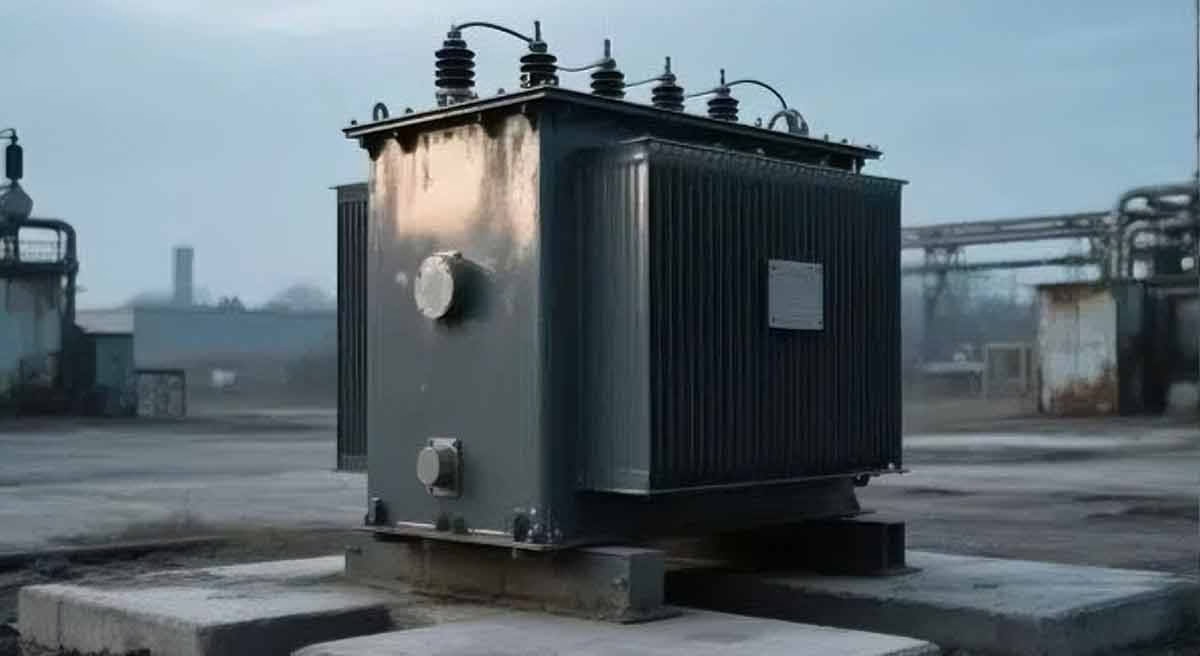
Minimizing Energy Loss: Every Watt Counts
Transformers lose small amounts of energy during operation—primarily through core losses (hysteresis and eddy currents) and winding losses (resistance in the wires). While these losses seem negligible for a single transformer, they add up across millions of units worldwide. Here’s how modern transformers reduce energy waste:
- Advanced Core Materials: As mentioned earlier, amorphous metal cores and high-grade laminated steel minimize core losses. A study I participated in found that replacing older transformers with amorphous core models reduced total grid losses by 8-10% in a mid-sized city.
- Optimized Winding Design: Using thicker copper or aluminum wires (to reduce resistance) and improved winding patterns lowers winding losses. In high-power transformers, we often use copper windings for better conductivity, though aluminum is more cost-effective for smaller units.
- Efficient Cooling Systems: Oil-cooled transformers use high-quality coolant and efficient radiators to dissipate heat, while dry-type transformers (used in indoor settings) use air cooling or forced ventilation. Proper cooling reduces thermal stress and extends transformer life.
Voltage Regulation: Keeping Power Stable
Have you ever noticed your lights dimming when a neighbor starts a lawnmower or a factory turns on heavy machinery? That’s a voltage drop caused by increased load. Transformers play a key role in regulating voltage to maintain stable power quality:
- On-Load Tap Changers (OLTCs): These devices adjust the turns ratio of a transformer while it’s still operating (under load), allowing real-time voltage adjustment. I installed OLTC-equipped transformers in a rural area with fluctuating agricultural loads—they kept voltage stable even during peak irrigation season.
- Automatic Voltage Regulators (AVRs): Smaller transformers (like those used in industrial equipment) often include AVRs to fine-tune output voltage. These are critical for sensitive electronics that require precise voltage levels.
- Reactive Power Compensation: Transformers can also help manage reactive power (unused power that affects grid efficiency) by incorporating capacitors or reactors. This improves power factor and reduces energy waste.
Fault Management: Protecting the Grid from Disruptions
Transformers are built to withstand harsh conditions, but faults can still occur—from lightning strikes to internal component failure. Effective fault management is critical to prevent cascading outages:
- Overcurrent Protection: Circuit breakers and fuses protect transformers from excessive current caused by short circuits or overloads.
- Differential Protection: This advanced system compares current entering and exiting the transformer. If there’s a mismatch (indicating an internal fault), it shuts down the transformer immediately. I helped design a differential protection system for a critical substation—during a severe storm, it isolated a faulty transformer in 0.02 seconds, preventing a regional blackout.
- Thermal Monitoring: Sensors track transformer temperature, alerting operators to overheating before it causes damage. Modern transformers often include real-time thermal monitoring via IoT devices.
The Evolution of Transformer Technology: From Traditional to Smart Grids
Transformers have been around for over 150 years, but their technology has evolved dramatically—especially in the past decade. From simple mechanical devices to smart, connected components, transformers are now at the heart of the global shift toward renewable energy and smart grids. As someone who’s witnessed this evolution firsthand, I’m excited to share how modern transformers are adapting to meet the demands of the 21st century.
Smart Monitoring and Predictive Maintenance
Gone are the days of manual transformer inspections and reactive maintenance. Today’s smart transformers are equipped with sensors and communication technology that enable real-time monitoring and predictive diagnostics:
- Condition Monitoring Sensors: These track key parameters like temperature, oil quality (for oil-cooled transformers), load levels, and vibration. Data is transmitted to a central system for analysis.
- AI-Powered Analytics: Machine learning algorithms process sensor data to predict potential issues (e.g., insulation degradation, overheating) before they cause failures. I implemented a smart monitoring system for a fleet of urban transformers—within the first year, it identified 12 potential faults, allowing us to perform maintenance during off-peak hours and avoid outages.
- Remote Diagnostics: Operators can access transformer data from anywhere, enabling remote troubleshooting and reducing the need for on-site visits. This is especially valuable for transformers in remote areas (like wind farms in rural regions).
Integration with Renewable Energy Sources
Renewable energy (solar, wind, hydro) is growing rapidly, but it presents unique challenges for the grid—variable output, bidirectional power flow, and harmonic distortion. Modern transformers are designed to address these challenges:
- Dynamic Load Management: Transformers for renewable projects can handle fluctuating input voltages (e.g., from cloudy or windy conditions) and adjust output to maintain grid stability. I worked on a wind farm project where transformers with dynamic load management reduced voltage fluctuations by 40% compared to standard units.
- Bidirectional Power Flow: Unlike traditional transformers (which only handle one-way power flow), modern units can manage power flowing from the grid to renewable sources (e.g., battery charging) and back to the grid (e.g., excess solar power). This is critical for net-zero energy systems.
- Harmonic Mitigation: Renewable energy inverters can introduce harmonic distortion (unwanted frequencies) into the grid. Transformers with active filtering technology reduce harmonics, ensuring power quality remains high.

Smart Grid Integration: Transformers as Grid Nodes
Smart grids are intelligent, interconnected power systems that optimize energy flow and improve reliability. Transformers are now key nodes in these grids, with advanced communication and control capabilities:
- Two-Way Communication: Transformers can exchange data with grid control centers, renewable energy systems, and even smart homes. This enables coordinated operation across the entire grid.
- Adaptive Control: Transformers can adjust their operation based on real-time grid conditions (e.g., demand spikes, renewable output changes). For example, during a heatwave, transformers can prioritize power to critical infrastructure (hospitals, cooling systems) while reducing load for non-essential users.
- Cybersecurity Features: As transformers become more connected, cybersecurity is a top priority. Modern units include encryption, firewalls, and intrusion detection systems to protect against cyber threats. I helped implement cybersecurity measures for a smart grid project in a major city—ensuring transformers couldn’t be hacked or compromised.
Conclusion: Why Transformers Are Essential to Our Electrified World
Electrical transformers are more than just metal boxes—they’re the unsung heroes that power our modern way of life. From enabling long-distance power transmission to ensuring safe, reliable electricity for homes and businesses, transformers play a critical role in every aspect of the power grid. Their ability to convert voltage efficiently, manage loads, and adapt to new technologies (like renewable energy and smart grids) makes them indispensable for a sustainable, electrified future.
After decades in the transformer industry, I’ve seen how these devices have evolved—from simple mechanical tools to smart, connected components that drive innovation. As we transition to a cleaner, more efficient energy system, transformers will continue to adapt, meeting the demands of renewable integration, smart grids, and growing global power needs.
Whether you’re a homeowner plugging in a phone charger, a business owner running industrial equipment, or a utility company managing a regional grid, transformers are working behind the scenes to keep the power flowing. The next time you drive past a substation or see a pole-mounted transformer, take a moment to appreciate the engineering marvel that makes our electrified world possible.