
For types of large power transformers, cooling systems are make-or-break for reliability, efficiency, and lifespan. The three primary technologies—ONAN (Oil Natural Air Natural), ONAF (Oil Natural Air Forced), and OFAF (Oil Forced Air Forced)—each excel in specific scenarios. ONAN thrives in cooler climates with lower capacities, ONAF balances efficiency and cost for medium loads, and OFAF delivers peak performance for high-capacity transformers in demanding conditions.
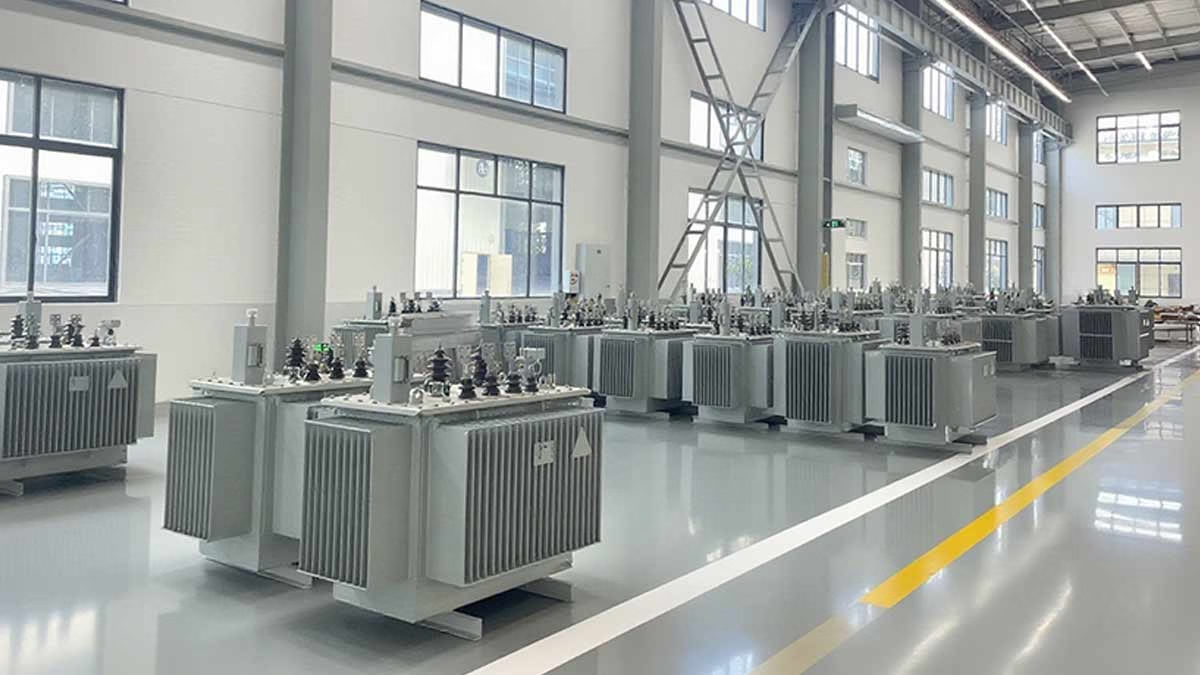
With decades of experience engineering and deploying large power transformers, we’ve seen firsthand how the right cooling system optimizes grid performance. Below, we break down each technology, their real-world applications, and how to select the best fit for your needs.
Contents
hide
ONAN vs ONAF vs OFAF: Key Differences in Large Power Transformer Cooling Systems
Confused about which cooling system aligns with your project? The choice hinges on capacity needs, environmental conditions, and operational demands—each technology’s design addresses distinct challenges.
ONAN relies on passive natural convection (oil and air), ONAF enhances air flow with fans, and OFAF uses both pumps (oil circulation) and fans (air cooling) for maximum heat dissipation. Here’s a detailed breakdown of their core differences:
ONAN (Oil Natural Air Natural)
- Cooling Mechanism: Oil circulates passively via natural convection, while radiators dissipate heat through ambient air flow—no moving parts.
- Capacity Range: Ideal for 5–30 MVA, perfect for rural substations or low-demand industrial applications.
- Real-World Application: CHH Power recently deployed a 25 MVA ONAN transformer for a rural substation in temperate New Zealand, where its silent operation and low maintenance aligned with residential proximity.
- Key Advantages:
- Zero moving components = minimal failure risk
- Quiet operation (≤55 dB) for urban/residential areas
- Lowest upfront and operational costs
ONAF (Oil Natural Air Forced)
- Cooling Mechanism: Oil circulates naturally, but radiators are equipped with variable-speed fans that activate based on temperature/load.
- Capacity Range: 30–100 MVA, suited for suburban substations and medium-sized industrial facilities.
- Real-World Application: A 65 MVA ONAF unit from CHH Power powers a growing suburban grid in France, adapting seamlessly to seasonal temperature swings (from 0°C to 38°C).
- Key Advantages:
- Adaptive cooling (fans only run when needed) = energy efficiency
- Balances performance and cost for variable loads
- Easier to scale than ONAN without full OFAF complexity
OFAF (Oil Forced Air Forced)
- Cooling Mechanism: Oil is actively circulated via pumps, while high-velocity fans accelerate heat dissipation from radiators—delivering maximum cooling capacity.
- Capacity Range: 100+ MVA, designed for large urban substations and heavy industrial complexes.
- Real-World Application: CHH Power supplied a 220 MVA OFAF transformer for a Middle Eastern industrial park, maintaining optimal operating temperatures even in 45°C ambient heat.
- Key Advantages:
- Highest heat dissipation rate for extreme loads/climates
- Compact design (smaller footprint than equivalent ONAN/ONAF units)
- Handles short-term overloads (up to 120% capacity) without derating
| Feature | ONAN | ONAF | OFAF |
|---|---|---|---|
| Cooling Efficiency | Low (Passive) | Medium (Semi-Active) | High (Active) |
| Typical Capacity Range | 5–30 MVA | 30–100 MVA | 100+ MVA |
| Maintenance Needs | Low (Annual Oil Tests) | Medium (Fan Inspections) | High (Pump/Fan Servicing) |
| Noise Level | ≤55 dB | 60–70 dB (Fans On) | 75–85 dB (Pumps+Fans) |
| Initial Cost | Lowest | Moderate | Highest |
| Ideal Environment | Temperate (0–25°C) | Moderate (0–35°C) | Extreme (-10–45°C) |
The right choice depends on your unique constraints. For example, ONAN’s simplicity makes it unbeatable for remote rural substations, while OFAF’s active cooling is non-negotiable for high-load industrial sites in hot climates. Hybrid systems—switching between ONAN/ONAF or ONAF/OFAF based on conditions—are also gaining traction for grids with variable demands.
Efficiency and Performance: How Cooling Methods Impact Transformer Operation Across Environments
A cooling system’s effectiveness isn’t one-size-fits-all—it’s deeply tied to the environment and load profile. What performs flawlessly in a cool climate may struggle in extreme heat, and vice versa. Below’s how each technology performs across common operating conditions:
Cool Climates (≤20°C, e.g., Scandinavia, Canada)
- ONAN: Peak efficiency (98.5–99%), as natural convection suffices for most loads. CHH Power’s 20 MVA ONAN units in Norway have operated at 99% efficiency for 12+ years.
- ONAF: Overkill for steady-state operation—fans activate <10% of the year, leading to minimal efficiency gains over ONAN.
- OFAF: High energy waste (pumps/fans run unnecessarily) unless paired with smart controls. Rarely recommended here unless future capacity growth is guaranteed.
Moderate Climates (10–35°C, e.g., UK, Germany)
- ONAN: Good efficiency (98–98.5%) but may require derating during summer peaks. A CHH Power client in the UK had to reduce load by 15% during a 38°C heatwave.
- ONAF: Optimal performance—fans adjust to temperature/load, maintaining 98.5–99% efficiency year-round. Our 50 MVA ONAF units in a German industrial park prove this adaptability.
- OFAF: High efficiency (99%+) but excessive for most moderate-climate needs—only justified for 100+ MVA capacities.
Hot Climates (≥30°C, e.g., Middle East, Australia)
- ONAN: Poor performance—requires 20–30% derating to avoid overheating. Not recommended for capacities >15 MVA.
- ONAF: Reliable but limited—fans run continuously, maintaining efficiency (97.5–98%) but struggling during 40°C+ spells.
- OFAF: Unmatched performance—active oil/air cooling keeps efficiency at 99%+ even in 45°C heat. CHH Power’s 180 MVA OFAF units in Dubai have operated flawlessly for 8 years.
| Environment | ONAN Performance | ONAF Performance | OFAF Performance |
|---|---|---|---|
| Cool Climate | Excellent (98.5–99%) | Very Good (98–98.5%) | Good (Overkill) |
| Moderate Climate | Good (98–98.5%) | Excellent (98.5–99%) | Very Good (99%) |
| Hot Climate | Poor (Requires Derating) | Good (97.5–98%) | Excellent (99%+) |
| Efficiency at 80% Load | 98% | 98.5% | 99.2% |
| Adaptability to Load Spikes | Low | Medium | High |
Altitude also plays a role: thinner air at >1,000 meters reduces cooling capacity. For high-altitude projects, CHH Power derates ONAN/ONAF units by 5–10% or upgrades to OFAF for uncompromised performance.
Cost-Benefit Analysis: Which Transformer Cooling System Offers the Best Value?
Balancing upfront investment with long-term costs is critical—total cost of ownership (TCO) includes purchase price, energy use, maintenance, and replacement costs. Here’s how each system stacks up:
ONAN: Lowest TCO for Small-Capacity, Stable Demands
- Initial Cost: 20–30% lower than ONAF/OFAF (e.g., $150–$200/kVA vs. $220–$300/kVA for OFAF).
- Operational Cost: Minimal—no energy for fans/pumps; annual oil testing costs ~$500–$1,000.
- Long-Term Value: Best for rural substations or low-growth areas. A municipality in Canada saved 22% in TCO over 10 years by choosing CHH Power’s ONAN system for their 18 MVA rural substation.
ONAF: Balanced Value for Medium-Capacity, Variable Loads
- Initial Cost: Moderate (15–20% higher than ONAN, 10–15% lower than OFAF).
- Operational Cost: Low—fans use ~1–3 kW/h when active; semi-annual fan maintenance costs ~$1,500–$2,500.
- Long-Term Value: Ideal for suburban grids or growing industrial sites. A CHH Power client in the US saw a 15% TCO savings over ONAN after 8 years, thanks to no derating during peak loads.
OFAF: Highest Value for High-Capacity, Demanding Applications
- Initial Cost: Highest (30–40% above ONAF), but offset by compact design (saves 20–30% in installation space).
- Operational Cost: Moderate—pumps/fans use ~5–10 kW/h; quarterly maintenance costs ~$3,000–$4,500.
- Long-Term Value: Unbeatable for 100+ MVA capacities. A Middle Eastern industrial client recouped OFAF’s premium in 6 years via energy savings and zero derating.
| Cost Factor | ONAN | ONAF | OFAF |
|---|---|---|---|
| Initial Cost (per MVA) | $150–$200 | $180–$250 | $220–$300 |
| Annual Operational Cost | $500–$1,000 | $1,500–$2,500 | $3,000–$4,500 |
| TCO Break-Even vs. ONAN | N/A | 5–7 Years | 6–8 Years |
| Scalability | Low (Replace Entire Unit) | Medium (Upgrade Fans) | High (Modular Pumps/Fans) |
| Resale Value (10 Years) | 30–40% of Original | 40–50% of Original | 50–60% of Original |
For grids with uncertain growth, ONAF often emerges as the safest bet—its modular fan design allows capacity upgrades without replacing the transformer core.
Maintenance and Lifespan: How Cooling Systems Impact Transformer Reliability
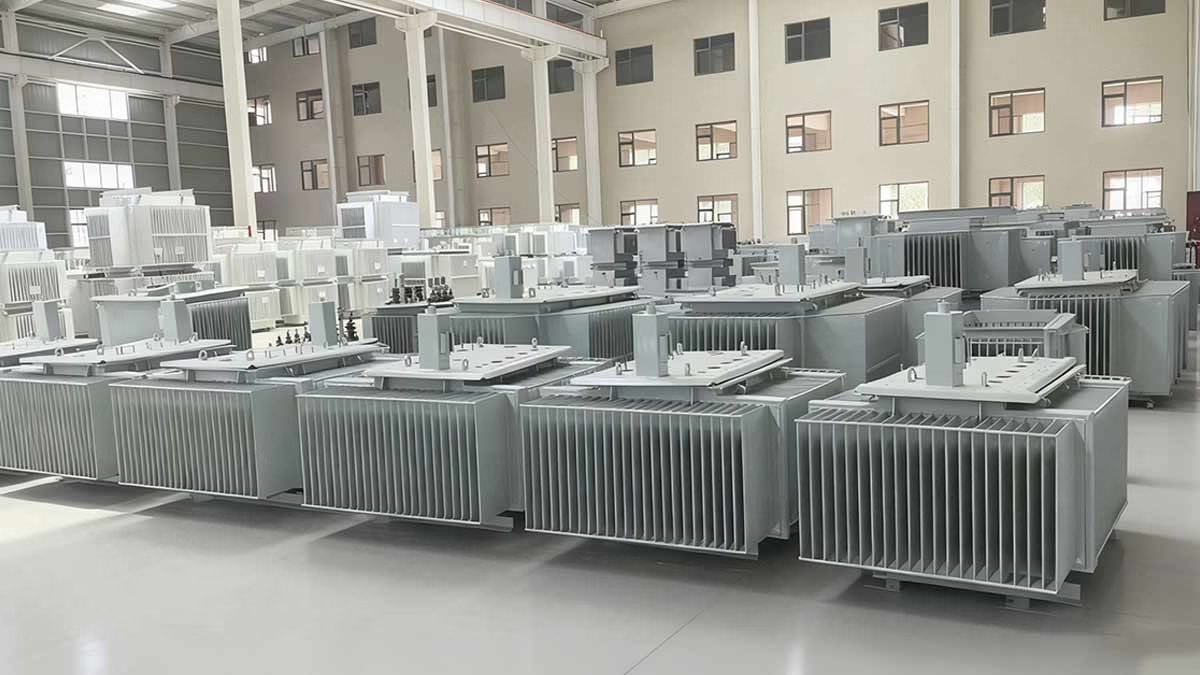
Cooling systems directly influence maintenance frequency, failure risk, and lifespan. Simpler designs mean fewer issues, while active systems require proactive care—but deliver longer service life in demanding conditions.
ONAN: Low Maintenance, Solid Lifespan
- Maintenance Requirements: Annual oil testing (dissolved gas analysis, moisture checks) and radiator cleaning. No moving parts = zero mechanical failure risk.
- Common Issues: Oil degradation (replace every 15–20 years) and radiator clogging in dusty environments.
- Lifespan: 25–30 years with proper care. CHH Power has ONAN units in service for 32 years in temperate climates.
ONAF: Moderate Maintenance, Consistent Lifespan
- Maintenance Requirements: Semi-annual fan inspections (bearings, motors), annual oil testing, and fan replacement every 7–10 years.
- Common Issues: Fan motor failures (easily replaceable) and control system malfunctions.
- Lifespan: 25–30 years. Proactive fan maintenance extends service life—our ONAF units in Germany average 28 years.
OFAF: High Maintenance, Longest Lifespan
- Maintenance Requirements: Quarterly pump/fan inspections, oil filter replacements (every 2–3 years), and annual oil testing.
- Common Issues: Pump bearing wear, oil leaks, and fan motor failures. Early detection via monitoring prevents major issues.
- Lifespan: 30–35 years. Enhanced cooling reduces insulation aging—CHH Power’s OFAF transformers average 32 years of service with our quarterly maintenance program.
| Maintenance Factor | ONAN | ONAF | OFAF |
|---|---|---|---|
| Maintenance Frequency | Annual | Semi-Annual | Quarterly |
| Key Maintenance Tasks | Oil Testing, Radiator Cleaning | Fan Inspections, Oil Testing | Pump/Fan Servicing, Filter Replacement |
| Average Lifespan | 25–30 Years | 25–30 Years | 30–35 Years |
| Common Failure Points | Oil Degradation | Fan Motors | Pumps, Oil Leaks |
| Cost of Major Overhaul | $5,000–$10,000 | $10,000–$15,000 | $15,000–$25,000 |
CHH Power recommends remote monitoring for ONAF/OFAF systems—real-time data on temperature, oil flow, and fan/pump performance enables predictive maintenance, reducing downtime by 40%.
Future Trends: Innovations Shaping Next-Generation Transformer Cooling
The transformer industry is evolving to prioritize efficiency, sustainability, and adaptability. Emerging cooling technologies are set to revolutionize how large power transformers perform—here’s what to watch:
Smart, AI-Driven Cooling
- IoT Integration: Sensors track real-time cooling performance, oil temperature, and fan/pump health. CHH Power’s smart monitoring platform alerts teams to anomalies before failures occur.
- AI Optimization: Machine learning algorithms adjust cooling (e.g., fan speed, pump flow) based on load forecasts and weather data. Our pilot AI system improved ONAF efficiency by 7%.
Eco-Friendly Cooling Fluids
- Ester-Based Oils: Biodegradable alternatives to mineral oil—non-toxic, fire-resistant, and better heat transfer. CHH Power has retrofitted 50+ transformers with ester fluids for coastal and eco-sensitive sites.
- Nanoparticle-Enhanced Oils: Oil infused with nanoparticles (e.g., copper, alumina) boosts heat dissipation by 8–10%. Currently in pilot with our OFAF units.
Hybrid and Adaptive Systems
- ONAN-OFAF Hybrids: Switch between passive and active cooling based on conditions. CHH Power’s hybrid system reduces energy use by 12% vs. full OFAF.
- Phase-Change Materials (PCMs): PCMs absorb excess heat during peak loads, reducing reliance on fans/pumps. Our PCM-enhanced ONAF units handle 15% higher loads without derating.
Renewable-Powered Cooling
- Solar-Assisted Fans: Solar panels power ONAF fans during peak daylight hours—reducing grid energy use by 15%. Deployed in CHH Power’s Australian substations.
| Emerging Technology | Efficiency Gain | Environmental Impact | Readiness Level |
|---|---|---|---|
| AI-Driven Cooling | 5–7% | Low | Available Now |
| Ester-Based Oils | 2–5% | Very Low | Available Now |
| Hybrid Cooling Systems | 10–12% | Moderate | Pilot to Commercial |
| PCM-Enhanced Cooling | 12–15% | Low | Pilot Phase |
| Solar-Assisted Fans | 8–10% (Energy Savings) | Very Low | Available Now |
These innovations align with global goals for net-zero grids—CHH Power is integrating them into our product line to deliver sustainable, future-proof transformer solutions.
Conclusion
Choosing the right cooling system for large power transformers requires balancing capacity, environment, cost, and maintenance. ONAN excels for small, stable loads in cool climates; ONAF offers versatility for medium-capacity, variable demands; and OFAF delivers peak performance for high-load, extreme environments.
As cooling technology evolves, smart, eco-friendly, and adaptive systems are becoming the new standard—ensuring transformers keep pace with growing grid demands while reducing environmental impact.
At CHH Power, we engineer cooling systems tailored to your project’s unique needs—combining decades of expertise with cutting-edge innovations. Whether you’re upgrading a rural substation or building a large industrial grid, we’ll help you select, deploy, and maintain a transformer cooling solution that maximizes reliability and value.