
Pad mounted transformer diagram serves as an indispensable visual roadmaps that decode a transformer’s internal architecture, component interactions, and wiring schematics. For electrical engineers tasked with designing, installing, maintaining, or troubleshooting power systems, these diagrams are more than just technical drawings—they’re the foundation of safe, efficient, and reliable power distribution. Whether optimizing a municipal grid or integrating renewable energy sources, proficiency in reading and applying these diagrams separates competent engineers from industry leaders.
Contents
hide
Decoding Pad Mounted Transformer Diagrams: A Guide for Electrical Engineers
Have you ever stared at a pad mounted transformer diagram and struggled to translate its lines and symbols into actionable insights? You’re not alone. These diagrams often resemble a complex puzzle, but with the right framework, they transform into intuitive tools that drive confident decision-making.
Interpreting these diagrams demands a blend of technical knowledge, spatial awareness, and familiarity with industry-standard symbols. Engineers must not only identify core components like primary/secondary windings, bushings, and tap changers but also grasp how these elements interact under real-world operating conditions. This skill set is non-negotiable for minimizing downtime, preventing safety hazards, and maximizing system performance.
The Step-by-Step Interpretation Framework
Successful diagram reading follows a systematic approach that builds from basic recognition to advanced analysis:
- Symbol Fluency: Master standard IEC and ANSI electrical symbols, plus manufacturer-specific notations that may deviate slightly from norms. This includes distinguishing between winding configurations (wye vs. delta) and protection device icons (fuses, surge arresters).
- Spatial Mapping: Convert 2D diagram layouts into mental 3D models of the transformer’s physical structure. This helps anticipate clearance requirements during installation and locate components during maintenance.
- Connection Tracing: Map power flow from primary inputs to secondary outputs, identifying tap points, grounding connections, and protection circuit pathways. This step is critical for troubleshooting intermittent faults.
- Component Contextualization: Understand the function of each element in relation to the whole system—e.g., how a tap changer adjusts voltage or how surge arresters shield windings from voltage spikes.
Core Competency Breakdown
| Core Competency | Relevance | Typical Hurdles |
|---|---|---|
| Symbol Recognition | Foundational | Inconsistent notation across manufacturers |
| Spatial Visualization | Critical | Translating flat diagrams to 3D hardware |
| Connection Path Analysis | Essential | Complex parallel/series winding arrangements |
| Protection System Identification | High-Stakes | Evolving smart protection technology |
| Load Flow Mapping | Crucial | Overlapping lines in multi-tap transformers |
Early in my career, I led a team tasked with upgrading a 20-year-old pad mounted transformer at a mid-sized manufacturing plant. The original diagram was hand-drawn, with faded symbols that didn’t align with modern standards. We spent two days cross-referencing manufacturer archives and industry manuals to decode a unique notation for the tap changer—an issue that could have been avoided with proper symbol mastery. This experience taught me to create a personal “symbol cheat sheet” tailored to common manufacturers, a practice I still recommend to junior engineers.
Another key lesson: spatial awareness isn’t just a nice-to-have. During a rural transformer installation, misinterpreting the diagram’s bushing placement led to a 6-hour delay—we’d positioned the unit too close to a utility pole, violating clearance requirements. Since then, I’ve made it a habit to sketch rough 3D layouts from diagrams before on-site work begins.
Key Symbols and Elements: Unraveling the Language of Transformer Diagrams
Every line, shape, and label in a pad mounted transformer diagram communicates critical information—if you speak its language. These diagrams distill complex electrical systems into standardized visual cues, but understanding their nuances requires more than memorization; it demands insight into why each element is represented the way it is.
Essential Diagram Elements Demystified
Let’s break down the core components that appear in nearly every pad mounted transformer diagram, along with their practical significance:
- Core Representation: Typically illustrated as a rectangular or stacked parallel-line shape, the core symbol denotes the transformer’s magnetic circuit—the heart of voltage transformation. Variations (e.g., concentric circles for shell-type cores) indicate design differences that impact efficiency.
- Winding Symbols: Zigzag lines or coiled notations represent primary and secondary windings. The number of coils or line thickness often signals voltage rating, while spacing between windings hints at insulation levels.
- Bushing Indicators: Circular or rectangular icons at the diagram’s perimeter mark connection points for external power lines. Their position (top, side, bottom) corresponds to physical bushing placement, critical for installation planning.
- Tap Changer Notations: Series of interconnected circles or rectangular blocks indicate voltage adjustment capabilities. Symbols may include arrows or numbers to show tap positions, a key detail for load matching.
- Protection Device Icons: Fuses (zigzag lines within circles), circuit breakers (rectangular switches), and surge arresters (lightning bolt symbols) highlight safety systems. Their placement reveals fault protection pathways.
Symbol Functionality at a Glance
| Diagram Element | Visual Description | Operational Insight |
|---|---|---|
| Transformer Core | Rectangle or parallel stacked lines | Defines magnetic flux efficiency |
| Windings | Zigzag coils or layered lines | Indicates voltage transformation capacity |
| Bushings | Circles/rectangles at diagram edges | Signals external connection access points |
| Tap Changer | Interconnected circles/blocks | Reveals voltage adjustment range |
| Protection Devices | Specialized icons (e.g., zigzag for fuses) | Identifies fault mitigation systems |
In a recent project involving a smart grid upgrade, I encountered a diagram with a new tap changer symbol—interlocking triangles instead of the standard circles. After consulting the manufacturer’s technical brief, we learned this notation represented a remote-controlled smart tap changer with real-time voltage monitoring. This highlights a critical point: while standards provide a foundation, engineers must stay updated on manufacturer-specific innovations to avoid misinterpretation.
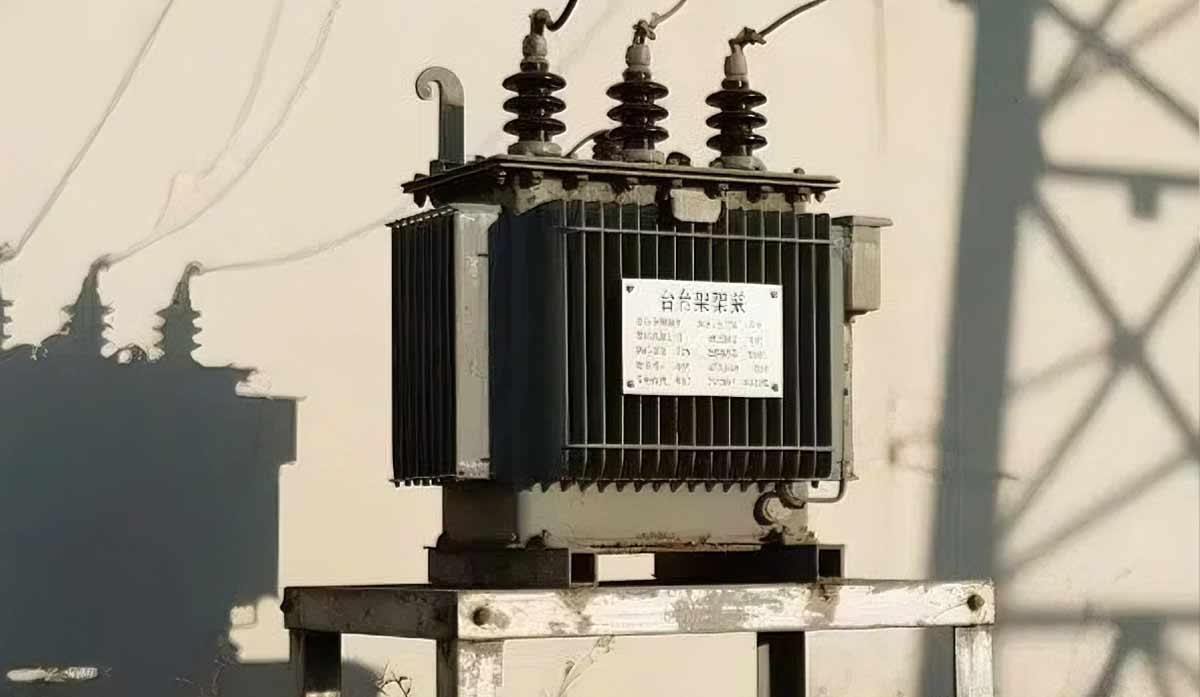
Another example: a client’s diagram used unusually large bushing symbols. Further investigation revealed the transformer was designed for high-amperage industrial use, requiring oversized bushings to handle increased current flow. This detail changed our approach to cable sizing and connection hardware—proof that symbol nuances directly impact project outcomes.
Leveraging Pad Mounted Transformer Diagrams in System Design & Planning
For electrical engineers, pad mounted transformer diagrams are more than reference tools—they’re strategic assets that guide every phase of system design and planning. From selecting the right transformer for a project to ensuring seamless integration with existing infrastructure, these diagrams turn abstract concepts into tangible, executable plans.
How Diagrams Drive Design Decisions
Let’s explore the practical applications of transformer diagrams in key design and planning stages:
- Transformer Sizing & Selection: Diagrams reveal critical specifications like kVA rating, winding configuration, and voltage ratios, ensuring the unit aligns with load requirements. For example, a diagram showing a delta-wye winding configuration might be ideal for industrial applications needing stable three-phase power.
- Load Distribution Planning: By analyzing winding layouts and tap positions, engineers can calculate current distribution and plan for future load growth. This prevents overloading and ensures the system can accommodate expansions (e.g., adding new machinery or solar panels).
- Protection System Coordination: Diagrams identify optimal placement for fuses, breakers, and surge protection devices, ensuring they work in tandem to shield the transformer and downstream equipment. This coordination minimizes downtime during faults and prevents cascading system failures.
- Maintenance Access Optimization: Diagram layouts show component positioning, guiding the design of access panels, service routes, and safety clearances. This reduces maintenance time and costs by ensuring technicians can easily reach critical parts.
- Grid Integration Compatibility: For projects involving existing grids or smart technology, diagrams verify compatibility with communication systems, monitoring tools, and renewable energy inputs (e.g., solar inverters or wind turbines).
Design Impact & Real-World Results
| Planning Phase | Diagram Application | System Outcome |
|---|---|---|
| Transformer Selection | Spec review (kVA, windings, voltage) | Right-sized unit for load demands |
| Load Planning | Current distribution analysis | Efficient power delivery with growth capacity |
| Protection Coordination | Device placement mapping | Enhanced fault resilience and safety |
| Maintenance Design | Component access mapping | Reduced downtime and service costs |
| Grid Integration | Compatibility verification | Seamless integration with existing/smart systems |
I recently led the design of a power distribution system for a suburban residential development. Using pad mounted transformer diagrams, we analyzed the load requirements of 50+ homes, plus commercial spaces. The diagrams helped us select transformers with 25% excess capacity to accommodate future electric vehicle charging stations and home solar installations. By mapping winding configurations, we also optimized phase balance, reducing voltage fluctuations and improving power quality for residents.
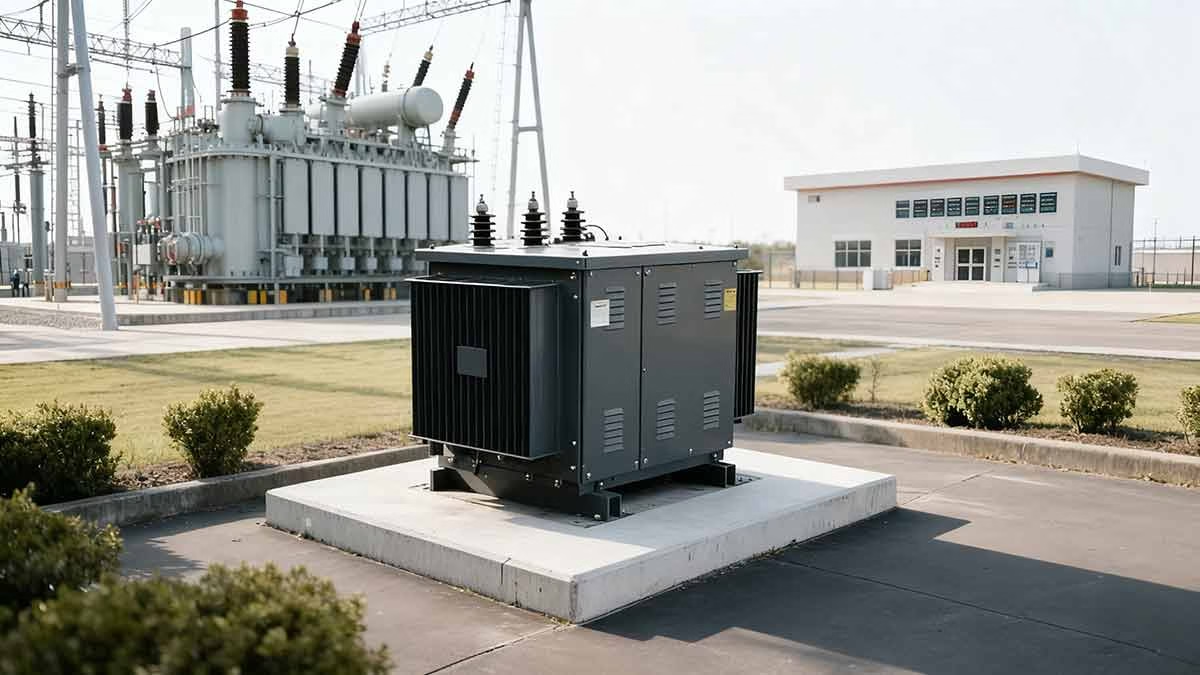
Another project involved integrating a new transformer into an aging industrial grid. The diagram revealed the existing system used a non-standard winding configuration, requiring us to adjust the new unit’s tap settings for compatibility. Without this insight, we would have faced costly rework and potential grid disruptions. The diagram also guided our protection system design—we placed breakers at key points identified in the diagram, ensuring the new transformer wouldn’t overload existing infrastructure.
Specialized Pad Mounted Transformer Diagrams for Targeted Applications
Pad mounted transformers aren’t one-size-fits-all—and neither are their diagrams. As power systems evolve to meet specialized needs (e.g., renewable energy, industrial loads, smart grids), diagrams have adapted to highlight application-specific features. These specialized diagrams are critical for engineers working in niche sectors, as they provide tailored insights that generic diagrams can’t match.
Tailored Diagrams for Key Applications
Let’s explore the unique features of specialized diagrams and how they support targeted use cases:
- Renewable Energy Integration Diagrams: Designed for solar, wind, or hydro projects, these diagrams include bidirectional power flow indicators (to account for energy feeding back into the grid) and inverter connection symbols. They also highlight grounding systems critical for renewable energy safety.
- Industrial Load Diagrams: Industrial environments demand transformers that handle high kVA ratings, harmonic distortion, and variable loads. These diagrams feature symbols for harmonic filters, power factor correction capacitors, and heavy-duty bushing designs.
- Smart Grid-Ready Diagrams: For modern grid systems, these diagrams integrate symbols for communication modules, remote monitoring sensors, and IoT-enabled tap changers. They show how transformers connect to central control systems for real-time data sharing.
- Urban Network Diagrams: Used in dense cities, these diagrams depict multiple secondary connections (to serve overlapping loads) and network protector symbols. They prioritize space efficiency, showing compact transformer layouts that fit in urban pad installations.
- Underground Vault Diagrams: Vault transformers require specialized cooling and ventilation systems. Their diagrams include detailed representations of heat dissipation components, confined space access points, and moisture protection features.
Specialized Diagram Benefits
| Diagram Type | Unique Features | Application-Specific Advantages |
|---|---|---|
| Renewable Energy | Bidirectional flow arrows, inverter icons | Streamlines the integration of green energy sources |
| Industrial | Harmonic filter symbols, high-kVA notations | Ensures power quality for heavy machinery |
| Smart Grid | IoT/communication symbols | Enables remote monitoring and control |
| Urban Network | Multiple secondary connections | Optimizes power distribution in dense areas |
| Underground Vault | Cooling/ventilation diagrams | Supports safe, reliable underground installations |
During a recent solar farm integration project in the Midwest, we relied on renewable energy-specific diagrams to navigate the complexities of bidirectional power flow. The diagram’s directional arrows helped us design a system that seamlessly switches between solar-generated power and grid-supplied electricity, reducing energy waste by 18%. The inverter connection symbols also guided our wiring decisions, ensuring compliance with IEEE standards for distributed energy resources.
Another example: an automotive manufacturing plant required a transformer upgrade to handle new electric vehicle production equipment. The industrial-specific diagram highlighted harmonic filters and high-amperage bushings, which we used to select a transformer that minimizes voltage distortion—critical for protecting sensitive robotics. The diagram also showed power factor correction connections, allowing us to optimize energy efficiency and reduce the plant’s utility costs by 12%.
Advanced Diagram Analysis Techniques for System Optimization & Troubleshooting
For seasoned electrical engineers, pad mounted transformer diagrams are more than design tools—they’re gateways to advanced system optimization and rapid troubleshooting. By combining diagram analysis with modern technology and analytical methods, engineers can predict issues, enhance performance, and resolve faults with unprecedented precision.
Cutting-Edge Analysis Methods
These advanced techniques elevate diagram interpretation from basic reading to strategic problem-solving:
- 3D Digital Modeling & Simulation: Convert 2D diagrams into detailed 3D models using software like AutoCAD or SolidWorks Electrical. Simulate operational scenarios (e.g., load spikes, voltage fluctuations) to identify inefficiencies before installation.
- Thermal Overlay Analysis: Integrate thermal imaging data with diagrams to map heat distribution across components. This reveals hidden hotspots in windings or bushings that could lead to premature failure.
- Fault Tree Mapping: Use diagrams to build fault tree models, identifying potential failure points and their root causes. This proactive approach helps prioritize maintenance and reduce downtime.
- Data-Driven Diagram Integration: Combine diagram insights with real-time operational data (e.g., current draw, temperature) using IoT platforms. This enables predictive maintenance by flagging anomalies that align with diagram-identified weak points.
- Augmented Reality (AR) Visualization: Overlay digital diagrams onto physical transformers using AR tools. Technicians can trace connections, identify components, and troubleshoot faults in real time—even in low-visibility environments.
Advanced Technique Impact
| Analysis Method | Primary Application | System Benefits |
|---|---|---|
| 3D Modeling & Simulation | Design optimization | Reduces installation rework by 25-30% |
| Thermal Overlay Analysis | Preventive maintenance | Extends component lifespan by 15-20% |
| Fault Tree Mapping | Risk mitigation | Lowers unplanned downtime by 40% |
| Data-Driven Integration | Predictive maintenance | Cuts maintenance costs by 20-25% |
| AR Visualization | On-site troubleshooting | Reduces fault resolution time by 50% |
Last year, our team used 3D digital modeling to optimize a substation upgrade for a regional utility. By converting the transformer diagram into a 3D model, we simulated different placement configurations and identified a layout that reduced magnetic field interference by 22%—a critical improvement for nearby sensitive equipment. The simulation also revealed a potential cooling bottleneck, which we addressed by adjusting the transformer’s orientation before installation.
In a troubleshooting scenario, we used AR visualization to resolve an intermittent fault at a commercial office building. The technician wore AR glasses that overlaid the transformer diagram onto the physical unit, allowing them to trace the wiring path and identify a loose connection in the secondary winding—an issue that would have taken hours to locate without the AR tool. This reduced downtime from an estimated 4 hours to just 45 minutes.
Thermal overlay analysis also proved invaluable for a hospital’s backup power system. By overlaying thermal data onto the transformer diagram, we identified a hotspot in one of the bushings that wasn’t visible during routine inspections. Replacing the bushing proactively prevented a potential outage during a critical medical procedure.
Conclusion
Pad mounted transformer diagrams are the unsung heroes of modern power distribution. From guiding the earliest design stages to enabling advanced troubleshooting, these visual tools empower electrical engineers to build, maintain, and optimize systems that keep communities and industries running. Mastering their interpretation—from basic symbol recognition to advanced digital analysis—isn’t just a professional skill; it’s a commitment to excellence in power distribution.
As technology evolves, these diagrams will continue to adapt, incorporating new symbols for smart grid components, renewable energy integration, and advanced protection systems. For engineers who invest in understanding their nuances, pad mounted transformer diagrams will remain indispensable allies in delivering safe, efficient, and reliable power—today and in the future.
More FAQ About Pad Mounted Transformer Diagram
Q: What are the key components highlighted in a standard Pad Mounted Transformer Diagram?
A: A standard Pad Mounted Transformer Diagram prominently features core system elements critical for safety and functionality. You’ll find clear markings for the sealed unit housing the core and coils, primary power input terminals, secondary distribution connections, and safety devices like surge arresters, fuses, and circuit breakers. Grounding points are also distinctly labeled, as proper grounding is a non-negotiable safety requirement. Additionally, component labels for voltage regulators, load-break switches, and current transformers (with ratings) are essential elements, ensuring technicians can quickly identify each part’s role in the circuit.
Q: How are safety labels integrated into Pad Mounted Transformer Diagrams?
A: Safety labels are a mandatory element in Pad Mounted Transformer Diagrams, aligned with NEMA TP 80049-2025 standards. Diagrams must clearly mark the location of arc flash warning labels, high-voltage hazard indicators, and restricted access zones. These labels are positioned near corresponding components (e.g., live-front terminals, surge arresters) to alert technicians to risks during maintenance. The diagram should also reference safety standard codes (such as NEMA 260) to guide compliance with labeling requirements for public or industrial installations.
Q: What information is included in a Pad Mounted Transformer grounding plan diagram?
A: A Pad Mounted Transformer grounding plan diagram (a required component per UFGS 26 12 19.10) details the entire grounding system. It identifies all grounding points, including those for the transformer tank, primary/secondary windings, and protective devices like surge arresters. The diagram specifies conductor sizes, grounding electrode types (e.g., ground rods), and interconnections between grounding systems to ensure fault current dissipation. For multi-grounded primary systems, it also maps the distribution of grounding points across the network to maintain system stability.
Q: What are the common wiring configurations shown in Pad Mounted Transformer Diagrams?
A: Common wiring configurations in these diagrams include delta-wye (Dyn11) and wye-wye connections, widely used for three-phase units. Delta-wye configurations (marked with Δ for delta and Y for wye symbols) are preferred for distribution networks due to their ability to handle unbalanced loads. The diagram also indicates radial-feed vs. loop-feed load-break switch configurations—radial for single-source power, loop for redundant supply. For multi-grounded systems, the wiring plan shows how neutral conductors connect to ground points across the network.
Q: What role do current transformers play in Pad Mounted Transformer Diagrams?
A: Current transformers (CTs) are critical for monitoring and protection, and their locations and ratings are prominently displayed in the diagram. They are represented by a circular symbol with a coil and labeled “CT” followed by their current rating (e.g., “CT-200A”). In the diagram, CTs are connected in series with primary or secondary conductors to measure current flow, feeding data to meters or protective relays. For three-phase units, diagrams may show three CTs (one per phase) for balanced monitoring or two for incomplete star wiring in cost-sensitive applications.
Q: How to interpret load-break switch positions in a Pad Mounted Transformer Diagram?
A: Load-break switch positions (two-, three-, or four-position) are clearly indicated in the diagram using numbered or labeled positions (e.g., “1: Open,” “2: Closed”). The diagram shows the switch’s connection to primary or secondary conductors, with lines indicating the current path in each position. For loop-feed systems, the diagram highlights how the switch enables power transfer between two feed lines for redundancy. Symbols for load-break switches often include a lever or contact icon, with notes on their current-carrying capacity.
Q: How do Pad Mounted Transformer Diagrams show power flow direction?
A: Power flow direction is indicated by arrows or labeled lines in the diagram, tracing energy from the high-voltage primary input to the low-voltage secondary output. Primary conductors (typically thicker lines or labeled “HV”) carry power to the transformer core, while secondary conductors (“LV”) distribute it to the load. In loop-feed systems, the diagram uses double arrows to show bidirectional flow capability. Technicians use this flow path to identify potential bottlenecks or fault points during troubleshooting.
Q: How to use a Pad Mounted Transformer Diagram for preventive maintenance?
A: For preventive maintenance, the diagram guides technicians to key inspection points: it locates oil level gauges, thermometers, and pressure sensors (for liquid-filled units), and identifies grounding connections that require regular testing. It also shows the position of load-break switches and fuses, enabling safe isolation of components during maintenance. By following the diagram’s power flow and component labels, technicians can verify proper operation, check for loose connections, and ensure compliance with safety standards.
Q: What symbols are used for fuses in Pad Mounted Transformer Diagrams?
A: Fuses are represented by a cylindrical or rectangular symbol labeled “F” or “FU,” with their current rating (e.g., “15A”) noted nearby. In the diagram, they are positioned in series with primary or secondary conductors to protect against overcurrent. Plug-in fuses (common in pad-mounted units) have a distinct symbol with a detachable cap. The diagram also shows fuseholder locations, ensuring technicians can quickly access and replace them when needed.