
As a core component determining the performance, efficiency, and safety of oil-immersed distribution transformers, the winding structure is a key focus of CHH Power’s product design and manufacturing. For its 630kVA 10kV oil-immersed distribution transformer—widely used in urban and rural power grids, industrial parks, and commercial complexes—CHH Power has optimized the winding structure to balance load capacity, energy loss, and operational reliability. Below is a detailed breakdown of its design principles, core components, and technical characteristics.

1. Core Design Principles of the Winding Structure
CHH Power’s 630kVA 10kV transformer windings are engineered based on three core principles, ensuring alignment with grid operation requirements and industry standards:
- Load Capacity Matching: The winding cross-sectional area, turn count, and insulation thickness are calculated to withstand the rated 630kVA capacity and 10kV voltage, with a 10% overload capacity for short-term peak loads (per IEC 60076 standards).
- Loss Minimization: Through optimized copper-iron ratio and winding arrangement, the design reduces both copper loss (from winding resistance) and stray loss (from leakage magnetic fields), ensuring the transformer’s efficiency exceeds 98.5% at full load.
- Mechanical & Thermal Stability: The structure is reinforced to resist short-circuit electromagnetic forces, while heat dissipation channels are designed to work with the oil-immersed cooling system, keeping winding temperatures within 105°C (rated operating temperature).
2. Key Components of the Winding System
CHH Power selects high-performance materials and precision components for the winding system, laying the foundation for long-term reliable operation:
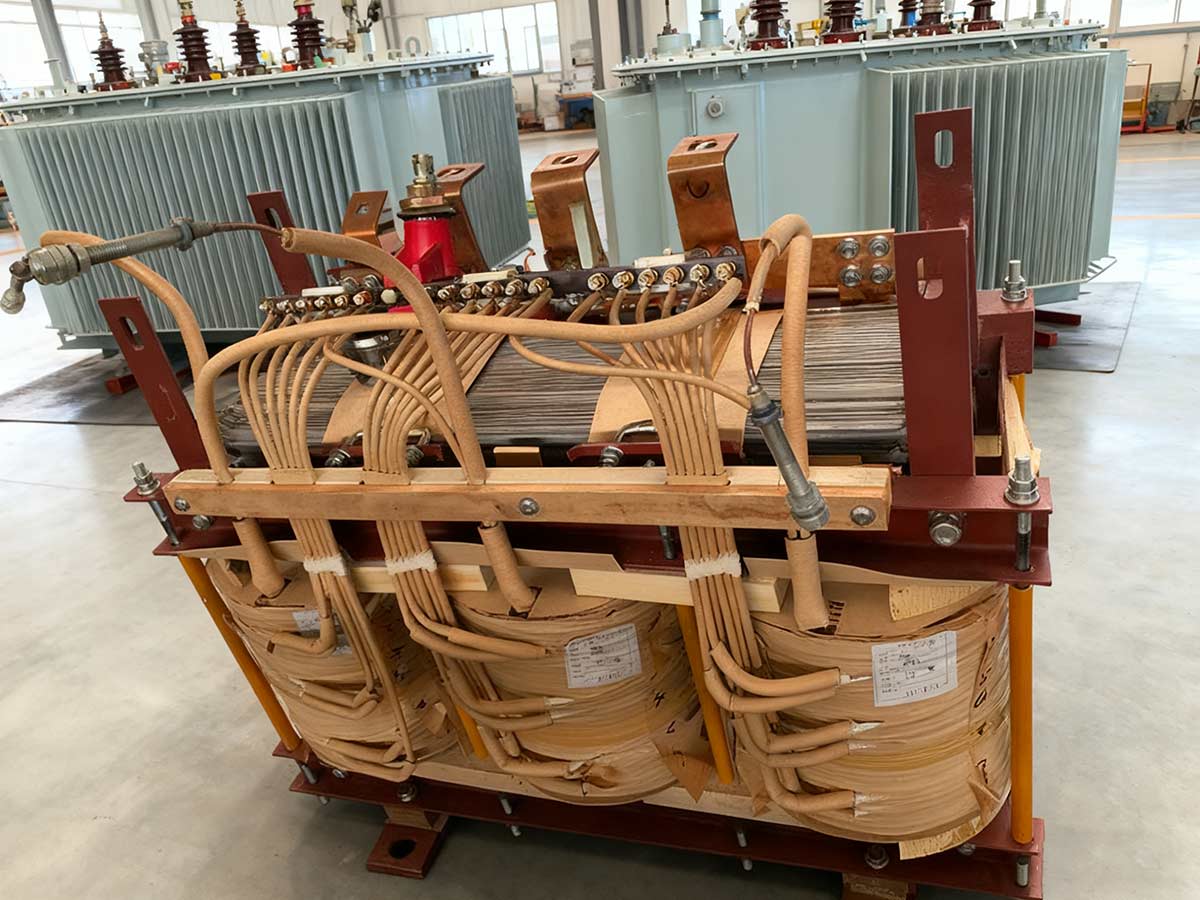
(1) Winding Conductors
- Material: Uses high-purity oxygen-free copper wires (99.95% purity) instead of aluminum. This choice reduces electrical resistivity by 40% compared to aluminum, lowering copper loss and improving heat conductivity.
- Form Factor: Adopts double-filament insulated flat copper wire (size: 2.5mm×8mm typical). Flat wires offer a larger winding fill factor (up to 85%) than round wires, reducing the winding volume and improving space utilization within the transformer core.
(2) Insulation Materials
- Turn-to-Turn Insulation: Each copper wire is coated with a 0.15mm-thick polyimide film, which withstands temperatures up to 155°C and resists oil aging—critical for the oil-immersed environment.
- Layer-to-Layer Insulation: Uses 0.2mm-thick kraft paper impregnated with transformer oil. This paper enhances dielectric strength (≥30kV/mm) and bonds tightly with the oil to form a stable insulation system.
- Winding-to-Core & Winding-to-Winding Insulation: Deploys pressboard barriers (thickness: 5–8mm) between the windings and the iron core, as well as between primary and secondary windings. CHH Power treats these pressboards with vacuum pressure impregnation (VPI) to eliminate air bubbles, preventing partial discharge.
3. Winding Type & Arrangement
CHH Power adopts a cylindrical helical winding structure for the 630kVA 10kV transformer, a design proven to balance efficiency and manufacturability:

(1) Primary (10kV) Winding
- Structure: Four-layer cylindrical helical winding, with each layer consisting of 120–140 turns (total turns: ~500, calculated based on voltage ratio). The helical design (wire wound at a small angle to the axial direction) enhances mechanical strength, enabling it to withstand short-circuit forces of up to 250kN.
- Connection: Y-connected (star connection) to reduce line voltage stress on the insulation. The neutral point is led out and grounded, complying with grid neutral grounding requirements.
(2) Secondary (0.4kV) Winding
- Structure: Three-layer cylindrical winding with a higher turn density (total turns: ~20) to match the low-voltage output. It is placed inside the primary winding (concentric arrangement) to minimize leakage magnetic flux—this reduces stray loss by 15% compared to eccentric designs.
- Connection: Δ-connected (delta connection) to improve load balance and suppress third-harmonic currents, ensuring stable 0.4kV output for three-phase loads.
(3) Key Layout Advantages
- Concentric Arrangement: Primary and secondary windings are coaxial with the iron core, optimizing magnetic flux coupling and reducing leakage inductance.
- Radial Heat Dissipation: The gap between windings (10–12mm) serves as an oil flow channel. Transformer oil circulates through these gaps, absorbing heat from the windings and transferring it to the tank radiator—ensuring uniform temperature distribution.
4. CHH Power’s Manufacturing & Quality Control for Windings
To ensure the winding structure meets design standards, CHH Power implements strict process control and testing throughout production:
- Precision Winding: Uses CNC winding machines with a positioning accuracy of ±0.1mm to ensure uniform turn spacing and layer alignment. This prevents local overheating caused by uneven winding density.
- Vacuum Pressure Impregnation (VPI): After winding assembly, the entire winding module undergoes VPI treatment—impregnated with thermosetting epoxy resin under vacuum and high pressure. This seals micro-gaps in the insulation, improving moisture resistance and mechanical strength.
- Post-Manufacturing Testing: Conducts three key tests on windings:
- Winding Resistance Test: Verifies conductor integrity and connection correctness.
- Turn-to-Turn Insulation Test: Uses a surge voltage generator to detect insulation defects between turns.
- Short-Circuit Withstand Test: Simulates short-circuit conditions to verify mechanical stability of the winding structure.
CHH Power’s optimized 630kVA 10kV oil-immersed distribution transformer winding structure ensures the product delivers reliable performance, low energy consumption, and long service life—making it a preferred choice for medium-capacity power distribution scenarios.