
Distribution transformer diagrams serve as visual blueprints that unravel the internal architecture and wiring of transformers. Employing universal symbols to illustrate components such as windings, cores, and safety mechanisms, these diagrams are indispensable for designing robust power distribution systems, conducting effective maintenance, and resolving operational issues.

Whether you’re a seasoned electrical engineer or new to the field of power distribution, this guide will demystify transformer schematics. We’ll break down symbolic language, explore component connections, and uncover the practical insights these diagrams convey—empowering you to harness their full potential in your work.
Transformer Anatomy: Unveiling the Power Core
Ever curious about the inner workings of the metal enclosures that keep our electrical grids running? Transformer diagrams may initially appear as a labyrinth of lines and symbols, but they hold the key to understanding how these critical devices function.
At their core, transformer diagrams map the essential components that drive energy transformation. They illustrate primary and secondary windings, core configurations, and critical connection points—laying the groundwork for interpreting even the most complex schematics. Grasping this “anatomy” is the first step toward mastering transformer operation.
Key Components in Diagram Form
Let’s explore the foundational elements of transformer diagrams:
Windings: The Pathways of Power
Windings are the functional heart of transformers, where electromagnetic induction occurs. Diagram symbols for windings convey critical details:
- Primary winding designations
- Secondary winding indicators
- Polarity marking conventions
- Coil configuration cues
Core: The Magnetic Backbone
The core directs magnetic flux, and its diagram representation reveals structural characteristics:
- Core leg symbols
- Yoke configuration indicators
- Core type differentiators (shell vs. core design)
Connections & Terminals: Interface with the Grid
Diagrams clarify how transformers connect to external systems through:
- Bushing symbols (insulated conductor pathways)
- Terminal labeling standards
- Grounding point designations
Component | Symbol Example | Function |
Primary Winding | ⚂ | Accepts incoming electrical power |
Secondary Winding | ⚃ | Delivers transformed output power |
Core | □ | Channels and concentrates magnetic flux |
Bushing | ○ | Provides insulated passage for conductors |
A Lesson in Practical Interpretation
One project early in my career stands out as a pivotal lesson in transformer anatomy. Tasked with upgrading a municipal substation, I was confronted with a set of outdated transformer diagrams that initially seemed indecipherable—nothing more than a jumble of lines and shapes.
My mentor guided me through a systematic breakdown. He pointed out the subtle variations in winding symbols, emphasizing: “Those small dots adjacent to the windings indicate polarity. Misinterpreting them could lead to catastrophic system failures.” We then analyzed the core representation, learning how the arrangement of legs and yokes revealed whether it was a shell-type or core-type transformer—critical knowledge for predicting performance under variable loads.
The most illuminating moment came when tracing connection pathways. “This diagram tells the story of power flow,” my mentor explained. “Follow the path from high-voltage bushings through the windings to low-voltage terminals, and you’ll understand how the transformer responds to different operating conditions.”
As we worked, patterns emerged. The once-random symbols coalesced into a clear picture of internal operations—like learning a new language that communicates the principles of energy transformation. This experience taught me that understanding transformer anatomy goes beyond memorizing symbols; it’s about recognizing component relationships and how they collaborate to convert electrical energy.
Practical Tips for Beginners
For those new to transformer diagrams:
- Start with the fundamentals—master identifying windings, cores, and connection points
- Practice tracing power flow paths through simple schematics
- Focus on understanding polarity markings and their implications
- Gradually progress to more complex diagrams as basic recognition becomes second nature
Remember: Every transformer diagram narrates a story of design, capability, and potential challenges. Mastering this language unlocks invaluable insights for system design, troubleshooting, and maintenance—skills that are foundational in the power distribution industry.
Decoding Winding Symbols & Connections
Staring at transformer winding diagrams, it’s easy to feel overwhelmed by the maze of coils and connections. Yet these schematics follow a logical framework—one that reveals how windings shape voltage ratios, current capacities, and overall transformer performance.
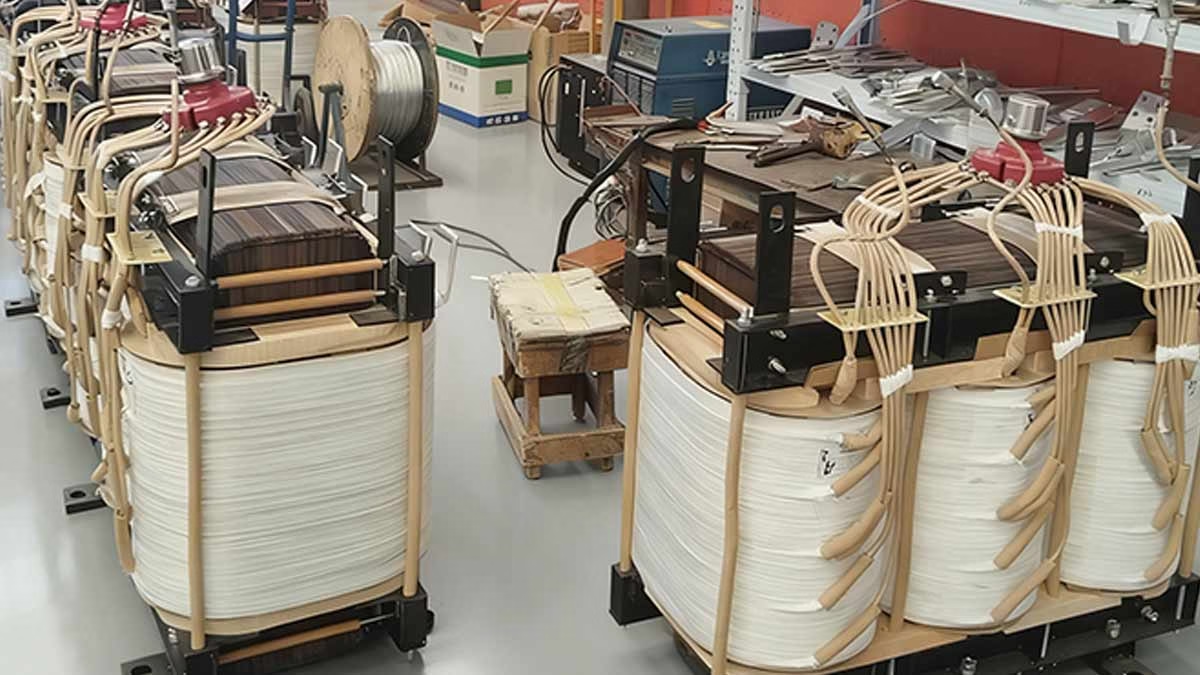
Transformer winding diagrams use standardized symbols to represent coil arrangements, connection types, taps, and polarity. Understanding these elements is essential for configuring transformers correctly, troubleshooting issues, and optimizing system performance.
Symbolic Language of Windings
Let’s break down the key components of winding diagrams:
Coil Symbols: Building Blocks of Windings
Coil symbols communicate the basic structure of winding configurations:
- Single coil representations
- Multi-coil grouping indicators
- Tapped winding designations (for voltage adjustment)
Connection Configurations
The way coils connect defines electrical characteristics:
- Series connection symbols
- Parallel connection indicators
- Wye (Star) and Delta configuration notations
Polarity & Phasing: Critical for Compatibility
Polarity markings ensure proper system integration:
- Dot convention for polarity identification
- Phase angle representation
- Vector group designations
Symbol | Meaning | Application |
⚆ | Single coil unit | Basic winding foundation |
⚇ | Tapped coil | Voltage regulation capabilities |
Y | Wye connection | Three-phase load balancing |
Δ | Delta connection | Harmonic distortion mitigation |
A Case Study in Complex Winding Interpretation
A particularly challenging project highlighted the importance of mastering winding diagrams. We were retrofitting an industrial transformer to integrate with a new variable frequency drive (VFD) system—requiring precise understanding of the existing winding configuration to avoid full replacement.
The original diagram was remarkably complex: multiple taps, interconnected coil groups, and a hybrid of wye and delta connections. I approached it systematically, starting with the primary windings—tracing each coil and documenting series-parallel groupings. The taps proved especially tricky; some were placed at unconventional points, likely added over years to adapt to changing voltage demands.
The secondary side was even more intricate, with mixed delta-wye connections and fine-tuning taps. I created simplified sketches to map relationships between coil groups, spending hours cross-referencing symbols with manufacturer specifications.
The breakthrough came with analyzing polarity markings. Those seemingly insignificant dots revealed how magnetic fields interacted across coils. By applying the dot convention, I could trace power flow and predict how modifications to one section would affect the entire system. A critical discovery was a subtle phase shift introduced by the winding arrangement—explaining persistent operational quirks reported by maintenance teams.
Armed with this insight, we designed targeted modifications: adding strategic taps and reconfiguring select connections to accommodate the VFD while preserving the transformer’s core functionality. The result was seamless integration and flawless performance—all made possible by precise winding diagram interpretation.
Mastery Tips for Engineers
To excel at reading winding diagrams:
- Practice with increasingly complex configurations
- Always trace power flow paths, noting polarity relationships
- Redraw diagrams from different perspectives to reveal hidden connections
- Cross-reference symbols with industry standards (IEC, ANSI)
- Document lessons learned from each project
Winding diagrams are more than technical drawings—they’re roadmaps to how transformers manipulate electrical energy. Fluency in this language empowers engineers to optimize designs, resolve complex issues, and innovate solutions in an evolving power landscape.
Core Design: The Magnetic Heart of Transformer Diagrams
Transformers cores—available in diverse shapes and materials—are the unsung heroes of energy efficiency. Their diagram symbols carry critical information about magnetic circuit design, yet these symbols are often overlooked or misunderstood.
Transformer core diagrams use specialized symbols to represent core structure, flux paths, and material composition. Decoding these elements is essential for analyzing efficiency, predicting load performance, and designing optimal magnetic circuits—especially as energy efficiency standards become increasingly stringent.

Core Representation in Diagrams
Let’s explore the key aspects of core diagrams:
Core Types: Shape Determines Performance
Core shape directly impacts functionality and efficiency:
- Shell-type core symbols (robust mechanical design)
- Core-type representations (simplified construction)
- Wound core indicators (continuous-wrap design)
Flux Path Visualization
Diagrams map how magnetic flux travels through the core:
- Main flux path symbols
- Leakage flux indicators
- Air gap notations (where applicable)
Material Coding
Core material significantly influences performance, denoted by:
- Silicon steel lamination symbols
- Amorphous metal core indicators
- Nanocrystalline material designations
Core Type | Symbol Example | Key Characteristics |
Shell-type | ⊞ | High mechanical strength, compact |
Core-type | ⊟ | Simplified assembly, cost-effective |
Wound Core | ⦾ | Low hysteresis losses, premium design |
Designing for Renewable Energy: A Core Case Study
A project to design a high-efficiency distribution transformer for a solar farm highlighted the value of core diagram mastery. The client required minimal energy loss under variable loads—a common challenge in renewable energy applications.
Initially, I leaned toward a standard shell-type core (familiar and reliable for mechanical stability). However, reviewing core diagrams revealed limitations: the shell-type design’s flux paths created potential saturation points under fluctuating solar output.
I shifted focus to wound core diagrams, recognizable by their spiral symbols indicating continuous material wrapping. The diagrams showed fewer joints (reducing flux leakage) and more uniform flux distribution—key for variable load efficiency. But the design presented manufacturing challenges, requiring careful balance between theoretical performance and practical feasibility.
Analyzing flux path symbols in the wound core diagram revealed uniform magnetic flow with minimal concentration points—exactly what the variable solar load required. We paired this with high-grade, thin-gauge silicon steel (denoted by closely spaced lines in the core symbol) to minimize eddy current losses.
The prototype exceeded expectations: 15% lower core losses than conventional designs and consistent efficiency across 20-100% load ranges. This success stemmed directly from interpreting core diagram nuances—turning symbolic representations into tangible performance gains.
Practical Guidance for Core Diagram Mastery
To effectively interpret core diagrams:
- Visualize 3D magnetic circuits from 2D symbols
- Relate flux path symbols to real-world performance
- Understand material notation implications for efficiency
- Compare core type symbols against application requirements
- Question conventional choices—uncommon core designs may solve specific challenges
The core is literally and figuratively at the center of transformer performance. In an era focused on energy efficiency, mastering core diagram interpretation isn’t just a technical skill—it’s a competitive advantage that drives innovation and sustainability.
Safety Symbols: Identifying Protective Devices in Schematics
Electrical safety begins with understanding the protective devices in transformer schematics. These symbols represent the first line of defense against overcurrent, overvoltage, and thermal damage—yet their importance is often underestimated.
Transformer diagrams use standardized symbols to denote protective components like fuses, circuit breakers, and surge arresters. Recognizing these symbols and their placement is critical for ensuring compliance, preventing equipment failure, and safeguarding personnel.

Essential Safety Symbols
Let’s explore the key protective device symbols:
Overcurrent Protection
Devices that safeguard against current surges:
- Fuse symbols (one-time protection)
- Circuit breaker indicators (resettable protection)
- Relay designations (automated fault response)
Overvoltage Protection
Components that mitigate voltage spikes:
- Surge arrester symbols (divert excess voltage to ground)
- Spark gap representations (arc-over protection)
- Varistor indicators (voltage-dependent resistance)
Temperature Protection
Devices that prevent thermal damage:
- Thermometer symbols (temperature monitoring)
- Thermal relay designations (overheat shutdown)
- Winding temperature indicators (direct coil monitoring)
Protection Type | Symbol Example | Primary Function |
Fuse | ⏛ | Interrupts circuit during overcurrent |
Circuit Breaker | ⎓ | Resettable overcurrent/short-circuit protection |
Surge Arrester | ⏊ | Diverts transient overvoltage to ground |
A Safety Critical Case Study
A series of unexplained transformer failures at an industrial facility highlighted the consequences of misinterpreting safety symbols. The transformers were relatively new, and initial schematic reviews suggested adequate protection—until we dug deeper.
The standard symbols for fuses and circuit breakers were present, but the surge arrester symbols revealed a critical flaw. While the zigzag arrester symbols were correctly placed at the bushings, the diagram lacked clear grounding path indicators. This oversight led to improper installation: physical arresters were present but not properly grounded, leaving the transformers vulnerable to voltage spikes.
We conducted a comprehensive review, tracing protection circuits through the schematics and cross-referencing with site photos. It became clear the facility had underestimated industrial voltage surge risks. We redesigned the protection scheme, adding robust surge arresters with clear grounding symbols and incorporating missing temperature monitoring devices.
The updated schematics used detailed symbols to show arrester connections to both transformers and grounding systems. The result: zero failures in the subsequent year, plus simplified maintenance checks for on-site teams.
This experience emphasized that safety symbol interpretation goes beyond recognition—it requires understanding component interactions and system context. A symbol’s placement and connections are just as important as the symbol itself.
Best Practices for Safety Symbol Mastery
To effectively interpret safety symbols:
- Trace complete protection circuits, not just individual devices
- Verify symbol standards (IEC 60617, ANSI Y32) for consistency
- Cross-reference symbols with manufacturer documentation
- Stay updated on emerging protection technologies and their symbols
- Question gaps in protection—what’s missing from the schematic?
In transformer design and maintenance, safety symbols are more than technical notation—they’re life-saving tools. Proficiency in interpreting these symbols safeguards infrastructure, prevents costly downtime, and ensures compliance with global safety standards.
Advanced Blueprint Features: Beyond Basic Transformer Design
Modern transformer blueprints incorporate sophisticated features that address evolving grid demands—from dynamic voltage regulation to smart monitoring. These advanced symbols and notations represent the future of power distribution, yet many engineers struggle to interpret them fully.
Advanced transformer diagrams include symbols for on-load tap changers (OLTCs), hybrid cooling systems, and intelligent monitoring devices. They also depict complex winding arrangements, specialized core designs, and grid-integration technologies. Mastering these elements is essential for optimizing performance in smart grid environments.

Key Advanced Symbols
Let’s explore cutting-edge blueprint features:
On-Load Tap Changers (OLTCs)
Devices that adjust voltage without power interruption:
- Tap selector symbols
- Diverter switch representations
- Electronic control interface indicators
Advanced Cooling Systems
Technologies for managing high loads:
- Forced oil circulation symbols
- Radiator bank indicators
- Variable-speed fan/pump designations
Smart Monitoring Systems
Digital technologies for predictive maintenance:
- Dissolved Gas Analysis (DGA) sensor symbols
- Fiber optic temperature monitoring indicators
- Data communication gateway representations
Advanced Feature | Symbol Example | Function |
On-Load Tap Changer | ≡ | Dynamic voltage regulation under load |
Forced Oil Cooling | ⇌ | Enhanced heat dissipation for high loads |
DGA Sensor | ⊗ | Real-time insulation condition monitoring |
Integrating Advanced Features: A Substation Upgrade
A critical substation upgrade project demonstrated the value of advanced blueprint interpretation. The goal: increase load capacity and improve grid stability with minimal downtime—requiring integration of cutting-edge transformer technologies.
The proposed blueprint initially seemed overwhelming, filled with unfamiliar symbols for OLTCs, hybrid cooling systems, and smart sensors. The OLTC section was particularly complex, showing mechanical selector contacts, diverter switches, and microprocessor control interfaces—all represented by specialized symbols.
I spent weeks dissecting the OLTC schematic, mapping how it integrated with primary and secondary windings. This revealed the system’s ability to make rapid voltage adjustments (up to 50 taps) in response to grid fluctuations—essential for accommodating variable renewable energy inputs.
The cooling system symbols told another important story: a hybrid design combining forced oil circulation with variable-speed radiators. The diagram showed stage activation based on load and temperature thresholds, ensuring efficient heat management across operating ranges.
Most revealing was the smart monitoring section—symbols for fiber optic sensors embedded in windings, DGA units sampling transformer oil, and a communication gateway linking to the utility’s SCADA system. These symbols represented a shift from reactive to predictive maintenance, enabling remote condition monitoring and early fault detection.
As we translated the blueprint into reality, each advanced feature proved integral to meeting project goals. The OLTC maintained voltage stability during peak loads, the hybrid cooling system handled 30% increased capacity, and the smart monitoring system reduced maintenance costs by 40%.
Mastering Advanced Blueprints
To excel with advanced transformer diagrams:
- Treat complexity as a learning opportunity, not a barrier
- Cross-reference advanced symbols with latest IEC/ANSI standards
- Understand the operational context of each advanced feature
- Collaborate with manufacturers to clarify custom symbols
- Relate blueprint elements to real-world performance goals
Advanced transformer features aren’t luxury add-ons—they’re essential for modern grid resilience, efficiency, and sustainability. By mastering their blueprint representations, engineers can design and maintain transformers that meet the demands of 21st-century power systems.
Conclusion
Distribution transformer diagrams are more than technical drawings—they’re the language of power distribution. From basic component identification to advanced smart grid integration, these schematics convey critical insights that drive design innovation, operational safety, and maintenance efficiency.
Mastering diagram interpretation requires moving beyond symbol memorization to understanding component relationships, system context, and real-world application. Whether you’re designing new systems, troubleshooting existing infrastructure, or integrating cutting-edge technologies, fluency in this visual language is indispensable.
As power systems evolve to incorporate renewable energy, smart technologies, and higher efficiency standards, transformer diagrams will continue to grow in complexity. By developing and refining your diagram-reading skills, you’ll position yourself at the forefront of the industry—ready to tackle the challenges and opportunities of the future.
In the world of power distribution, the ability to decode transformer diagrams isn’t just a technical skill—it’s the foundation of reliable, efficient, and safe electrical infrastructure.