
Single phase power transformer prices vary widely—from $1,200 for compact distribution units to over $550,000 for large-scale power solutions—and are shaped by a mix of technical, material, and market dynamics. For project managers, engineers, and procurement teams, navigating these price fluctuations requires more than just comparing upfront costs—it demands a deep understanding of how design choices, material quality, and market trends impact long-term value.
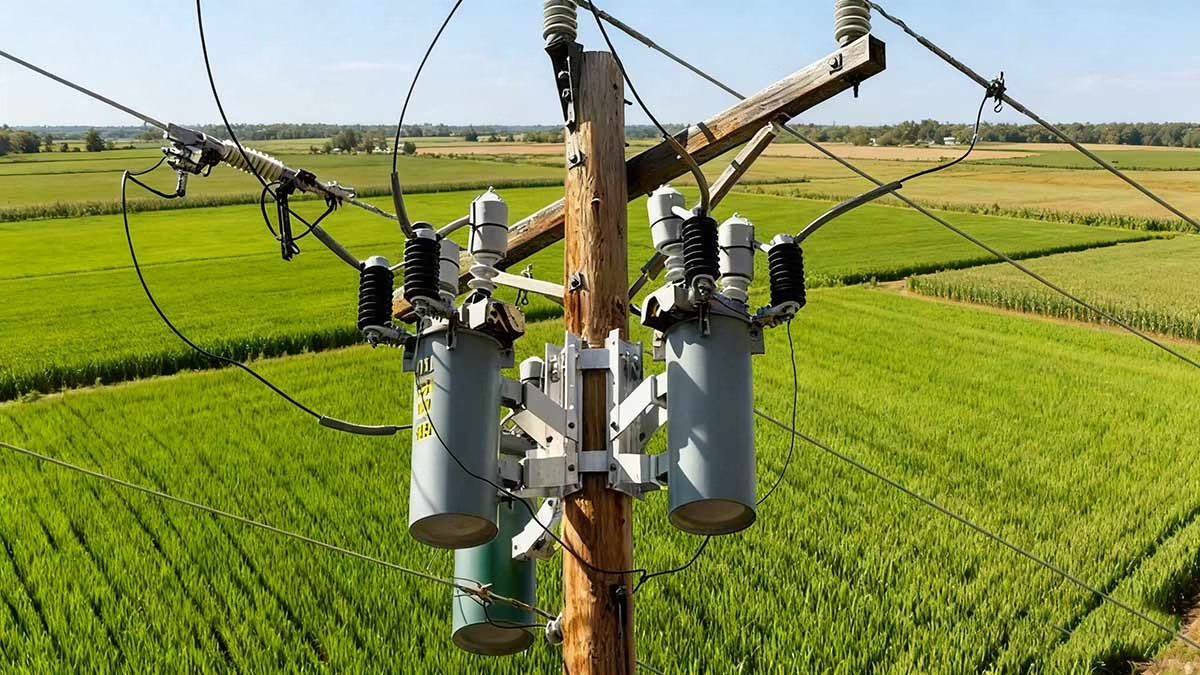
With over two decades in the power industry, I’ve guided countless clients to balance budget constraints with performance needs. This guide breaks down the critical factors driving transformer pricing, market trends shaping 2025 costs, and actionable strategies for cost-effective procurement.
Key Drivers of Single Phase Transformer Pricing
The wide price range of single phase transformers isn’t random—it’s dictated by specific technical and market factors that interact to shape the final cost. Understanding these drivers is the first step to avoiding overpaying or compromising on quality.
Core Influences on Pricing
- Power Rating & Physical Size:
Higher kVA ratings generally increase costs, but the relationship isn’t linear. Economies of scale kick in for larger standard units: a 1,250 kVA transformer might cost 5x more than a 125 kVA unit (e.g., $37,500 vs. $7,500), not 10x. Larger units also require more raw materials, and their transportation/installation costs rise—for utility projects, doubling kVA often adds 65% to total project costs, not 100%.
- Voltage Class:
Medium voltage transformers (up to 35 kV) cost 35–55% more than low-voltage counterparts. Upgrading from 480V to 4,160V for the same kVA can increase costs by 45%, driven by enhanced insulation requirements and rigorous testing.
- Material Quality:
Core materials (silicon steel vs. amorphous metal) and windings (copper vs. aluminum) create significant price gaps. Amorphous cores boost efficiency by 70% but add 22–32% to upfront costs, while copper windings—offering better conductivity—increase material costs by 14–18% compared to aluminum.
- Design & Features:
Dry-type transformers (safer for indoor use) cost 25–45% more than oil-filled models. Advanced cooling systems (e.g., forced air vs. natural cooling) add 12–22% to costs but enable 30% higher continuous load capacity. Smart monitoring or on-load tap changers can increase prices by 8–16%.
| Factor | Cost Impact Range | Real-World Example |
|---|---|---|
| Power Rating (125–1,250 kVA) | 400–500% increase | 125 kVA ($7,500) → 1,250 kVA ($37,500) |
| Voltage Class (480V→4,160V) | 35–55% increase | 500 kVA low-voltage ($22,000) → medium-voltage ($34,100) |
| Amorphous Core vs. Silicon Steel | 22–32% increase | 250 kVA silicon steel ($12,000) → amorphous ($15,840) |
| Dry-Type vs. Oil-Filled | 25–45% increase | 300 kVA oil-filled ($15,000) → dry-type ($21,750) |
Why Similar Transformers Might Have Different Prices
A recent client was confused by a 38% price gap between two 500 kVA transformers. The difference? One was a standard commercial unit ($23,000), while the other was engineered for renewable energy integration—equipped with advanced voltage regulation and smart monitoring ($31,740). The latter’s specialized design justified the premium for a solar farm project, but would have been overkill for a basic office building.
Material choices also create disparities. For a cost-sensitive residential project, aluminum windings saved 15% ($1,800 on a $12,000 transformer) but increased energy losses by 9%. For a data center requiring 24/7 reliability, copper windings were worth the extra cost to avoid downtime from overheating.
Power Rating & Capacity: How Size Shapes Costs
The relationship between a transformer’s kVA rating and its price is nuanced—size matters, but so do design efficiency, voltage class, and application-specific requirements. Understanding this dynamic is critical for accurate budgeting.
Beyond Linear Pricing
- Economies of Scale:
Manufacturers optimize production for standard large capacities, reducing per-kVA costs. A 630 kVA transformer might cost $28,000 (≈$44 per kVA), while a 1,250 kVA unit costs $48,750 (≈$39 per kVA). For utilities, buying fewer large units instead of multiple small ones can cut total costs by 12–18%.
- Voltage & Size Interplay:
A 500 kVA low-voltage transformer (480V) might cost $22,000, but the same kVA at 13.8kV jumps to $33,000—50% higher—due to thicker insulation and specialized testing.
- Size-Related Hidden Costs:
Larger transformers incur higher shipping and installation expenses. A 2,500 kVA unit’s transportation and crane rental can add $18,000 (15% of the $120,000 unit cost) for remote industrial sites. In urban areas, compact designs might cost 20% more upfront but save $60,000 in civil works by fitting into tight spaces.
| Capacity Range | Average Price (USD) | Cost per kVA (USD) | Key Design Notes |
|---|---|---|---|
| 25–125 kVA | $1,200–$8,500 | $48–$68 | Basic cooling, standard windings |
| 125–630 kVA | $8,500–$28,000 | $44–$68 | Improved efficiency, optional monitoring |
| 630–1,250 kVA | $28,000–$48,750 | $39–$44 | Advanced cooling, smart features |
| 1,250–2,500 kVA | $48,750–$120,000 | $39–$48 | Custom designs, medium-voltage options |
Real-World Sizing Decisions
For a manufacturing plant expanding its operations, we compared a 1,000 kVA transformer ($35,000) vs. two 500 kVA units ($22,000 each, total $44,000). The single larger unit saved $9,000 upfront plus $3,000 annually in energy losses—proving economies of scale and efficiency can align for big savings.
In contrast, an urban substation upgrade required compact 800 kVA units despite the cost premium. The $2,500 extra per unit ($32,500 vs. $30,000 for standard sizes) avoided $75,000 in street widening and civil works— a classic case of upfront investment justifying long-term savings.
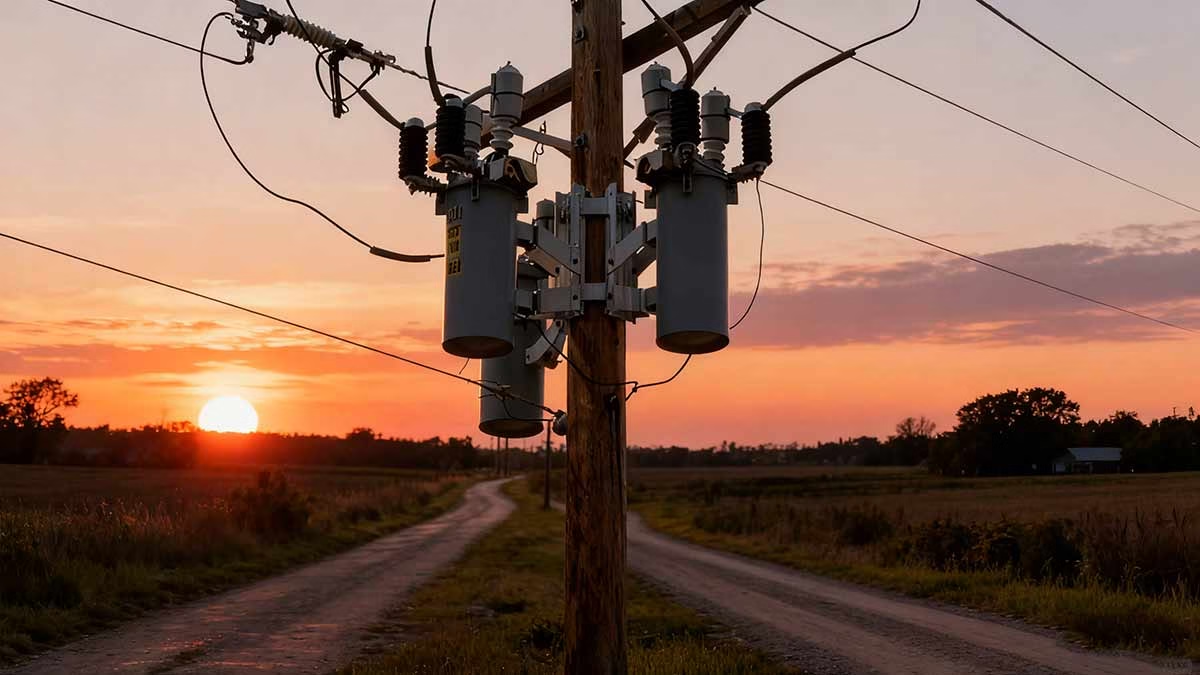
Material Quality & Design: Balancing Performance & Cost
Choosing between high-grade and budget materials often feels like a trade-off between upfront costs and long-term value. The right decision depends on your application’s load profile, lifespan expectations, and efficiency goals.
Core Material Choices
- Silicon Steel:
The industry standard, offering a balance of cost and efficiency. Ideal for applications with intermittent loads (e.g., small commercial buildings). Upgrading from M4 to M3 grade steel adds 11% to costs but improves efficiency by 16%, cutting energy losses.
- Amorphous Metal:
A premium option with 70% lower core losses than silicon steel. For 24/7 operations (e.g., data centers, utilities), the 22–32% cost premium (e.g., $15,840 vs. $12,000 for 250 kVA) pays for itself in 5–7 years via energy savings.
Winding Materials
- Copper:
Superior conductivity reduces load losses by 20–25% and withstands higher temperatures. Worth the 14–18% cost premium for critical applications (e.g., hospitals, industrial processes) where downtime is costly.
- Aluminum:
Lighter and 15% cheaper than copper, but with 10–12% higher losses. A viable choice for non-critical applications (e.g., residential distribution) with lower load factors.
Design Features That Impact Cost & Value
- Insulation:
Premium paper insulation and high-grade oil add 8–10% to costs but extend a transformer’s lifespan by 25–30%. For outdoor or coastal applications, corrosion-resistant coatings (adding 5–7% to costs) prevent premature degradation from salt spray or humidity.
- Cooling Systems:
- ONAN (Oil Natural Air Natural): Basic, cost-effective for small units.
- ONAF (Oil Natural Air Forced): Adds 15–20% to costs but increases capacity by 30%.
- OFAF (Oil Forced Air Forced): Premium option (25–30% cost increase) for large industrial units with continuous high loads.
- Smart Features:
Advanced monitoring (adding 8–16% to costs) enables predictive maintenance, reducing annual upkeep expenses by 35–40%. For remote or hard-to-access installations, this feature alone can save $5,000–$10,000 over a 10-year lifespan.
| Material/Feature | Cost Premium | Key Benefit | Ideal For |
|---|---|---|---|
| Amorphous Core | 22–32% | 70% lower core losses | 24/7 operations |
| Copper Windings | 14–18% | 20–25% lower load losses | Critical applications |
| ONAF Cooling | 15–20% | 30% higher capacity | Medium industrial loads |
| Advanced Monitoring | 8–16% | 35–40% lower maintenance costs | Remote installations |
Finding the Right Balance
For a small retail center with 12-hour daily operation, we recommended silicon steel cores and aluminum windings—saving 18% upfront without significant long-term energy costs. For a data center running 24/7, amorphous cores and copper windings justified the 28% premium: the energy savings would recoup the extra cost in 6 years, with 15 more years of efficient operation.
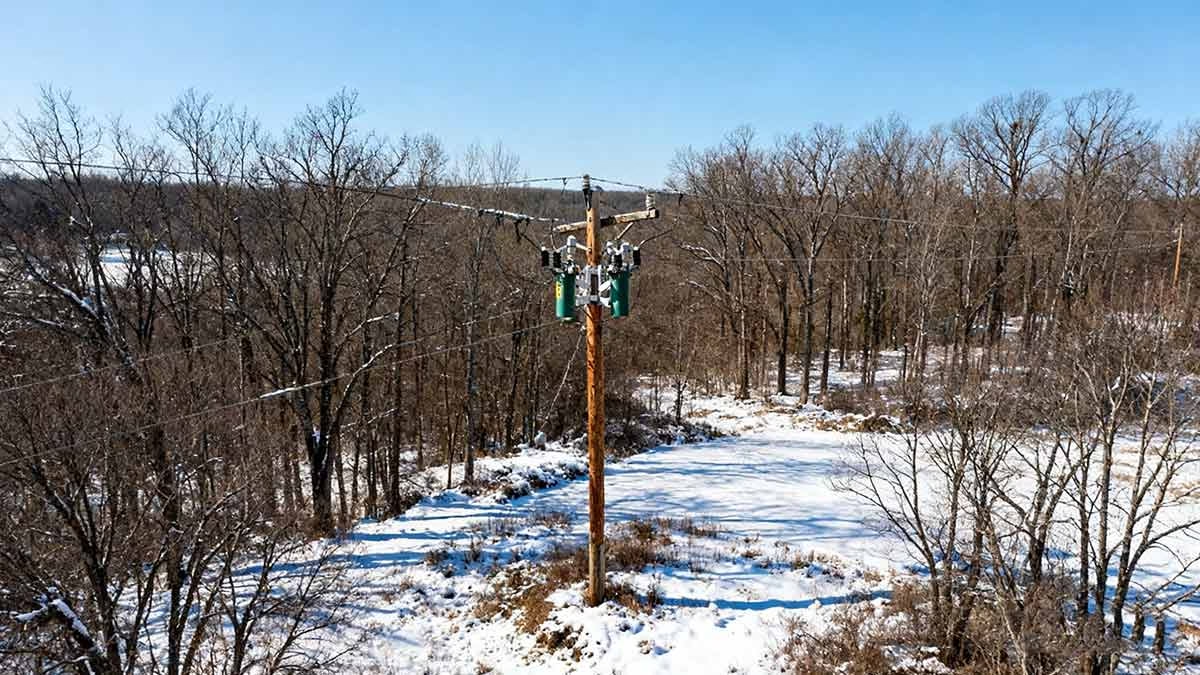
2025 Market Trends Shaping Transformer Prices
Global market dynamics—from raw material fluctuations to regulatory shifts—are driving significant changes in single phase transformer pricing. Staying ahead of these trends helps avoid unexpected cost hikes and capitalize on opportunities.
Key 2025 Market Drivers
- Raw Material Volatility:
Copper prices, which influence 15–20% of transformer costs, rose 18% in 2024, pushing transformer prices up 5–8%. Grain-oriented electrical steel (critical for cores) saw a 14% price increase due to demand from EV and renewable sectors, adding 3–6% to transformer costs. Insulating oil prices jumped 11% in early 2025, contributing 1–2% to overall costs.
- Supply Chain Shifts:
Increased production in emerging markets (e.g., Southeast Asia) has lowered prices for standard transformers by 5–11% in North America and Europe. However, shipping costs rose 28% in 2025, making imported units less competitive for large orders (local production now saves 2–4% on total costs).
- Regulatory Pressures:
Stricter efficiency standards (e.g., EU’s Ecodesign 2024, DOE’s 2025 updates) have increased minimum efficiency requirements, adding 12–17% to the cost of entry-level transformers. High-efficiency models (IE4+) now command a 15–22% premium but offer 35–45% lower losses.
- Technological Advancements:
Smart grid integration and renewable energy compatibility are becoming standard. Transformers with bidirectional power flow (for solar/wind integration) cost 8–12% more but are now required for most green energy projects. Smart monitoring features, once optional, add 7–15% to costs but are increasingly mandated for utility-scale installations.
| Trend | Price Impact | Long-Term Outlook |
|---|---|---|
| Copper Price Increases | +5–8% | Volatility expected to continue through 2026 |
| Stricter Efficiency Standards | +12–17% | Ongoing tightening will keep upward pressure |
| Smart/Renewable Features | +7–15% | Will become standard (no premium by 2028) |
| Local Production Growth | -2–4% | Cost savings to expand as supply chains stabilize |
Preparing for 2025 Pricing Shifts
For a utility planning a 2025 transformer procurement, we recommended locking in prices via a 2-year contract to hedge against copper volatility—saving an estimated 6% on a $2M order. For a commercial project, opting for IE4+ efficient transformers (17% cost premium) will avoid retrofitting costs when stricter standards take effect in 2026.
Cost-Effective Procurement Strategies
Navigating transformer pricing successfully requires a strategic approach that goes beyond comparing upfront costs. These proven strategies help minimize total cost of ownership (TCO) while meeting performance requirements.
Focus on Total Cost of Ownership (TCO)
- Calculate Lifespan Costs:
A 20% higher upfront investment in efficient transformers (e.g., $27,600 vs. $23,000 for 500 kVA) can yield 30% TCO savings over 20 years. For industrial clients paying $0.15/kWh, the $4,600 premium translates to $13,800 in energy savings—tripling the initial investment.
- Factor in Downtime Costs:
For critical applications (e.g., data centers), a 25% premium for high-reliability transformers is justified by avoiding $100,000+ in downtime costs per hour of failure.
Strategic Purchasing Tactics
- Bulk & Long-Term Contracts:
Utilities and multi-site organizations save 12–16% by negotiating 3-year bulk purchase agreements. One client secured a 14% discount by committing to 50+ transformers annually, locking in prices amid copper volatility.
- Standardization:
Developing uniform specifications for common applications reduces customization costs by 9–13%. A retail chain standardized on 125 kVA and 250 kVA dry-type transformers, cutting procurement time and costs across 80+ locations.
- Timing Purchases:
Monitor raw material prices and time large orders during market dips. A manufacturing client saved 8% by purchasing 10 transformers when copper prices dropped 12% in Q3 2024.
Alternative Procurement Options
- Refurbished Units:
For non-critical applications (e.g., temporary construction sites), refurbished transformers offer 35–55% savings. A property developer saved 42% by using reconditioned 100 kVA units for a residential project’s temporary power needs.
- Leasing or Energy-as-a-Service (EaaS):
Leasing transformers for short-term projects (e.g., 2–5 years) cuts upfront costs by 50–60%. EaaS models—where providers own and maintain transformers—save 18–22% on TCO for small businesses by eliminating maintenance and replacement costs.
- Right-Sizing with Digital Tools:
Digital twin technology and load analysis prevent oversizing, saving 10–18% on procurement. An industrial client used load modeling to downsize from 750 kVA to 630 kVA, cutting costs by 14% without compromising performance.
| Strategy | Potential Savings | Best For |
|---|---|---|
| TCO Analysis | 20–30% over 20 years | Long-term installations |
| Bulk Contracts | 12–16% | Utilities, multi-site organizations |
| Standardization | 9–13% | Retail chains, industrial parks |
| Refurbished Units | 35–55% | Non-critical/temporary applications |
| Leasing/EaaS | 18–60% | Small businesses, short-term projects |
Real-World Success Stories
A municipal utility combined bulk purchasing (15% discount) and TCO analysis to select amorphous core transformers. The $3.2M investment yielded $9.6M in energy savings over 20 years— a 3x return. For a small manufacturing plant, leasing transformers during a 3-year expansion saved $80,000 upfront, with the option to purchase at a reduced rate later.

Conclusion
Single phase transformer pricing is shaped by a complex interplay of technical specifications, material quality, and global market trends. Effective procurement isn’t about finding the lowest upfront cost—it’s about balancing initial investment with long-term efficiency, reliability, and adaptability.
By understanding the key drivers of pricing, leveraging 2025 market insights, and adopting strategic procurement tactics, you can optimize your transformer investment. Whether you’re a utility managing large-scale projects or a small business upgrading your electrical system, focusing on total cost of ownership and aligning your choice with application needs will deliver the best value.
In a market defined by volatility and innovation, partnering with experienced suppliers and staying informed about industry trends is critical. The right transformer choice today will not only meet your current needs but also adapt to future energy demands—ensuring long-term performance and cost savings.