
First, a critical correction: Terms like “dry-type transformer oil” and “oil tank” mentioned in the original content belong to oil-immersed transformers, not dry-type transformers. Dry-type transformers use air/gas as the cooling medium and have no oil-related components. Below is a reorganized, error-corrected breakdown of dry-type transformer core components (core, winding, insulation, tap changer) based on valid information from the original content.
Contents
hide
1. Core: Magnetic Circuit Backbone of Dry-Type Transformers
The core is the closed magnetic circuit of the transformer, responsible for transmitting magnetic flux and minimizing iron loss.
1.1 Core Structure
There are two main structural types, with core-type being the mainstream for power applications:
- Core-Type Core
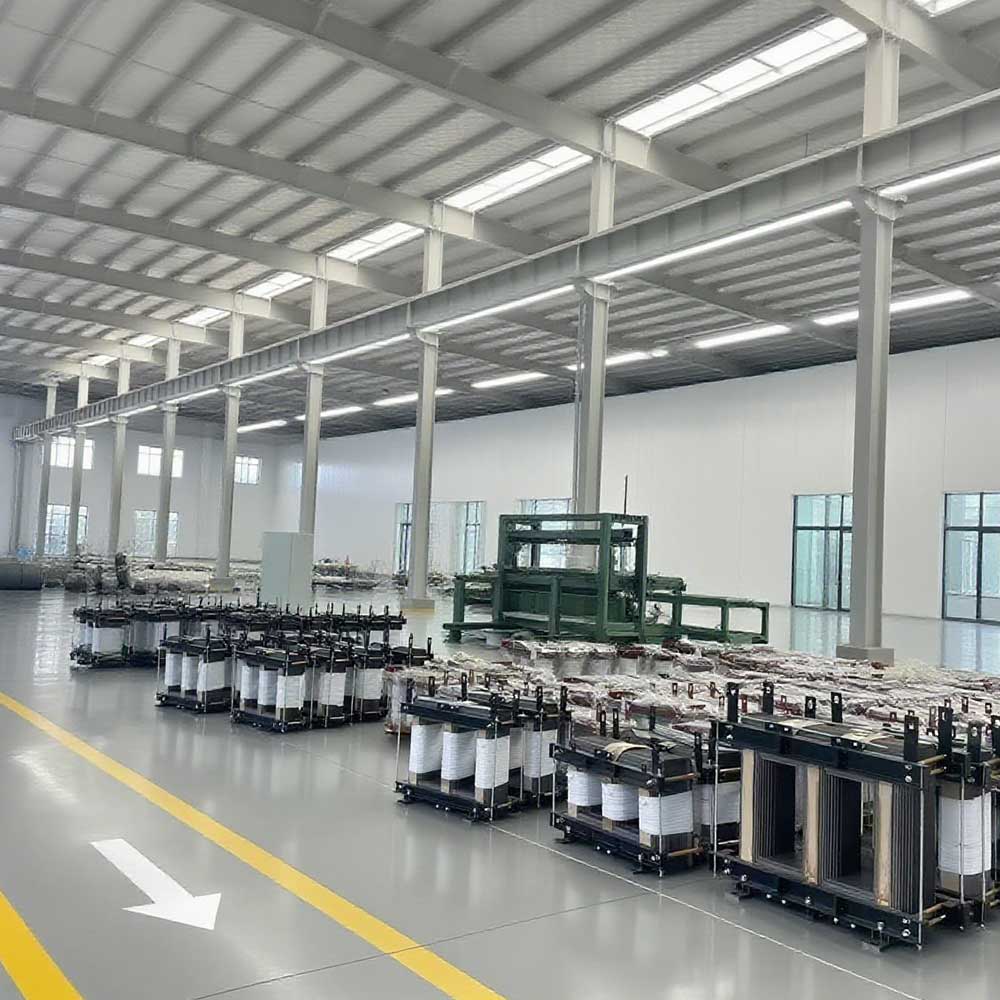
- Composition: Consists of iron core columns (where windings are sleeved) and iron yokes (connecting the top/bottom of core columns to close the magnetic circuit).
- Key Feature: The iron yoke only supports the top and bottom of the winding, not surrounding its sides.
- Advantage: Simple structure, easy winding assembly and insulation processing. It is widely used in domestic power dry-type transformers (e.g., SCB series distribution transformers).
- Shell-Type Core
- Key Feature: The iron yoke surrounds not only the top and bottom of the winding but also its sides, forming a “shell” around the winding.
- Application: Only used in special scenarios (e.g., electric furnace dry-type transformers) due to complex manufacturing and high material consumption.
1.2 Core Material
Core materials prioritize high magnetic permeability to reduce iron loss (hysteresis + eddy current loss):
- Silicon Steel Sheets: The only material used for dry-type transformer cores, divided into two categories:
- Hot-Rolled Silicon Steel Sheets: Lower magnetic permeability and higher unit loss; rarely used in modern dry-type transformers.
- Cold-Rolled Silicon Steel Sheets:
- Advantage: Higher magnetic permeability when magnetized along the rolling direction, 30–50% lower unit loss than hot-rolled sheets.
- Domestic Specifications: Common thicknesses are 0.35mm, 0.30mm, and 0.27mm. Thinner sheets reduce eddy current loss but lower the lamination factor (due to the insulating varnish coating on each sheet’s surface, which prevents inter-sheet conduction).
- Current Status: All domestic dry-type transformers use cold-rolled silicon steel sheets to meet energy efficiency standards (e.g., Class 1 efficiency per GB 20052-2024).
2. Winding: Circuit Core for Power Conversion
The winding is the electrical circuit part of the transformer, responsible for inputting (primary) and outputting (secondary) AC power.
2.1 Winding Materials
Made of insulated conductive wires, with two common options:
- Copper Wires: Enameled copper wires or paper-wrapped copper wires (purity ≥99.95%). Advantages: Low resistivity (low load loss), high mechanical strength, and good heat resistance—suitable for high-efficiency, large-capacity transformers.
- Aluminum Wires: Enameled aluminum wires or paper-wrapped aluminum wires. Advantages: Lower cost; disadvantages: Higher resistivity (higher load loss) and lower mechanical strength—used in cost-sensitive, small-capacity scenarios.
2.2 Winding Arrangement
Classified by the relative position of high-voltage (HV) and low-voltage (LV) windings:
- Concentric Winding (Most Common)
- Layout: HV and LV windings are concentrically sleeved on the iron core column.
- LV Winding Position: Placed close to the core column—reduces insulation requirements between the winding and the core (LV voltage is low, requiring thinner insulation).
- Overlapping Winding (Note: “Diamond-stacked” in the original content is a misnomer)
- Layout: HV and LV windings are arranged in layers along the iron yoke’s axial direction, overlapping each other.
- LV Winding Position: Placed close to the iron yoke—minimizes the insulation distance between the winding and the yoke, reducing the transformer’s overall height.
- Application: Suitable for transformers with strict height limits (e.g., underground substations).
3. Insulation: Critical for Electrical Safety
Dry-type transformer insulation prevents short circuits between windings, between windings and the core, and must resist heat and moisture.
3.1 Common Insulation Materials (Correcting the “Dry-Type Transformer Oil” Error)
Dry-type transformers use solid/gaseous insulation materials, not oil. Key materials include:
- Epoxy Resin: Used for casting windings (e.g., cast resin dry-type transformers). Advantages: High dielectric strength, moisture resistance, and heat resistance (Class F/H insulation).
- Insulating Paper: Wrapped around wires to insulate turns/layers (e.g., crepe paper, cable paper). Requires compatibility with high temperatures (≥155°C for Class F).
- Glass Fiber: Reinforces epoxy resin insulation, improving mechanical strength and heat dissipation.
- Silicone Rubber: Used for lead bushings and external insulation parts—resistant to aging and moisture.
3.2 Insulation Function
- Prevent inter-turn, inter-layer, and winding-to-core short circuits.
- Withstand long-term operating temperatures (up to 180°C for Class H insulation) without degradation.
4. Tap Changer: For Stable Voltage Regulation
Tap changers adjust the number of winding turns to stabilize output voltage, addressing grid voltage fluctuations.
4.1 Voltage Regulation Principle
Draw taps (different turn positions) on one winding (usually HV). Cutting or adding turns changes the winding turn ratio, thereby adjusting the output voltage.
4.2 Why Taps Are Set on HV Windings
- Easy Lead-Out: HV windings are often sleeved outside LV windings, making tap leads easier to access.
- Small Current Advantage: HV side current is smaller (I ∝ 1/U), so tap leads and switch contacts have smaller cross-sections, simplifying manufacturing.
4.3 Tap Changer Types
- Non-Excitation Tap Changer
- Operation: Voltage regulation is only possible when the transformer is unloaded (primary disconnected from the grid, secondary no load).
- Application: Suitable for stable loads (e.g., rural distribution grids with little load fluctuation).
- On-Load Tap Changer (OLTC)
- Operation: Adjusts taps without disconnecting the load, enabling real-time voltage stabilization.
- Application: Suitable for grids with fluctuating loads (e.g., industrial parks, urban commercial areas).
5. Key Reminder: Oil Tanks Belong to Oil-Immersed Transformers
The “oil tank” mentioned in the original content is exclusive to oil-immersed transformers (used to hold insulating oil). Dry-type transformers have no oil tanks—their core and windings are either open (air-cooled) or sealed in a metal cabinet (with air/gas cooling), so oil-related components must not be confused with dry-type transformer structures.






OUR CERTIFICATE


OUR PROJECTS


