
Are you struggling with unexpectedly high energy costs due to your transformers? You’re not alone. Many industrial facility managers overlook the subtle yet significant impact of transformer energy loss, which can quietly erode profits and hinder operational efficiency. In this comprehensive guide, we’ll delve into five real-world scenarios of transformer energy loss, break down the underlying mechanisms—from copper and iron losses to harmonic disruptions—and deliver actionable prevention strategies. We’ll also explore overloading pitfalls, voltage regulation glitches, and aging equipment issues that contribute to energy waste. By the end, you’ll know how to identify, measure, and mitigate these losses to enhance transformer efficiency and slash unnecessary expenses.
Transformer-Energy-Loss-(3)
As an engineer with over a decade of experience optimizing transformer performance for industrial clients, I’ve witnessed firsthand how seemingly minor energy leaks can accumulate into six-figure annual losses. Let’s dive deep into the world of transformer energy loss, separate fact from fiction, and equip you with the knowledge to keep your equipment operating at peak efficiency.
 

Copper Loss vs. Iron Loss: What’s the Difference in Transformer Energy Loss?

Did you know there’s a constant energy struggle unfolding inside every transformer? Understanding the distinction between copper loss and iron loss is the foundation of optimizing transformer efficiency. These two primary loss types operate differently, respond to load changes uniquely, and require targeted mitigation strategies.
 
Copper loss originates in the transformer’s windings due to electrical resistance, while iron loss (also known as core loss) stems from magnetic effects in the transformer’s core. Balancing these competing loss factors is a critical consideration in transformer design and ongoing performance management. Unlike copper loss, which rises with increased load, iron loss remains relatively stable regardless of how much power the transformer is supplying.
 
In my years of designing and retrofitting transformers, I’ve found that neglecting either copper or iron loss can lead to significant efficiency gaps. Let’s break down each type in detail, including their causes, calculation methods, and key influencing factors:
 

Copper Loss: The Load-Dependent Energy Drain

Nature of Copper Loss: Copper loss, also referred to as winding loss, occurs when electrical current flows through the transformer’s copper windings. The resistance of the copper conductors converts some electrical energy into heat, which is dissipated and lost. This type of loss is directly tied to the amount of current passing through the windings.
 
Calculation Methodology: Copper loss is calculated using the formula I²R, where I is the current flowing through the winding, and R is the resistance of the winding. A key characteristic of copper loss is that it increases quadratically with load—if the load current doubles, the copper loss quadruples. This makes copper loss a major concern during high-load operations.
 
Key Influencing Factors: Several factors impact the magnitude of copper loss, including: Conductor material and cross-sectional area: Thicker conductors with higher conductivity reduce resistance and minimize loss.Winding temperature: As temperatures rise, copper resistance increases, leading to higher losses.Load current fluctuations: Irregular load patterns can cause sudden spikes in copper loss.
Transformer-Energy-Loss-(1)

Iron Loss: The Constant Energy Consumer

Components of Iron Loss: Iron loss consists of two primary components: hysteresis loss and eddy current loss. Hysteresis loss occurs when the magnetic field in the core reverses direction, requiring energy to realign the magnetic domains. Eddy current loss results from induced currents circulating within the core material, which generate heat.
 
Calculation Methodology: Unlike copper loss, iron loss is not dependent on load. Instead, it is determined by the core material’s properties, the operating frequency, and the maximum flux density in the core. Iron loss remains relatively constant as long as the transformer is energized, even when it’s operating at low load or no load.
 
Key Influencing Factors: The main factors affecting iron loss include: Core material quality: Advanced materials like amorphous steel have lower hysteresis and eddy current losses compared to traditional silicon steel.Lamination thickness: Thinner core laminations reduce eddy current flow, minimizing loss.Operating frequency: Higher frequencies increase both hysteresis and eddy current losses.
 
Copper Loss vs. Iron Loss: A Comparative Analysis
 
Aspect
Copper Loss
Iron Loss
Load Dependence
Varies directly with load current (quadratic relationship)
Nearly constant, regardless of load
Location
Transformer windings (copper conductors)
Transformer core (magnetic material)
Mitigation Tactics
Larger conductor cross-sections, improved cooling systems, and parallel winding configurations
High-grade core materials, thinner laminations, laser-scribed core designs
Efficiency Impact
Dominant during high-load operations
Dominant during low-load or no-load conditions
One memorable project involved a food processing plant that was puzzled by high energy bills despite operating at reduced capacity during off-seasons. Our analysis revealed that while they had invested in large-gauge copper windings to minimize copper loss, the transformer’s core was made of outdated silicon steel, leading to excessive iron loss during low-load periods. By retrofitting the core with amorphous steel laminations, we reduced overall energy loss by 18% and saved the plant over $45,000 annually.
Transformer-Energy-Loss-(4)

Balancing Copper and Iron Loss: Design and Operational Considerations

Optimizing transformer energy loss requires a balanced approach that considers both copper and iron loss, as well as the facility’s typical load profile. Key strategies include:
Load Profile Analysis: Conduct a detailed analysis of your typical load patterns to design or select a transformer that operates at peak efficiency during the most common load levels. For example, a facility with consistently high loads should prioritize copper loss mitigation, while one with variable or low loads should focus on iron loss reduction.
 
Material Selection: Use high-conductivity copper (or even aluminum in some cases) for windings and advanced core materials like amorphous steel or grain-oriented silicon steel to minimize both loss types.
 
Cooling System Optimization: Efficient cooling systems reduce winding temperatures, lowering copper resistance and loss. Ensure your transformer’s cooling system (whether air, oil, or forced-air) is properly maintained and sized for your operational needs.
 
Total Cost of Ownership (TCO) Analysis: Look beyond the initial purchase price and consider the long-term energy savings when selecting a transformer. A higher upfront investment in a low-loss transformer often pays off within a few years through reduced energy costs.

Overloading and Transformer Energy Loss: Risks and Prevention Strategies

Have you ever pushed your transformer to handle more load than it’s rated for, thinking it’s a temporary solution? While transformers can withstand short-term overloads, prolonged or repeated overloading is a major contributor to increased energy loss and can lead to catastrophic failures. Let’s explore how overloading impacts transformer energy loss and examine real-world cases from industries most vulnerable to this issue.
 
Overloading increases transformer energy loss in multiple ways. First, it causes a sharp rise in copper loss due to the quadratic relationship between current and I²R loss. Second, excessive current leads to higher winding temperatures, which further increase resistance and loss. Over time, sustained overloading can also damage insulation, leading to additional loss mechanisms like partial discharges and short circuits. Industries with variable or rapidly growing power demands—such as data centers, manufacturing plants, and renewable energy facilities—are particularly susceptible to overloading-related energy loss and failures.
Transformer-Energy-Loss-(5)

Real-World Overloading Cases and Their Consequences

Throughout my career, I’ve witnessed the devastating impact of transformer overloading on both energy efficiency and equipment longevity. Here are three industry-specific cases that highlight the risks:
 
Case 1: Data Center Overload Disaster. A rapidly expanding cloud computing data center underestimated the power requirements of new server racks and continued to use its existing transformer beyond its rated capacity. During a peak usage period (a major online shopping event), the transformer overheated, causing insulation breakdown and a complete failure. The resulting downtime lasted 14 hours, costing the data center over $2.3 million in lost revenue and customer compensation.
 
Prevention Strategies Implemented: The data center installed real-time load monitoring systems with alert capabilities, upgraded to a higher-capacity transformer, and implemented dynamic load management software to shift non-critical loads during peak periods.
 
Case 2: Automotive Manufacturing Plant Meltdown automotive parts manufacturer added new robotic assembly lines without upgrading their transformer. The existing transformer was pushed to 135% of its rated capacity during production shifts, leading to sustained high temperatures and eventual winding failure. Production was halted for three weeks while the transformer was replaced, resulting in $1.7 million in lost production. 
 
Prevention Strategies Implemented: The plant conducted a comprehensive load analysis before adding future equipment, installed a parallel transformer system to share the load, and implemented load-shedding protocols for non-essential operations during peak demand.
 
Case 3: Solar Farm Overload and Aging utility-scale solar farm experienced unexpected energy surges during peak sunlight hours, exceeding the transformer’s rated capacity. The transformer, which was not designed for the variable load profiles of renewable energy, began to show signs of accelerated aging within just two years. This included increased oil degradation, higher operating temperatures, and a 22% rise in energy loss.
 
Prevention Strategies Implemented: The farm upgraded to a transformer specifically designed for renewable energy applications (with improved load cycling capabilities), installed energy storage systems to smooth out load fluctuations, and implemented advanced forecasting tools to predict and manage peak energy output.
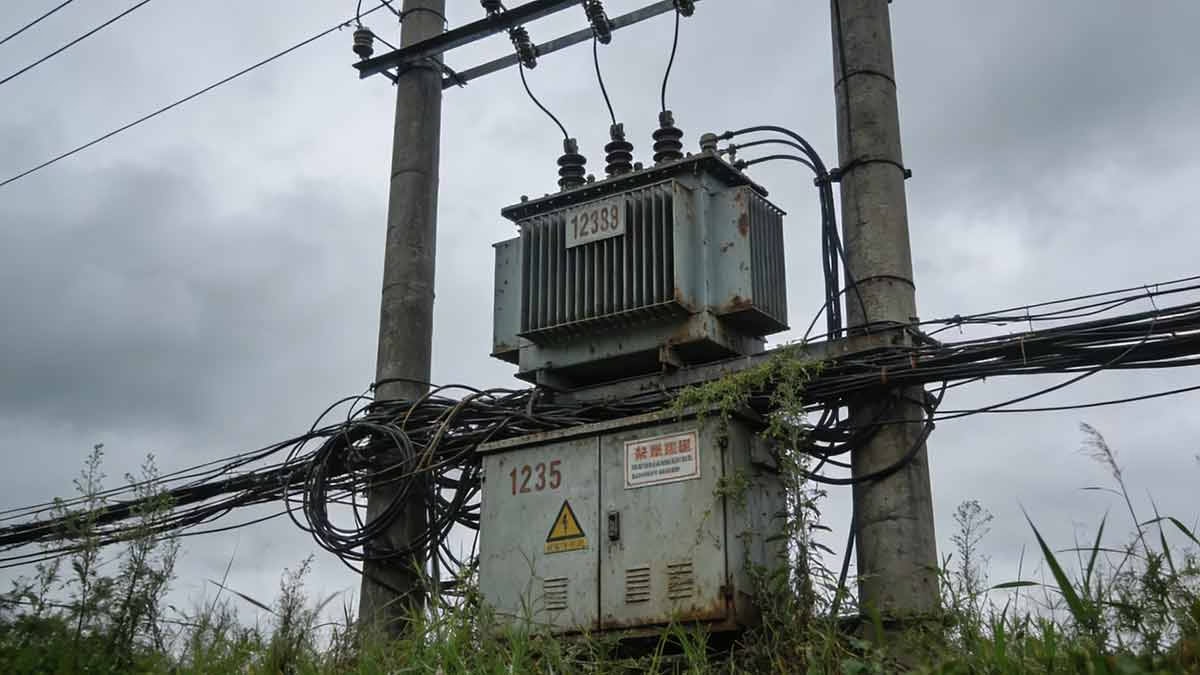
Transformer-Energy-Loss-(2)
Overloading Impact Comparison Across Industries
 
Industry
Short-Term Effects of Overloading
Long-Term Consequences for Transformer Energy Loss
Data Centers
Service interruptions, data loss, and equipment overheating
Permanent insulation damage, increased copper and stray loss, reduced transformer lifespan by 50% or more
Manufacturing
Production delays, quality control issues, and equipment downtime
Increased maintenance costs, higher energy loss due to damaged windings, and premature transformer failure
Renewable Energy
Grid instability, energy waste, reduced power output
Accelerated insulation aging, increased core and stray loss, and frequent maintenance requirements

Key Strategies to Prevent Overloading-Related Transformer Energy Loss

Preventing overloading and its associated energy loss requires a proactive approach that combines monitoring, planning, and proper maintenance. Here are the most effective strategies:
Accurate Load Forecasting: Use advanced analytics and historical load data to predict future power needs. Consider factors like business growth, new equipment additions, and seasonal variations in demand. This will help you size your transformer appropriately and avoid the need for overloading.
 
Real-Time Load Monitoring: Install monitoring systems that track transformer load, temperature, and voltage in real time. Set up alerts for when the load approaches 80-90% of rated capacity, giving you time to take corrective action before overloading occurs.
 
Cooling System Maintenance: Ensure your transformer’s cooling system is in optimal condition. A well-maintained cooling system can help dissipate the additional heat generated during short-term overloads, reducing the impact on energy loss and equipment lifespan.
 
Load Management Techniques: Implement peak shaving (reducing non-essential loads during peak demand) and load shifting (moving loads to off-peak hours) to distribute demand more evenly. This helps keep the transformer operating within its rated capacity.
 
Regular Maintenance and Testing: Conduct frequent insulation resistance tests, oil analysis, and load tests to detect early signs of damage caused by overloading. Addressing minor issues early can prevent major failures and reduce energy loss.

FAQ About Transformer Energy Loss

1. What is Transformer Energy Loss and Its Global Impact?

Transformer energy loss refers to the inevitable energy dissipation during the electromagnetic induction process of transformers, mainly manifested as heat generation. According to data from the International Energy Agency (IEA), global industrial transformer energy losses exceed 200 billion kWh annually, equivalent to the total annual electricity consumption of Germany. Notably, transformer losses account for approximately 5% of global electrical energy consumption, surpassing the total electricity demand of the entire African continent, making it a crucial focus for global energy conservation and emission reduction efforts.
 

2. What Are the Main Types of Transformer Energy Losses?

Transformer energy losses are primarily categorized into three core types: core losses (iron losses), copper losses (load losses), and stray losses. Core losses occur in the magnetic core due to alternating magnetic fields, consisting of hysteresis losses and eddy current losses. Copper losses result from the resistance of windings when current flows through them, which is proportional to the square of the load current. Stray losses are caused by leakage flux that fails to link both primary and secondary windings, occurring in structural components like tanks and bolts, though they are relatively small compared to the first two types.
 

3. What Constitutes Transformer Core Loss (Iron Loss) and Its Influencing Factors?

Core loss, also known as iron loss, is composed of hysteresis loss and eddy current loss, existing even when the transformer is under no-load conditions. Hysteresis loss arises from the lag of magnetic domains behind the magnetizing force during cyclic magnetization, related to core material, magnetic field frequency, and maximum flux density. Eddy current loss is caused by circulating currents induced in the core by alternating magnetic fields, with its magnitude proportional to the square of frequency, flux density, and core lamination thickness. Key influencing factors include core material properties, operating frequency, peak flux density, and manufacturing precision of laminations.
 

4. How Do Winding Materials Affect Transformer Copper Losses?

Winding material is a decisive factor in copper losses, as it directly determines the winding resistance. Under the same cross-sectional area, the resistance of aluminum windings is 1.68 times that of copper windings, leading to significantly higher copper losses in aluminum-wound transformers. In contrast, copper windings have lower resistivity and better thermal conductivity, which helps reduce energy dissipation. Additionally, advanced winding designs such as foil windings can reduce AC resistance by 15% compared to traditional round wires, while Litz wire (stranded conductor) can effectively suppress high-frequency eddy current losses in windings.
 

5. What Is the Relationship Between Transformer Load Rate and Energy Loss?

The load rate has a significant impact on transformer energy loss, especially copper losses, which vary with the square of the load current. There is an economic critical point for the load rate: when the load rate exceeds 75%, the growth rate of losses will surpass the increase in output benefits, resulting in a decline in marginal profits. Maintaining the load rate within the 50%-70% range is considered the efficient operation interval. Intelligent load management systems can dynamically balance three-phase currents, precisely controlling the load rate to minimize unnecessary energy losses.
 

6. How Does an Amorphous Alloy Core Reduce Transformer Energy Loss?

Amorphous alloy cores significantly reduce energy loss by virtue of their unique atomic structure (disordered arrangement) compared to traditional silicon steel cores. Their coercivity is only 1-5 A/m, much lower than 20-50 A/m of conventional silicon steel, reducing hysteresis loss by 80%. Meanwhile, the resistivity of amorphous alloys is 2.6 times that of silicon steel, and their lamination thickness is only 25-30 μm (vs. 300 μm for silicon steel), suppressing eddy current loss by 70%-90%. For 1000kVA transformers, amorphous alloy cores reduce no-load losses to 0.3-0.6 kW, 60%-75% lower than traditional silicon steel cores.
 

7. What Role Does Laser-Scribed Steel Play in Reducing Transformer Core Loss?

Laser-scribed steel is an upgraded solution for traditional silicon steel cores to reduce core loss. By creating micron-level grooves on the silicon steel surface, the technology refines magnetic domains from 5-10 mm to 0.1-0.3 mm, making magnetization reversal more uniform and reducing hysteresis loss by 25%-35%. This technology maintains a cost increase of only 8%-12% while achieving significant energy-saving effects, making it a cost-effective upgrade path for scenarios where silicon steel cores are still required.
 

8. How to Measure Transformer Core Loss Accurately?

Common accurate measurement methods for core loss include no-load tests, single-sheet tests, and magnetic performance analysis. The no-load test involves applying rated voltage to the primary winding with the secondary open; the measured input power primarily reflects core loss. The single-sheet test measures the core loss of small sample materials under controlled frequency and flux density in a laboratory environment. Magnetic performance analysis uses a B-H analyzer to visualize the hysteresis loop, enabling the separation and independent measurement of hysteresis loss and eddy current loss.
 

9. What Are the Latest Standards for Transformer Energy Efficiency Globally?

The IEC 60076-20 technical specification, released in 2017, is the first global reference document for transformer efficiency and related metrics, providing unified definitions for energy performance indicators that can be adopted by regional Minimum Energy Performance Standards (MEPS). Major economies have implemented mandatory MEPS for transformers, with variations in rating conditions: for example, the EU uses total losses at 100% load for transformers below 3150 kVA, while the US and Canada reference IEEE efficiency standards at 50% load. China enforces mandatory MEPS based on IEC losses at 100% load.
 

10. How Does Temperature Affect Transformer Energy Loss?

Temperature has a direct impact on transformer copper losses, as the resistivity of winding materials increases with temperature at a rate of 0.4% per °C. Higher temperatures lead to increased winding resistance, thereby amplifying copper losses. For core losses, temperature has a relatively minor influence but still affects the magnetic properties of core materials indirectly. Effective cooling measures, such as ONAF forced air cooling or liquid cooling, can stabilize winding temperatures below 55°C, reducing resistance-induced losses—for every 10°C decrease in temperature, resistance losses are reduced by approximately 4%.
 

11. What Are Transformer Stray Losses and How to Mitigate Them?

Stray losses are caused by leakage flux that does not couple with both windings, resulting in energy loss in structural components like transformer tanks, bolts, and clamping parts. Although relatively small, they cannot be ignored in high-efficiency transformer designs. Common mitigation measures include the use of magnetic shunts (flux collectors) to guide leakage flux away from high-loss areas, optimizing winding design to reduce leakage flux, and adopting non-magnetic materials for structural components to avoid eddy current generation in them.
 

12. How Can Intelligent Operation and Maintenance Reduce Transformer Energy Loss?

Intelligent operation and maintenance (O&M) reduces energy loss through two core strategies: load optimization and predictive maintenance. Intelligent load management systems (e.g., Schneider PowerLogic™) dynamically balance three-phase currents, keeping the load rate within the efficient 50%-70% range. Predictive maintenance relies on DGA oil chromatography analysis and fiber optic temperature sensing (accuracy ±1°C) to monitor insulation aging and hot spot anomalies, using the Arrhenius equation to predict remaining equipment life. This synergy reduces operational costs by 18%-25% and avoids energy waste from abnormal losses.
 

13. What Are the Energy Loss Characteristics of Dry-Type Transformers?

Dry-type transformers, especially those with amorphous alloy cores, exhibit distinct energy loss characteristics: their no-load losses are only about 30% of traditional silicon steel dry-type transformers and 75% lower than the limits specified in GB/T 10228. Due to their excellent energy efficiency and safety, they are widely used in scenarios such as data centers and computing infrastructure. Compared to oil-immersed transformers, dry-type transformers have slightly higher copper losses but eliminate the risk of oil leakage, and their energy loss performance is more stable in high-temperature environments.
 

14. How Does a Solid-State Transformer (SST) Address Energy Loss Challenges?

Solid-state transformers (SST) replace traditional iron cores and copper windings with power electronic devices and high-frequency technology, fundamentally optimizing energy loss. SST integrates voltage conversion, rectification, inversion, and reactive power compensation, improving power conversion efficiency to over 98%—significantly higher than the 95% efficiency of traditional transformers. Additionally, SST supports bidirectional energy flow and real-time voltage regulation, adapting to dynamic load changes in AI computing centers and renewable energy systems, thereby minimizing energy loss caused by load fluctuations.
 

15. What Is the Economic Benefit of Reducing Transformer Energy Loss?

Reducing transformer energy loss brings significant life-cycle economic benefits. Taking a 1000kVA transformer as an example, an amorphous alloy transformer has an initial investment 40%-60% higher than a silicon steel model, but with an average no-load loss reduction of 0.7kW. At an electricity price of 0.8 yuan/kWh and annual operation of 8760 hours, it saves 6132 kWh of electricity and 4905 yuan in electricity costs annually, with an investment payback period of only about 2 years. For industrial users, reducing transformer losses can cut 20%-30% of hidden electricity costs.
 

16. How Do Renewable Energy Integrations Affect Transformer Energy Loss?

The integration of renewable energy sources (such as wind and solar) introduces intermittent and fluctuating loads, which increase transformer energy loss. Fluctuating loads lead to frequent changes in the transformer’s operating state, deviating from the efficient load interval and increasing copper losses. Moreover, the harmonic components generated by renewable energy converters exacerbate eddy current losses in windings and cores. To address this, transformers with low-loss core materials and harmonic suppression capabilities are required, combined with intelligent control systems to balance load fluctuations.
 

17. What Is the Formula for Calculating Transformer Eddy Current Loss?

The formula for transformer eddy current loss is Pe = ke·f²·B²·t²·V, where Pe represents eddy current loss, ke is the eddy current loss coefficient, f is the alternating current frequency, B is the maximum flux density, t is the core lamination thickness, and V is the core volume. This formula indicates that reducing lamination thickness is an effective way to reduce eddy current loss—modern laser-scribed silicon steel and amorphous alloy laminations achieve significant loss reduction by minimizing t.
 

18. How to Balance Transformer Core Size and Energy Loss?

There is a trade-off between transformer core size and energy loss: a higher maximum flux density allows for a smaller core size but increases core loss. During the design phase, engineers need to optimize this balance based on application scenarios. For example, in urban power distribution systems where installation space is limited, high-flux-density silicon steel cores can be used with laser-scribed technology to reduce losses. In remote areas with low land costs, larger cores made of low-loss amorphous alloys can be adopted to achieve better energy efficiency.
 

19. What Are the Energy Loss Differences Between Distribution and Power Transformers?

Distribution transformers operate at lower voltages (usually below 35kV) and longer no-load hours, so core losses account for a larger proportion of total losses—hence, low no-load loss materials like amorphous alloys are prioritized. Power transformers operate at higher voltages (above 110kV) with higher load rates, making copper losses the main component of total losses. Their optimization focuses on winding design (e.g., using foil windings) and cooling system upgrades. Additionally, power transformers are subject to stricter stray loss control due to their larger capacity.
 

20. What Are the Future Technology Trends in Reducing Transformer Energy Loss?

The future of transformer energy loss reduction lies in the integration of advanced materials, digitalization, and intelligent control. Key trends include: the widespread application of high-performance amorphous alloys and nanocrystalline materials, the development of ultra-thin lamination technology to further suppress eddy current losses, the integration of digital twins for real-time loss monitoring and optimization, and the combination of SST with energy storage systems to balance load and minimize peak losses. Additionally, global unified energy efficiency standards will drive the upgrading of low-loss transformer technologies.