
When it comes to power transmission and industrial operations, high voltage transformers are the unsung heroes that ensure stable energy flow. However, for procurement managers, electrical engineers, and facility operators, navigating the world of high voltage transformers is often fraught with confusion: How to choose the right type for specific applications? What are the key compliance standards to follow? How to balance performance, cost, and safety? And what about the emerging trends like solid-state technology that are reshaping the industry?
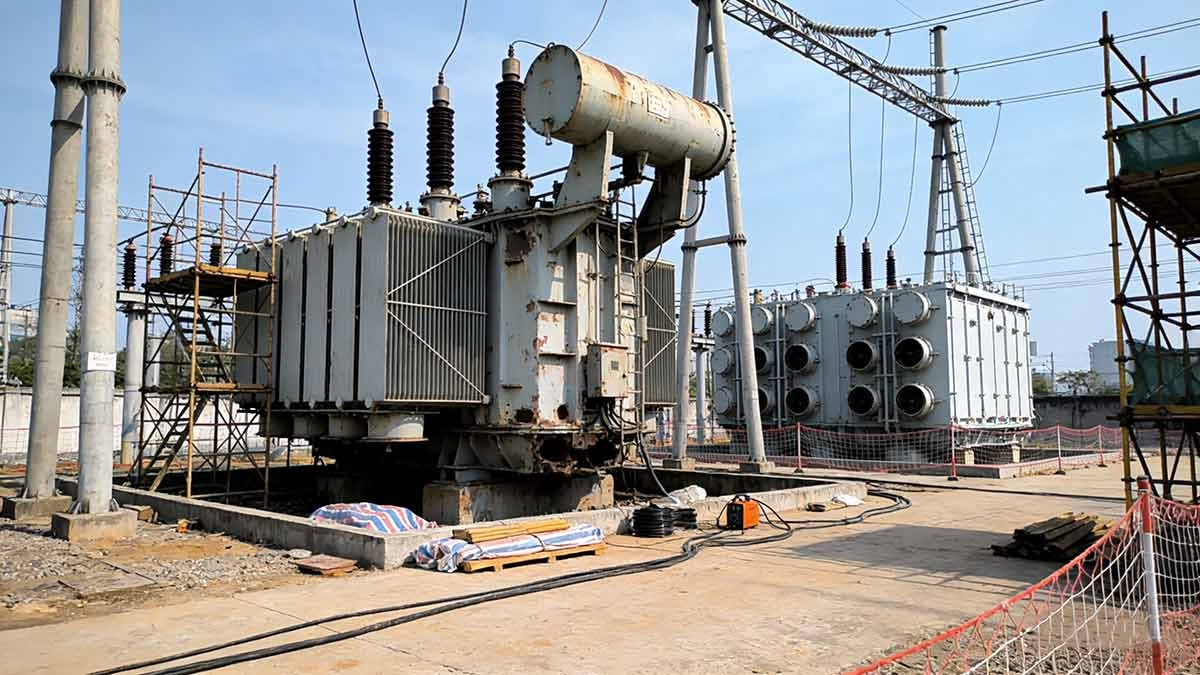
This guide is designed to address these core puzzles with authoritative answers, comparative analyses, and practical insights. We’ll break down complex concepts into actionable information, supported by data and industry standards, to help you make informed decisions about high voltage transformers. Whether you’re building a new power grid, upgrading industrial equipment, or exploring green energy solutions, this article covers everything you need to know about high voltage transformers.
Contents
hide
Understanding High Voltage Transformers: Core Principles and Industrial Significance
Before diving into the practical aspects, it’s essential to establish a clear understanding of what high voltage transformers are and why they are critical to modern electrical systems. At its core, a high voltage transformer is a device that transfers electrical energy between two or more circuits through electromagnetic induction, converting high voltage to lower voltage (or vice versa) while maintaining the frequency of the alternating current (AC). But what sets high voltage transformers apart from standard transformers? The key distinction lies in their voltage rating—typically, transformers handling 11kV and above are classified as high voltage transformers, though this threshold may vary slightly by industry and regional standards.
The industrial significance of high voltage transformers cannot be overstated. In power transmission networks, they step up the voltage generated at power plants (usually 10-35kV) to ultra-high levels (110kV, 220kV, 500kV, or higher) for efficient long-distance transmission. This step-up process reduces current, minimizing energy loss through heat dissipation in power lines—a critical factor in reducing operational costs and improving energy efficiency. At the distribution end, high voltage transformers step down the voltage to usable levels (e.g., 33kV for industrial facilities, 400V for commercial buildings), ensuring a safe and stable power supply for various applications.
Beyond traditional power grids, high voltage transformers are integral to a wide range of industries: heavy manufacturing (steel mills, petrochemical plants), renewable energy (wind farms, solar power plants), data centers, and even transportation (electric vehicle charging stations). In each of these sectors, their performance directly impacts operational reliability, energy efficiency, and safety. For example, in a steel mill, high voltage transformers must withstand harsh conditions such as thermal cycles and harmonic loads to power furnaces and motors continuously for decades. In wind farms, they convert the variable voltage generated by wind turbines to a stable high voltage for integration into the grid.
Key Types of High Voltage Transformers: Comparison and Selection Guidelines
One of the most common puzzles for buyers is selecting the right type of high voltage transformer for their specific needs. With various configurations, insulation materials, and cooling systems available, the choice can be overwhelming. Below is a detailed comparison of the most common types of high voltage transformers, along with selection guidelines to help you make the right decision.
Dry-Type vs. Oil-Immersed High Voltage Transformers
Dry-type and oil-immersed transformers are the two dominant types in industrial applications, differing primarily in their insulation and cooling mechanisms. The following table compares their key characteristics, advantages, disadvantages, and ideal use cases:
Comparison Dimension | Dry-Type High Voltage Transformers | Oil-Immersed High Voltage Transformers |
|---|---|---|
Insulation Medium | Epoxy resin casting, Nomex paper, or air insulation | Mineral insulating oil (e.g., 25# transformer oil) or natural ester oil |
Cooling Method | Air convection (AN) or forced air cooling (AF) | Natural oil circulation (ONAN), forced oil-air cooling (OFAF), or forced oil-water cooling (OFWF) |
Fire & Explosion Risk | Zero explosion risk; meets GB 1094.11-2007 F0-class flame retardant standard | Risk of oil leakage and fire (flammable B-class liquid); requires explosion-proof walls and accident oil pools |
Noise Level | Low (45-55dB at 1m distance) | High (60-70dB at 1m distance); may require sound insulation barriers |
Operational Cost | Annual maintenance cost accounts for 3%-5% of equipment price; no oil treatment needed | Annual maintenance cost accounts for 8%-12% of equipment price; oil filtration and replacement every 3 years |
Service Life | 25-30 years (requires regular dust cleaning) | 30-40 years (with proper oil management) |
Voltage Rating | Suitable for up to 35kV; limited for ultra-high voltage applications | Suitable for 11kV to 1000kV; ideal for ultra-high voltage transmission |
Initial Investment | 15%-20% higher than oil-immersed transformers of the same capacity | Lower initial cost; cost-effective for large-capacity, high-voltage applications |
Ideal Applications | Indoor facilities, densely populated areas (hospitals, schools), data centers, underground substations, and explosion-proof environments (chemical parks) | Outdoor substations, long-distance high-voltage transmission, large power plants (e.g., pumped storage stations), and harsh climate environments (-50℃ to +50℃) |
Selection Tip: For facilities with strict fire safety requirements or limited space, dry-type transformers are the preferred choice. For ultra-high voltage transmission or outdoor applications with large capacity demands, oil-immersed transformers offer better cost-effectiveness and performance. In “double carbon” goal scenarios, natural ester oil-immersed transformers (biodegradable) and low-loss dry-type transformers are gaining popularity for their environmental friendliness.

Traditional vs. Solid-State High Voltage Transformers
With the rise of AI computing power and 800V high-voltage DC power supply architectures in data centers, solid-state transformers (SST) have emerged as a cutting-edge alternative to traditional electromagnetic transformers. Here’s a detailed comparison of these two technologies:
Comparison Dimension | Traditional High Voltage Transformers | Solid-State High Voltage Transformers (SST) |
|---|---|---|
Working Principle | Electromagnetic induction relies on a silicon steel core and copper/aluminum windings | Power electronic conversion converts AC to DC, then to high-frequency AC, and back to the desired power via high-frequency transformers |
Efficiency | 92%-94% (copper loss and iron loss are unavoidable) | Over 98%; an additional 2%-3% efficiency gain by shortening power supply links, total energy saving over 10% |
Size & Weight | Large and heavy; a single large transformer can weigh tens of tons, requiring specialized transportation and installation equipment | 1/3 the size and weight of traditional transformers; saves up to 63% of floor space (e.g., 400㎡ to 150㎡ for data center switchgear rooms) |
Functionality | Single function: voltage transformation and electrical isolation; cannot adjust power quality | Multifunctional integration: voltage transformation, reactive power compensation, harmonic suppression, fault isolation, and bidirectional power flow support |
Intelligence | Basic monitoring; limited adaptive capacity to load changes | Full digital control; 0.1ms-level response speed; stable output voltage; adjustable power factor; compatible with PV and energy storage systems |
Reliability & Cost | Mature technology; high reliability; low maintenance cost | Still in the technical verification stage; high cost; limited long-term operation data; more power electronic components may increase failure risks |
Application Status | Widely used in all industrial sectors; a mature supply chain | Pilot applications in data centers, EV supercharging stations, and smart grids; expected to be large-scale commercialized around 2027-2030 |
High Voltage Transformers for Modern Applications: Data Centers, Renewable Energy, and Heavy Industry
The demand for high voltage transformers is evolving with the rapid development of emerging industries. Understanding the specific requirements of modern applications is key to selecting the right transformer. Below, we explore the tailored needs of three high-growth sectors: data centers, renewable energy, and heavy industry.
High Voltage Transformers for Data Centers: Adapting to 800V DC Power Supply Trends
With the surge in AI computing power demand, data centers are shifting from low-voltage to high-voltage DC power supply architectures. Nvidia’s white paper explicitly proposes an 800V DC power supply as the mainstream direction for next-generation data centers, supported by tech giants like Google, Meta, and Microsoft. This shift poses new requirements for high voltage transformers:
- High Efficiency: Data centers consume massive amounts of energy (over 2000 billion kWh annually in China), so transformers with efficiency above 98% are required to reduce energy loss. Solid-state transformers are considered the ultimate solution for megawatt-level server cabinets, while high-efficiency oil-immersed or dry-type transformers serve as transitional options.
- Compact Size: Data center floor space is valuable, so small and lightweight transformers (e.g., dry-type or solid-state) are preferred to maximize cabinet space.
- Reliability & Stability: Downtime in data centers can cause significant losses, so transformers must have high short-circuit withstand capacity and stable voltage regulation. IEEE standards require transformers to withstand 25kA/1s short-circuit current for data center applications.
- Compatibility with Renewable Energy: Data centers are increasingly adopting PV and energy storage systems, so transformers need to support bidirectional power flow and DC-AC conversion.
High Voltage Transformers for Renewable Energy: Wind and Solar Power Integration
Renewable energy sources (wind and solar) have variable output voltage and frequency, requiring high voltage transformers with specialized designs to integrate into the grid. For wind farms, transformers must be installed in wind turbine nacelles or centralized substations, with the following key requirements:
- Seismic & Corrosion Resistance: Offshore and onshore wind farms are exposed to harsh weather conditions (strong winds, salt spray), so transformers must meet IEC 60076-3 seismic standards (withstanding 0.5g horizontal acceleration) and have IP56-level protection.
- Low Loss: To improve the overall efficiency of wind farms, transformers with low no-load loss (iron loss) and load loss (copper loss) are required. Amorphous alloy core dry-type transformers can reduce no-load loss by 70% compared to traditional silicon steel core transformers.
- Variable Frequency Adaptability: Wind turbine output frequency varies with wind speed, so transformers must handle harmonic loads and transient disturbances effectively.
For solar power plants, high voltage transformers are used to step up the low voltage from solar panels to the grid-connected voltage. They require excellent temperature resistance (to withstand high temperatures in desert or rooftop environments) and compatibility with inverter systems.
High Voltage Transformers for Heavy Industry: Withstanding Harsh Operating Conditions
Heavy industries such as steel mills, petrochemical plants, and mining require high voltage transformers to power large-scale equipment (furnaces, motors, pumps). These transformers must withstand extreme operating conditions, including:
- High Thermal Cycles: Steel mill furnaces cause rapid temperature fluctuations, so transformers must use high-temperature insulation materials (e.g., H-class insulation, 180℃) to avoid insulation aging.
- Harmonic Loads: Variable frequency drives (VFDs) in industrial equipment generate harmonic currents, which can increase transformer losses and overheat windings. Transformers for heavy industry must be designed with harmonic filters or reinforced windings to withstand 3rd, 5th, and 7th harmonics.
- Long-Term Continuous Operation: Heavy industry facilities often operate 24/7, so transformers must have a service life of 30+ years with minimal maintenance. Oil-immersed transformers with natural ester oil and smart oil quality monitoring systems are commonly used in these applications.
Safety and Compliance Standards for High Voltage Transformers: IEC 60076, ANSI/IEEE, and CE Certification
Safety and compliance are top concerns for buyers of high voltage transformers, as non-compliant products can lead to accidents, downtime, and legal risks. Understanding international and regional standards is critical to ensuring that the transformers you select meet the required safety and performance criteria.
Key International Standards
Two primary international standards govern high voltage transformers: IEC 60076 (International Electrotechnical Commission) and ANSI/IEEE (American National Standards Institute/Institute of Electrical and Electronics Engineers). The following table summarizes their core requirements:
Standard | Core Parts | Key Requirements | Applicable Regions |
|---|---|---|---|
IEC 60076 | IEC 60076-1 (General Requirements), IEC 60076-2 (Temperature Rise Tests), IEC 60076-3 (Insulation Levels and Dielectric Tests) | Short-circuit withstand capacity: 25kA/1s; insulation resistance ≥1000MΩ; partial discharge ≤10pC at 1.1x rated voltage; lightning impulse test compliance | Europe, Asia, Africa, and most global markets |
ANSI/IEEE | IEEE C57.12.00 (Standard for Oil-Immersed Power Transformers), IEEE C57.12.70 (Standard for Dry-Type Power Transformers) | Higher short-circuit current withstand (up to 31.5kA/3s); stricter noise level limits; temperature rise limits for different insulation classes (e.g., 65℃ for A-class, 105℃ for F-class) | North America, South America, and some Middle Eastern markets |
CE Certification for High Voltage Transformers
For transformers sold in the European Union (EU), CE certification is mandatory, indicating compliance with the Low Voltage Directive (LVD) and Electromagnetic Compatibility (EMC) Directive. The certification process includes:
- Technical Documentation Preparation: Including design drawings, material specifications, test reports, and user manuals.
- Type Testing: Conducted by an accredited third-party laboratory, covering electrical performance (insulation, withstand voltage), mechanical performance (short-circuit, seismic), and EMC (electromagnetic interference, immunity).
- Factory Audit: Ensuring that production processes meet quality control requirements and can consistently produce compliant products.
- Declaration of Conformity (DoC): Issued by the manufacturer, confirming that the product meets all CE requirements.
Compliance Tip: When selecting a high voltage transformer manufacturer, verify that they can provide type test reports (e.g., from KEMA, CESI) and CE certification documents. For global projects, choose manufacturers with dual compliance to IEC and ANSI/IEEE standards to avoid rework and delays.
Common Operation Puzzles of High Voltage Transformers: Troubleshooting and Maintenance Tips
Even with the right transformer selection, operational issues can arise, causing downtime and performance degradation. Below are the most common puzzles faced by operators, along with authoritative troubleshooting and maintenance guidelines.
Puzzle 1: Transformer Overheating
Overheating is one of the most common issues, often indicated by high temperature readings, abnormal noise, or tripped thermal protection devices. The root causes and solutions are as follows:
- Core Saturation: Caused by excessive magnetic flux density (ΔB), input voltage surges, or insufficient air gaps. Symptoms include severe core heating, distorted excitation current, and reduced efficiency. Solution: Redesign the core with higher saturation flux density (Bsat) materials (e.g., PC95/PC200 ferrite), increase primary winding turns, or adjust air gap length for flyback transformers.
- High Copper Loss: Caused by skin effect, proximity effect, or undersized conductors. Symptoms include hot windings and increased energy loss. Solution: Use litz wire or flat copper strips to reduce AC resistance, optimize winding structure (e.g., sandwich winding), and ensure uniform winding tension.
- Inadequate Cooling: Caused by clogged cooling ducts, faulty fans/pumps, or high ambient temperatures. Solution: Clean cooling ducts regularly, replace faulty cooling components, and install forced cooling systems for high-load applications.
Puzzle 2: High Leakage Inductance
High leakage inductance leads to voltage spikes on switching devices, increased energy loss, and EMI issues. Common causes include poor winding coupling, excessive insulation thickness, or improper core selection. Solutions:
- Adopt Interleaved Winding: Use P-S-P (primary-secondary-primary) or S-P-S (secondary-primary-secondary) winding configurations to improve coupling between primary and secondary windings.
- Reduce Insulation Distance: Use thinner insulation tape (e.g., Kapton, Mylar) while meeting creepage and clearance requirements.
- Choose Low-Leakage Core Shapes: Select pot-type or RM cores instead of EE-type cores for lower leakage inductance.
Puzzle 3: Insulation Breakdown
Insulation breakdown is a serious safety hazard, often causing short circuits, fires, or explosions. It is typically caused by poor insulation materials, inadequate thickness, or mechanical damage. Solutions:
- Use High-Quality Insulation Materials: Select materials with high dielectric strength and temperature resistance (e.g., Nomex paper for dry-type transformers, natural ester oil for oil-immersed transformers).
- Optimize Winding Process: Add barrier tape at winding ends and lead roots, ensure smooth winding to avoid burrs, and use vacuum impregnation to eliminate air bubbles.
- Conduct Regular Insulation Tests: Perform hi-pot tests (1.5x rated voltage for 1 minute) and insulation resistance tests annually to detect early insulation degradation.
Preventive Maintenance Schedule
Regular maintenance is key to extending the service life of high voltage transformers and preventing unexpected failures. The following is a recommended maintenance schedule based on IEC 60076 and industry best practices:
Maintenance Interval | Dry-Type Transformers | Oil-Immersed Transformers |
|---|---|---|
Monthly | Check for dust accumulation, noise, and temperature; inspect cooling fans | Check oil level, oil color, and tank for leaks; inspect pressure release valve |
Quarterly | Clean cooling ducts; test insulation resistance; verify grounding | Test oil dielectric strength; inspect tap changer operation; clean radiator |
Annually | Comprehensive insulation test; check winding tightness; calibrate temperature sensors | Oil chromatography analysis; load loss test; inspect core and windings (if necessary) |
Every 5 Years | Partial discharge test; replace aging insulation materials | Oil filtration or replacement; short-circuit withstand test; seismic inspection |
Future Trends of High Voltage Transformers: Solid State Technology and Smart Integration
The high voltage transformer industry is undergoing a profound transformation driven by the dual trends of electrification and digitalization. Understanding these trends can help you make forward-looking decisions and gain a competitive edge.
Solid-State Transformers (SST): The Ultimate Solution for Next-Generation Power Systems
As mentioned earlier, SST is poised to revolutionize the industry with its high efficiency, compact size, and intelligent features. Key developments to watch include:
- Cost Reduction: With the mass production of silicon carbide (SiC) and gallium nitride (GaN) semiconductors, SST costs are expected to drop by 50% by 2030, making them competitive with traditional transformers.
- Reliability Improvement: Manufacturers are conducting long-term durability tests (10,000+ hours) to validate SST reliability, with early results showing failure rates comparable to traditional transformers.
- Grid Integration: SSTs will play a key role in smart grids, enabling seamless integration of distributed energy resources (DERs), electric vehicles, and microgrids. They can act as “energy routers” to optimize power flow and improve grid stability.
Smart Monitoring and Predictive Maintenance
Digitalization is transforming transformer maintenance from reactive to predictive. Advanced high voltage transformers are now equipped with:
- Fiber Optic Temperature Sensors: Provide real-time temperature monitoring with ±1℃ accuracy, detecting hotspots before they cause failures.
- IoT-Enabled Sensors: Monitor oil quality, partial discharge, vibration, and load current, transmitting data to cloud platforms for analysis.
- AI-Powered Predictive Analytics: Use machine learning algorithms to analyze historical data and predict potential failures (e.g., insulation degradation, winding faults) 3-6 months in advance, reducing unplanned downtime by 40%+.
Green and Sustainable Design
In line with global “double carbon” goals, high voltage transformers are becoming more environmentally friendly:
- Eco-Friendly Insulation Materials: Natural ester oil (derived from vegetable oils) replaces mineral oil, offering biodegradability and lower flammability. Dry-type transformers use recyclable epoxy resin and Nomex paper.
- Low-Loss Designs: Amorphous alloy cores and optimized windings reduce no-load loss by 70% and load loss by 15%, significantly cutting carbon emissions.
- Circular Economy: Manufacturers are developing take-back programs for old transformers, recycling copper, steel, and insulation materials to reduce waste.
FAQ About High Voltage Transformers
What is a high voltage transformer, and its classification?
A high voltage transformer is defined as an electrical device that converts high-voltage alternating current (AC) to low-voltage AC or vice versa, typically operating above 35 kV. According to IEEE standard C57.12.01-2015, it is classified into three main categories: distribution transformers (up to 69 kV), power transformers (69 kV to 230 kV), and extra-high-voltage (EHV) transformers (above 230 kV). Internationally, some classifications also define high voltage transformers as those with voltages ranging from 66 kV to 230 kV, while ultra-high-voltage transformers exceed 330 kV.How does a high voltage transformer work based on electromagnetic induction?
The working principle of a high voltage transformer is rooted in electromagnetic induction, specifically mutual inductance. When an alternating current passes through the primary coil, it generates an alternating magnetic field in the iron core. This magnetic field then induces an alternating electromotive force (voltage) in the secondary coil. The voltage ratio between the primary and secondary coils is determined by their turn ratio, following the formula U₁/U₂ = N₁/N₂ (U₁ = primary voltage, U₂ = secondary voltage, N₁ = primary turns, N₂ = secondary turns). Step-up transformers have more secondary turns to increase voltage for long-distance transmission, while step-down transformers have fewer secondary turns to reduce voltage for safe use.What are the main types of high voltage transformers and their applications?
Common types of high voltage transformers include step-up, step-down, isolation, HVDC, and FACTS transformers. Step-up transformers are used in power plants to elevate generator output voltage (3 kV-20 kV) to 35 kV-500 kV for long-distance transmission, minimizing power loss. Step-down transformers are installed in substations to reduce high transmission voltage to below 35 kV for industrial, commercial, and residential use. Isolation transformers provide galvanic isolation to protect sensitive equipment, while HVDC transformers support AC-DC conversion for high-voltage direct current transmission systems.What is hi-pot testing for high voltage transformers, and why is it necessary?
Hi-pot testing (high-potential testing) is a safety test that verifies the insulation integrity of high voltage transformers. It involves applying a voltage significantly higher than the normal operating voltage (typically twice the operating voltage plus 1000 V) to detect insulation voids, breaks, or winding enamel cracks. These defects are undetectable visually or through low-voltage testing and can lead to transformer failure. Hi-pot testing is performed during design and production phases to ensure compliance with UL/IEC standards, guaranteeing safe operation over the transformer’s lifetime and protecting against transient stresses from inrush or back EMF.What factors affect the energy efficiency of high voltage transformers?
The energy efficiency of high voltage transformers is primarily influenced by core loss (no-load loss) and copper loss (load loss). Core loss, caused by hysteresis and eddy currents in the silicon steel core, is present whenever the transformer is energized. Copper loss, resulting from winding resistance, is proportional to the square of the load current. Other factors include core material (high-grade silicon steel or amorphous alloy reduces core loss), winding material (copper is more efficient than aluminum), load factor (maintaining a load factor above 70% improves efficiency), and design optimization (step-lap core design, optimized magnetic distribution).What are the common causes of high voltage transformer failure?
Common causes of high voltage transformer failure include insulation degradation (due to aging, temperature, humidity, or electrical stress), core faults (such as multi-point grounding leading to circulation and overheating), winding faults (short circuits, open circuits, or poor connections), tap changer malfunctions (contact badness, excessive wear), cooling system failures (inadequate heat dissipation leading to overheating), and external factors (lightning strikes, voltage surges, or mechanical damage during transportation/installation).Why is core grounding critical for high voltage transformers?
The core of a high voltage transformer must be reliably grounded at exactly one point. If ungrounded, a floating potential may form, causing intermittent breakdown discharge to ground. However, multiple grounding points create circulating currents between the grounded locations, leading to core overheating, damage to silicon steel sheets, and reduced transformer performance. Single-point grounding eliminates floating potential while preventing circulating currents, ensuring safe and stable operation.What conditions are required for the parallel operation of high voltage transformers?
For safe parallel operation of high voltage transformers, three key conditions must be met: identical voltage ratios (to avoid circulating currents between transformers), matching percentage impedance (ensuring load sharing proportional to rated capacity), and the same connection group (consistent phase difference between primary and secondary voltages). Failure to meet these conditions can result in excessive circulating currents, overloading of individual transformers, or even short circuits, endangering the entire power system.How to handle cooling system faults in high voltage transformers?
When a cooling system fault occurs, immediate actions include reporting to the dispatcher and deactivating relevant protections if the working power supply for I/II stage cooling is lost. If power supply switching fails, manual switching should be performed promptly. For faults in individual cooling circuits, the faulty circuit should be isolated to prevent affecting the overall cooling efficiency. Regular maintenance of cooling systems (cleaning radiators, inspecting fans/pumps, and checking oil quality) is also essential to prevent faults.What do the rated values on a high voltage transformer nameplate mean?
The nameplate of a high voltage transformer includes key rated values: rated capacity (the guaranteed output capacity under rated conditions), rated voltage (the guaranteed no-load terminal voltage), rated current (line current calculated from rated capacity and voltage), no-load current (percentage of rated current consumed during no-load operation), short-circuit loss (active loss when one winding is short-circuited and the other carries rated current), no-load loss (active power loss during no-load operation), short-circuit voltage (percentage of rated voltage required to achieve rated current in a short-circuit test), and connection group (winding connection method and phase difference between line voltages).How much electricity does a high voltage transformer consume?
High voltage transformers do not “consume” electricity like household appliances but experience energy losses (core loss and copper loss). Their efficiency typically ranges from 95% to 99.7%. Core loss is constant when energized, while copper loss varies with load. Even at idle, transformers draw a small amount of current for core magnetization. The total energy loss depends on design, materials, load profile, and operating conditions. Selecting high-efficiency transformers and optimizing load distribution can minimize energy loss.What are the methods to improve the efficiency of high voltage transformers?
Methods to improve efficiency include selecting low-loss, high-efficiency transformers (such as S10, S11 series or amorphous alloy transformers to replace high-energy-consuming models like S7), matching transformer capacity to load requirements (avoiding underloading or overloading), maintaining a load factor above 70% (replacing with smaller capacity transformers if the load factor is below 30%), improving load power factor, and optimizing load configuration to reduce the number of operating transformers.What are the technical transformation measures for high-energy-consuming high voltage transformers?
High-energy-consuming distribution transformers (e.g., SJ, SJL, SL7, S7 series) have higher iron and copper losses compared to modern models. Technical transformation primarily involves replacing them with high-efficiency transformers (S10, S11 series or amorphous alloy transformers), which significantly reduce energy loss and improve energy conversion efficiency. Other measures include upgrading insulation materials, optimizing winding design, and installing intelligent monitoring systems to track operating conditions and prevent inefficient operation.What is the purpose of the impulse withstand test for high voltage transformers?
The impulse withstand test assesses the ability of high voltage transformers to withstand transient overvoltages (e.g., lightning strikes, switching surges). It involves applying standard impulse voltages (positive and negative polarity) to the transformer windings to verify insulation integrity under extreme voltage conditions. Passing the test ensures that the transformer can resist unexpected overvoltages in practical operation, preventing insulation breakdown and ensuring system reliability. The test is conducted in accordance with IEC 60076 and IEEE standards.How to select a suitable high voltage transformer manufacturer?
When selecting a high voltage transformer manufacturer, key factors include compliance with international standards (IEC, IEEE, UL), production capacity and technical strength (advanced design, precision manufacturing), product quality (reliable materials, strict quality control), after-sales service (24/7 technical support, maintenance services), and industry reputation (case studies, customer reviews). Leading manufacturers such as ABB, Siemens, Schneider, TBEA, and XD Group are recognized for their high-quality products and comprehensive services. Cost factors (purchase price, lifecycle energy loss, maintenance costs) should also be considered comprehensively.What are the considerations for neutral point grounding of parallel high voltage transformers?
Parallel-operated high voltage transformers should not have their neutral points grounded simultaneously. This is primarily to coordinate zero-sequence current and zero-sequence voltage protection. Partial neutral point grounding limits the level of ground fault current and improves the sensitivity of zero-sequence current protection. The selection of grounding transformers depends on system voltage level, fault current requirements, and protection configuration, ensuring stable operation of the power system during ground faults.Why is an impulse closing test required for newly installed or overhauled high voltage transformers?
Newly installed or overhauled high voltage transformers require an impulse closing test to verify that the insulation can withstand rated voltage and operational switching overvoltages. The test also evaluates the impact of inrush current on the transformer’s mechanical strength (e.g., winding stability) and the reliability of protective relays (ensuring they do not misoperate due to inrush current). Typically, the test involves 3-5 impulse closings under no-load conditions, with careful monitoring of transformer vibration, noise, and insulation performance.