
Choosing the optimal transformer type—step up or step down—is a cornerstone of building efficient, reliable power distribution networks. Step up transformers elevate voltage levels to minimize energy loss during long-haul transmission, while step down transformers reduce voltage to safe, usable levels for residential, commercial, and industrial end-users. Mastering their distinct functionalities, applications, and performance traits is the key to aligning transformer selection with your unique power system requirements.

In my two decades as a practicing electrical engineer, I’ve witnessed firsthand how transformer choices can make or break project outcomes—from small-scale industrial upgrades to large-grid transmission expansions. This guide distills field-tested insights to help you navigate the critical factors of transformer selection, whether you’re designing a new power infrastructure or retrofitting an existing one.
Contents
hide
Understanding the Basics of Step Up, Step Down, and Pad Mounted Transformers
Have you ever stopped to wonder how electricity travels hundreds of miles from power plants to your home without losing most of its energy? The answer lies in transformers—the unsung workhorses of the power grid.
Step up and step down transformers are foundational components of modern power systems, operating on the principle of electromagnetic induction but serving opposite, equally vital roles. Step up units boost voltage to enable cost-effective long-distance power transfer, while step down counterparts bring voltage back down to meet the safety and operational standards of end-use equipment. Pad mounted transformers, a compact, enclosed variant, bridge the gap between distribution lines and localized loads, often integrating step down capabilities for urban and suburban applications.
I still recall my first tour of a coal-fired power plant early in my career. The towering step up transformers at the plant’s output terminal—with their massive windings and robust cooling systems—left an indelible impression of how critical these units are to energy transmission.
Core Operating Principles
All transformers share three non-negotiable operational fundamentals:
- Electromagnetic Induction: When alternating current flows through the primary winding, it generates a fluctuating magnetic field in the transformer core. This field induces a voltage in the secondary winding, enabling power transfer without direct electrical contact between windings.
- Winding Turn Ratio: The ratio of turns in the primary to the secondary winding dictates whether a transformer steps voltage up or down. A higher number of secondary turns translates to higher output voltage, and vice versa.
- Near-Perfect Power Conservation: In ideal conditions, input power equals output power. Real-world transformers experience minor losses (core losses from magnetic hysteresis and copper losses from winding resistance), but cutting-edge models today achieve efficiency rates exceeding 99%.
Key Transformer Components
Every transformer, regardless of type, relies on four core components:
- Primary Winding: The input side that connects directly to the power source.
- Secondary Winding: The output side that delivers adjusted voltage to the load.
- Magnetic Core: Typically constructed from laminated silicon steel sheets to minimize eddy current losses and optimize magnetic flux transfer.
- Insulation System: Materials like mineral oil, epoxy resin, or cellulose paper that prevent electrical arcing between windings and protect the core from environmental damage.
Step Up vs. Step Down Transformer Comparison Table
| Aspect | Step Up Transformer | Step Down Transformer |
|---|---|---|
| Primary Winding Turns | Fewer | More |
| Secondary Winding Turns | More | Fewer |
| Voltage Impact | Increases output voltage | Decreases output voltage |
| Current Impact | Reduces output current | Increases output current |
| Primary Application | Power plant transmission, renewable energy integration | Substation distribution, end-user supply |
Key Differences Between Step Up, Step Down, and Pad Mounted Transformers
Why do power grids rely on multiple transformer types instead of a one-size-fits-all solution? The answer lies in their distinct design traits and specialized roles in the energy ecosystem—including the unique value of pad mounted transformers for localized power delivery.
The primary distinction between step up and step down transformers lies in their winding turn ratios and voltage adjustment capabilities. Step up units feature more secondary winding turns to amplify voltage, while step down units have fewer secondary turns to reduce voltage. Pad mounted transformers, by contrast, are defined by their enclosed, ground-level design; they are most commonly configured as step down units but can be customized for niche step up applications in remote industrial sites.
Early in my career, I led a project to upgrade a rural power grid that required both step up transformers (to boost wind turbine output to grid voltage) and pad mounted step down transformers (to deliver power to farmsteads and small businesses). Integrating these units into a cohesive system taught me the importance of matching transformer design to on-site operational needs.
Winding Configuration Breakdown
- Step Up Transformers:
- Primary (input) winding: Minimal turns
- Secondary (output) winding: Expanded turns count
- End Result: Voltage rises, current drops to cut transmission losses
- Step Down Transformers:
- Primary (input) winding: Maximal turns
- Secondary (output) winding: Reduced turns count
- End Result: Voltage drops to safe levels, current rises to meet load demands
- Pad Mounted Transformers:
- Winding configuration: Flexible (step down standard, step up custom)
- Unique Trait: Enclosed design protects internal components from weather, vandalism, and debris, ideal for urban/suburban installations
Voltage and Current Relationship Examples
- Step Up Transformers: A 12kV input from a hydroelectric generator might be stepped up to 220kV for cross-state transmission, cutting energy loss by over 70% compared to low-voltage transmission.
- Step Down Transformers: A 33kV substation input could be stepped down to 415V for powering factory machinery or to 240V for residential use.
- Pad Mounted Transformers: A 11kV distribution line input is typically stepped down to 240/120V for a cluster of suburban homes, with the enclosed design eliminating the need for overhead pole-mounted units.
Detailed Transformer Comparison Table
| Characteristic | Step Up Transformer | Step Down Transformer | Pad Mounted Transformer |
|---|---|---|---|
| Winding Turn Ratio | Secondary > Primary | Primary > Secondary | Flexible (customizable) |
| Voltage Change | Increase | Decrease | Typically decrease |
| Current Change | Decrease | Increase | Typically increase |
| Typical Input Voltage | 10–25 kV | 33–765 kV | 5–33 kV |
| Typical Output Voltage | 110–765 kV | 240V–33 kV | 120/240V–415V |
| Core Size | Larger | Smaller | Compact (enclosed) |
| Insulation Requirements | High (for high voltage stress) | Moderate | High (weather-resistant) |
| Cooling Needs | Intensive (oil-cooled standard) | Moderate (air/oil-cooled options) | Low (air-cooled standard) |
| Common Installation Locations | Power plants, wind farms | Substations, industrial facilities | Urban neighborhoods, commercial parking lots |
| Cost Point | Premium | Mid-range | Mid-range (low installation costs) |
Choosing the wrong transformer type can lead to cascading issues—from excessive energy waste and equipment overheating to safety hazards and costly unplanned outages. Always prioritize alignment between transformer capabilities and your power system’s specific voltage, current, and environmental requirements.
Application Areas of Step Up, Step Down, and Pad Mounted Transformers
Why do different segments of the power grid use different transformer types? The answer is simple: each transformer is engineered to solve a specific power delivery challenge, with pad mounted transformers filling a critical niche in localized distribution.
Step up transformers are the backbone of power generation and long-distance transmission, where boosting voltage is essential to minimizing energy loss over hundreds of miles. Step down transformers dominate distribution networks, reducing transmission-level voltage to levels that are safe for end-users. Pad mounted transformers shine in urban, suburban, and high-density areas, offering a compact, safe, and low-profile solution for delivering power directly to homes, businesses, and small industrial sites.
A few years ago, I managed a citywide power infrastructure upgrade project that required strategic placement of all three transformer types. Step up units at the city’s solar farm boosted panel output to grid voltage; step down units at downtown substations reduced transmission voltage to distribution levels; and pad mounted transformers delivered power to residential neighborhoods without the need for unsightly overhead poles.
Power Generation and Long-Distance Transmission (Step Up Focus)
Step up transformers are non-negotiable in this phase of the power grid, with two key applications:
- Traditional Power Plants: Boost generator output voltage (typically 15–25 kV) to ultra-high transmission voltages (132–765 kV). For example, an 800 MW natural gas power plant might use step up transformers to elevate voltage from 22 kV to 500 kV for cross-country transmission.
- Renewable Energy Integration: Amplify voltage from solar farms, wind turbines, or hydroelectric facilities to match grid standards. An offshore wind farm, for instance, might use step up transformers to boost 33 kV turbine output to 220 kV for subsea transmission to the mainland grid.
Power Distribution Networks (Step Down and Pad Mounted Focus)
This phase relies on step down and pad mounted transformers to deliver power to end-users, with three core tiers:
- Primary Substations: Step down ultra-high transmission voltages (400–765 kV) to regional distribution voltages (11–33 kV). A city’s main substation, for example, might reduce 400 kV transmission voltage to 22 kV for urban distribution.
- Secondary Substations: Further reduce regional distribution voltages to local distribution levels (5–11 kV). A suburban substation could cut 22 kV voltage to 10 kV for neighborhood-level power delivery.
- Localized End-User Delivery: Pad mounted transformers take over here, stepping down 5–11 kV voltage to 120/240V for residential use or 415V for small commercial use. Their enclosed design makes them ideal for installation in parking lots, sidewalks, or backyard utility areas.
Industrial Applications (Mixed Transformer Types)
Both step up and step down transformers play roles in industrial settings, with pad mounted units serving niche needs:
- Step Up Transformers: Power large industrial machinery (e.g., arc furnaces in steel production) that requires high voltage input, or boost on-site generator output to match factory distribution voltage.
- Step Down Transformers: Reduce incoming high-voltage power to levels suitable for conveyor systems, lighting, and HVAC equipment in manufacturing facilities.
- Pad Mounted Transformers: Deliver power to outdoor industrial facilities (e.g., construction yards, agricultural processing plants) where enclosed, weather-resistant units are critical for safety and reliability.
Application Comparison Table
| Application Scenario | Transformer Type | Typical Input Voltage | Typical Output Voltage | Key Selection Consideration |
|---|---|---|---|---|
| Power Plant Output | Step Up | 20 kV | 400 kV | Long-distance transmission efficiency |
| Offshore Wind Farm Integration | Step Up | 33 kV | 220 kV | Subsea environmental resistance |
| Urban Primary Substation | Step Down | 400 kV | 22 kV | Load capacity and voltage regulation |
| Suburban Neighborhood Delivery | Pad Mounted | 10 kV | 240/120 V | Compact design and safety |
| Steel Mill Arc Furnace | Step Up | 11 kV | 33 kV | High current handling capability |
| Office Building Power Supply | Pad Mounted | 11 kV | 480/277 V | Indoor/outdoor installation flexibility |
Performance Factors of Step Up, Step Down, and Pad Mounted Transformers: Efficiency and Power Handling
When it comes to transformers, efficiency isn’t just a technical specification—it’s a driver of long-term cost savings and system reliability. Power handling capability, meanwhile, determines how much load a transformer can support without overheating or failing.
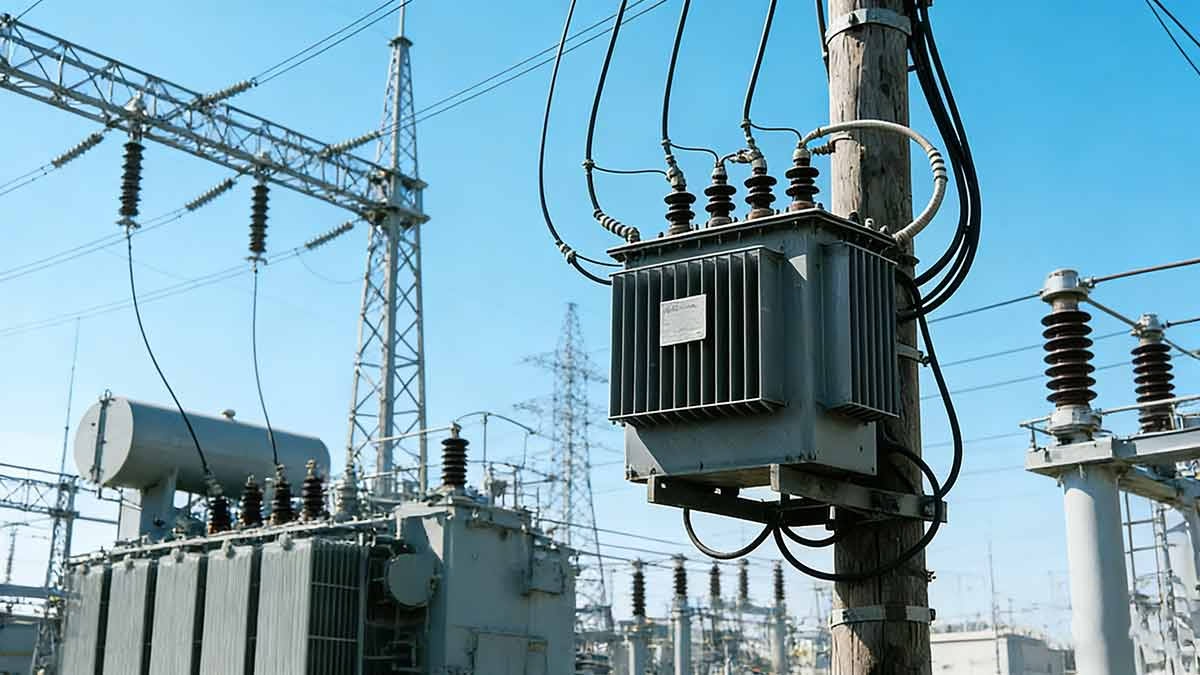
Modern transformers boast impressive efficiency rates, often exceeding 98% under full load conditions. Even marginal efficiency gains (e.g., from 98% to 99%) can translate to thousands of dollars in annual energy savings for high-load applications. Power handling capability, measured in kilovolt-amperes (kVA) or megavolt-amperes (MVA), defines the maximum load a transformer can sustain safely over its lifespan.
Early in my career, I consulted on a manufacturing plant project that upgraded from 97% efficient to 99% efficient step down transformers. The initial investment was 15% higher, but the plant saved over $120,000 in annual energy costs—achieving full ROI in just 18 months.
Key Efficiency Drivers
Transformer efficiency is determined by two primary loss types:
- Core Losses (No-Load Losses): These occur 24/7, even when the transformer is idle, and are caused by the alternating magnetic field in the core. Using high-grade core materials (e.g., grain-oriented silicon steel or amorphous metal) can reduce core losses by up to 70% compared to traditional steel cores.
- Copper Losses (Load Losses): These increase with transformer load and are caused by electrical resistance in the windings. Using larger cross-section copper conductors or optimizing winding design can minimize copper losses under high-load conditions.
Efficiency Calculation Formula
Transformer efficiency is calculated using this straightforward equation: Efficiency (%) = (Output Power / Input Power) × 100 = [Output Power / (Output Power + Core Losses + Copper Losses)] × 100
Global efficiency standards—such as the U.S. DOE transformer efficiency regulations and the IEC 60076 series—set minimum efficiency requirements for transformers, with premium-efficiency models qualifying for tax incentives in many regions.
Power Handling Capability Essentials
Three factors define a transformer’s power handling capacity:
- kVA/MVA Rating: This is the primary indicator of a transformer’s load capacity. A 1,000 kVA transformer can support 1,000 kW of load at a unity power factor (common in residential applications).
- Overload Capacity: Most transformers can handle short-term overloads (10–50% above rated capacity) for minutes or hours, but prolonged overloads cause overheating and shorten lifespan.
- Temperature Rise Rating: This measures how much the transformer’s temperature increases under full load. Standard ratings are 55°C, 80°C, and 115°C. Higher temperature rise ratings allow for more compact designs but may reduce insulation lifespan.
Performance Comparison Table
| Performance Factor | Step Up Transformer | Step Down Transformer | Pad Mounted Transformer |
|---|---|---|---|
| Typical Full-Load Efficiency | 98.5–99.5% | 97–99% | 97.5–99% |
| Core Loss Profile | Higher (due to high flux densities) | Lower (lower voltage stress) | Moderate (optimized for low-load efficiency) |
| Copper Loss Profile | Significant (high primary current) | Moderate (balanced load profiles) | Low (smaller winding size) |
| Cooling System Requirement | Oil-cooled (standard) | Air/oil-cooled (options) | Air-cooled (standard) |
| Overload Tolerance | Limited (high voltage stress risk) | Moderate to High | Moderate (enclosed design limits heat dissipation) |
| Size-to-Power Ratio | Larger (bulkier core/windings) | Smaller | Compact (space-efficient enclosed design) |
When evaluating transformer performance, don’t focus solely on efficiency ratings. Consider the transformer’s load profile—if it will operate at partial load most of the time, prioritize low core losses (critical for idle efficiency). For continuous full-load operation, minimize copper losses instead.
Design Considerations for Step Up, Step Down, and Pad Mounted Transformers: Core Components and Construction
Transformer design is a delicate balancing act between efficiency, cost, durability, and application suitability. The selection of core materials, winding configurations, and insulation systems directly impacts a transformer’s performance, lifespan, and maintenance needs—especially for pad mounted units, which face unique environmental challenges.
Advanced transformer designs can deliver superior efficiency and reliability, but they often come with higher upfront costs. For pad mounted transformers, design choices must also prioritize weather resistance, vandalism protection, and space efficiency to meet urban installation requirements.
A few years back, I consulted on a project that switched from traditional silicon steel cores to amorphous metal cores in pad mounted transformers for a coastal city. The upgrade reduced core losses by 65% and improved corrosion resistance—critical for withstanding salt air exposure—offsetting the higher material cost within three years of operation.
Core Design: The Foundation of Transformer Performance
The transformer core is responsible for transferring magnetic flux between windings, and material selection is a make-or-break design decision:
- Grain-Oriented Silicon Steel: The industry standard, offering a balance of cost, efficiency, and durability. Ideal for most step up and step down transformer applications.
- Amorphous Metal: A premium option with significantly lower core losses (up to 70% less than silicon steel). Ideal for pad mounted transformers and other units that operate at partial load for extended periods.
- Nanocrystalline Materials: An emerging technology with ultra-low core losses, suitable for high-efficiency step up transformers in renewable energy applications.
Core lamination thickness also plays a role: thinner laminations (0.23–0.30 mm) reduce eddy current losses, while thicker laminations cut manufacturing costs but increase losses.
Winding Design: Tailored to Voltage and Current Needs
Winding design varies dramatically between transformer types, with material and configuration choices aligned to operational demands:
- Conductor Material: Copper offers superior conductivity and durability but comes at a higher cost; aluminum is lighter and cheaper, making it a popular choice for pad mounted transformers and low-to-moderate load step down units.
- Winding Configurations:
- Disc Windings: Ideal for high-voltage step up transformers, with layered disc structures that minimize electrical stress.
- Helical Windings: Suited for high-current step down transformers, offering excellent heat dissipation.
- Layer Windings: A compact, cost-effective option for pad mounted transformers, optimized for low-to-moderate voltage applications.
Insulation and Cooling Systems: Critical for Longevity
Insulation and cooling prevent overheating and electrical arcing, with design choices tailored to transformer type:
- Insulation Materials:
- Oil-Paper Insulation: Standard for step up transformers and large step down units, offering excellent dielectric strength and heat dissipation.
- Epoxy Resin: Used in dry-type step down and pad mounted transformers, ideal for indoor or environmentally sensitive installations (e.g., near water sources).
- Cooling Systems:
- Oil-Immersed Cooling: ONAN (Oil Natural Air Natural) for small units, ONAF (Oil Natural Air Forced) for mid-size units, and OFAF (Oil Forced Air Forced) for large step up transformers.
- Air Cooling: Standard for pad mounted and small dry-type step down transformers, relying on natural convection or forced fans for heat dissipation.
Design Comparison Table
| Design Aspect | Step Up Transformer | Step Down Transformer | Pad Mounted Transformer |
|---|---|---|---|
| Core Material | Grain-oriented silicon steel (standard) | Grain-oriented silicon steel (standard) | Amorphous metal (premium), silicon steel (standard) |
| Winding Conductor | Copper (standard) | Copper/aluminum (options) | Aluminum (standard), copper (premium) |
| Insulation Type | Oil-paper (standard) | Oil-paper/dry-type (options) | Epoxy resin/dry-type (standard) |
| Cooling System | Oil-immersed (standard) | Oil-immersed/air-cooled (options) | Air-cooled (standard) |
| Tap Changer Inclusion | Rare (fixed voltage output) | Common (voltage regulation) | Optional (for voltage stability in variable load areas) |
| Surge Protection | Critical (high voltage exposure) | Important | Essential (outdoor installation exposure) |
When designing or selecting a transformer, always account for future load growth. Oversizing a transformer by 10–20% to accommodate future expansion is often more cost-effective than replacing an undersized unit prematurely.
Safety Features of Step Up, Step Down, and Pad Mounted Transformers: Protecting Equipment and Personnel
Safety is the non-negotiable priority in transformer design and operation. Modern transformers—including step up, step down, and pad mounted units—incorporate a suite of protective features to prevent catastrophic failures, minimize fire risks, and shield personnel from electrical hazards.
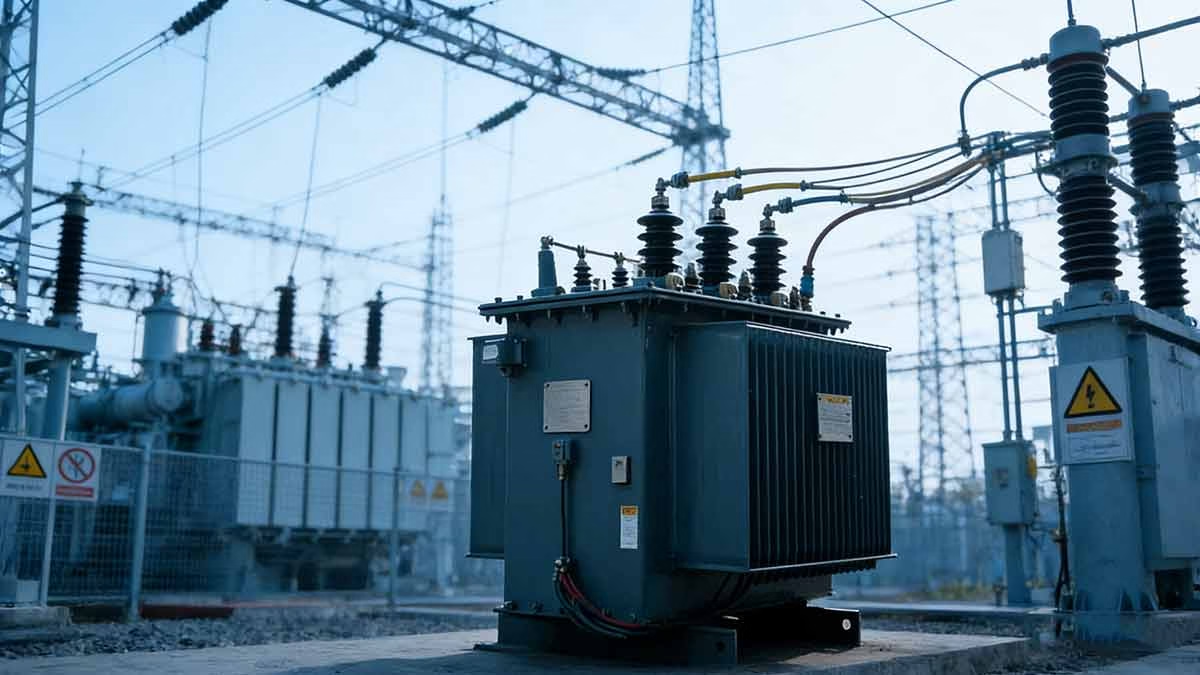
The safety systems in transformers are engineered to detect and mitigate issues before they escalate—from minor overheating to major internal faults. For pad mounted transformers, safety features also address the unique risks of outdoor, public-access installations.
Early in my career, I investigated a transformer failure at a suburban substation where a faulty Buchholz relay led to a small oil leak escalating into a fire. This incident underscored how even a single malfunctioning safety component can have severe consequences—reinforcing the importance of regular safety system maintenance.
Overcurrent Protection: Preventing Winding Damage
Overcurrent (caused by short circuits or overloads) is one of the most common transformer hazards, with three key protective measures:
- Fuses: A cost-effective solution for small step down and pad mounted transformers, providing fast, reliable overcurrent protection by melting and breaking the circuit during faults.
- Circuit Breakers: Used in large step up and step down transformers, these can be remotely operated to isolate faulty units without manual intervention, minimizing downtime.
- Differential Relays: The gold standard for high-value step up transformers, these compare current entering and exiting the unit; any discrepancy triggers an immediate shutdown to prevent internal damage.
Temperature Monitoring: Avoiding Insulation Degradation
Excessive temperature is a silent killer of transformer insulation, with three monitoring solutions tailored to transformer type:
- Oil Temperature Indicators: Standard in oil-immersed step up and step down transformers, these trigger alarms or cooling system activation when oil temperature exceeds safe thresholds.
- Winding Temperature Indicators: Calculate winding temperature using oil temperature and load current data, critical for preventing insulation breakdown in high-load units.
- Fiber Optic Sensors: A premium option for pad mounted transformers in critical applications, providing real-time, direct winding temperature measurements to detect hot spots early.
Pressure and Gas Monitoring: Early Fault Detection
For oil-immersed transformers, pressure and gas buildup are key indicators of internal faults:
- Pressure Relief Valves: Release excess pressure during rapid gas buildup (caused by short circuits or overheating), preventing tank rupture and fire risks.
- Buchholz Relays: Detect gas accumulation or oil flow irregularities in oil-immersed units, triggering alarms for minor faults and shutdowns for major issues.
Pad Mounted Transformer-Specific Safety Features
Pad mounted units require additional safety measures to address outdoor, public-access risks:
- Lockable Enclosures: Prevent unauthorized access to internal components, reducing electrical shock hazards.
- Corrosion-Resistant Housing: Protects against weather damage, extending lifespan and preventing insulation exposure.
- Low-Profile Design: Minimizes tripping hazards and visual impact in residential and commercial areas.
Safety Feature Comparison Table
| Safety Feature | Step Up Transformer | Step Down Transformer | Pad Mounted Transformer |
|---|---|---|---|
| Insulation Level | High-voltage class | Medium-voltage class | Weather-resistant medium-voltage class |
| Surge Arresters | Mandatory (lightning/transient protection) | Recommended | Mandatory (outdoor exposure) |
| Buchholz Relay | Standard | Optional (large units) | Rare (dry-type standard) |
| Fire Suppression | Advanced (oil containment systems) | Basic to advanced | Basic (enclosed design limits fire spread) |
| Physical Barriers | Extensive (fencing, warning signs) | Moderate | Lockable enclosures (standard) |
Regular safety audits and maintenance are non-negotiable. Proactive testing of protective relays, temperature sensors, and pressure valves can prevent minor issues from escalating into costly, dangerous failures.
Cost Analysis of Step Up, Step Down, and Pad Mounted Transformers: Initial Investment vs. Long-Term Operation
When evaluating transformer costs, the upfront purchase price is just the beginning. The total cost of ownership (TCO) includes installation, energy losses, maintenance, and downtime costs—factors that often outweigh the initial investment over a transformer’s 20–40 year lifespan.
Premium-efficiency transformers typically carry higher upfront price tags, but they deliver significant long-term savings through reduced energy losses. For pad mounted transformers, lower installation costs (no overhead poles or wiring) often offset higher material costs compared to pole-mounted alternatives.
I once advised a municipal utility to invest in premium-efficiency pad mounted transformers despite a 20% higher upfront cost. Over the transformers’ 30-year lifespan, the utility saved over $3 million in energy and maintenance costs—proving that TCO is the true measure of transformer value.
Initial Cost Breakdown
Initial costs include three key components that vary widely by transformer type:
- Purchase Price: Driven by size, efficiency, and design complexity. Step up transformers are the most expensive (due to high-voltage components), followed by pad mounted units, then standard step down transformers.
- Installation Costs: Step up transformers require specialized site preparation (e.g., heavy lifting equipment, cooling system installation) and skilled labor, driving up costs. Pad mounted transformers have low installation costs (ground-level placement, minimal wiring).
- Auxiliary Equipment: Step up transformers need advanced cooling systems and surge protection; pad mounted units require lockable enclosures and corrosion-resistant housing; step down transformers need basic auxiliary gear.
Long-Term Operational Costs
Operational costs are the biggest driver of TCO, with two primary components:
- Energy Losses: Core losses (24/7) and copper losses (load-dependent) add up over time. A 1% efficiency improvement in a 1,000 kVA transformer can save over $5,000 annually in energy costs (based on average industrial electricity rates).
- Maintenance Costs: Step up transformers require regular oil testing, cooling system maintenance, and relay calibration—driving higher costs. Pad mounted transformers have low maintenance needs (due to enclosed design), with routine visual inspections and cleaning as the primary tasks.
Downtime and Replacement Costs
Unplanned downtime can be catastrophic for critical applications:
- Step Up Transformers: Downtime costs are highest, as failures disrupt power plant output or renewable energy integration.
- Pad Mounted Transformers: Downtime costs are lowest, with easy replacement and minimal impact on surrounding loads.
Cost Comparison Table
| Cost Factor | Step Up Transformer | Step Down Transformer | Pad Mounted Transformer |
|---|---|---|---|
| Initial Purchase Price | High ($/kVA) | Medium ($/kVA) | Medium to high ($/kVA) |
| Installation Cost | High (specialized labor/equipment) | Medium | Low (ground-level placement) |
| Annual Energy Loss Cost | High | Medium | Low (optimized for partial load efficiency) |
| Annual Maintenance Cost | High (oil testing, cooling system upkeep) | Medium | Low (visual inspections, cleaning) |
| Typical Lifespan | 25–40 years | 20–35 years | 20–30 years |
| Downtime Cost Impact | Severe (grid-wide disruptions) | Moderate (localized disruptions) | Minor (individual load disruptions) |
To calculate TCO accurately, use this framework: TCO = Initial Cost + (Annual Energy Cost × Lifespan) + (Annual Maintenance Cost × Lifespan) + Downtime Cost Risk. This holistic approach ensures you select the most cost-effective transformer for your specific needs.
Maintenance Requirements for Step Up, Step Down, and Pad Mounted Transformers: Ensuring Longevity and Reliability
Proper maintenance is the secret to extending transformer lifespan, maximizing efficiency, and minimizing unplanned downtime. A well-designed maintenance program is tailored to transformer type, with step up units requiring the most intensive care and pad mounted units needing the least.
Proactive maintenance—rather than reactive repairs—can extend transformer lifespan by 10–15 years and reduce annual operational costs by up to 20%. For pad mounted transformers, maintenance focuses on protecting the enclosed system from environmental damage.
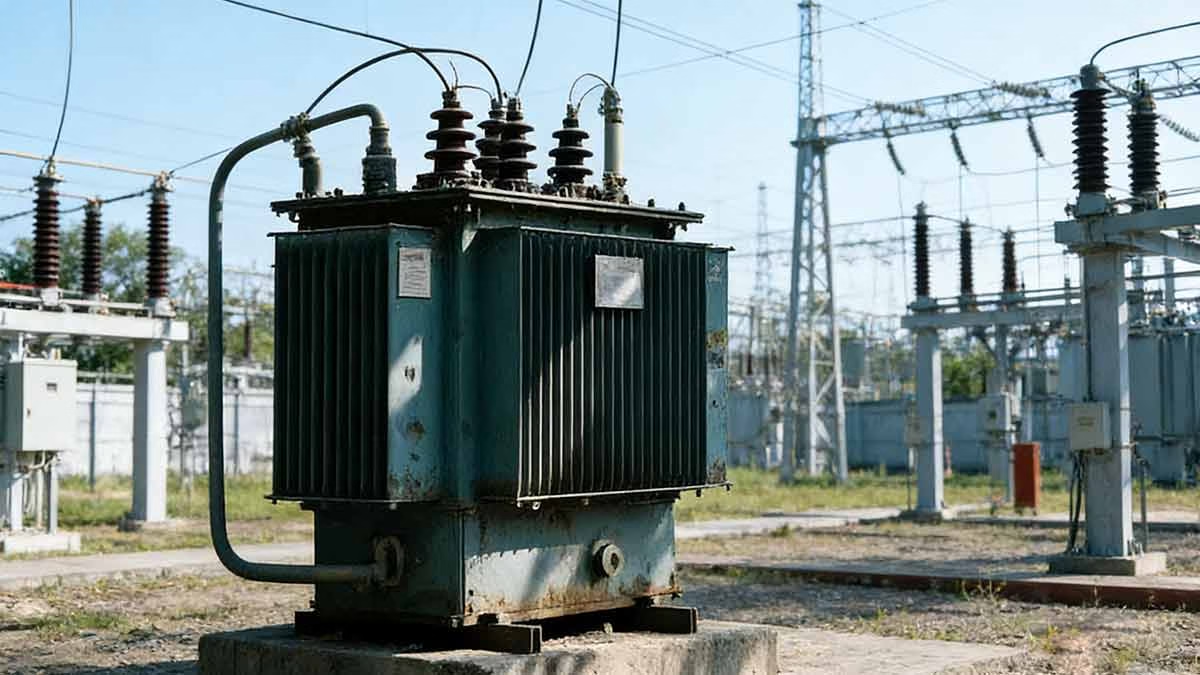
I once worked with a rural utility that implemented a proactive maintenance program for its step up and pad mounted transformers. Over five years, the utility reduced transformer-related outages by 45% and extended average transformer lifespan by 12 years—delivering significant cost savings.
Routine Inspection Protocols
Inspection frequency and scope vary by transformer type, with three core tasks:
- Visual Inspections:
- Step Up Transformers: Weekly checks for oil leaks, bushing damage, and cooling system malfunctions; monthly checks of pressure and temperature gauges.
- Step Down Transformers: Monthly visual checks for leaks, rust, and gauge abnormalities.
- Pad Mounted Transformers: Quarterly visual checks for enclosure damage, lock functionality, and vegetation encroachment (critical for preventing overheating).
- Thermal Imaging: Annual or semi-annual scans to detect hot spots in windings or connections—especially critical for step up transformers under high voltage stress.
- Acoustic Emission Testing: For large step up and step down transformers, annual testing to detect partial discharges or internal faults that are invisible to visual inspections.
Oil and Insulation Maintenance
For oil-immersed transformers, oil quality directly impacts lifespan:
- Dissolved Gas Analysis (DGA): Annual testing for step up transformers, biennial testing for large step down units, to detect gases produced by internal faults.
- Oil Quality Testing: Checks for moisture, acidity, and dielectric strength—critical for preventing insulation breakdown.
- Oil Filtering/Replacement: Performed when oil quality degrades, extending transformer lifespan by 5–10 years.
Pad mounted transformers (typically dry-type) require minimal insulation maintenance—only periodic checks for insulation damage caused by physical impact or corrosion.
Electrical Testing Protocols
Electrical testing verifies transformer performance and detects hidden issues:
- Insulation Resistance Tests: Annual testing for all transformer types to measure resistance between windings and ground, detecting insulation degradation.
- Power Factor Tests: Assess insulation condition in step up and large step down transformers, performed annually.
- Turns Ratio Tests: Verify winding turn ratios in step up transformers every 2–3 years to detect shorted turns or winding damage.
Maintenance Comparison Table
| Maintenance Task | Step Up Transformer | Step Down Transformer | Pad Mounted Transformer |
|---|---|---|---|
| Inspection Frequency | Weekly/Monthly | Monthly/Quarterly | Quarterly/Annually |
| Oil Testing | Annual DGA, oil quality tests | Biennial (large units) | None (dry-type standard) |
| Electrical Testing | Extensive (annual) | Moderate (annual) | Basic (biennial) |
| Cooling System Maintenance | Intensive (monthly) | Moderate (quarterly) | None (air-cooled standard) |
| Cost of Maintenance | High | Medium | Low |
For critical applications (e.g., power plant step up transformers), consider investing in online monitoring systems that provide real-time data on voltage, current, temperature, and pressure. These systems can detect faults days or weeks before traditional inspections, enabling proactive repairs and minimizing downtime.
Conclusion
Selecting between step up and step down transformers requires a holistic evaluation of application requirements, performance metrics, design features, safety protocols, cost factors, and maintenance needs. Each transformer type plays a specialized role in the power grid, with pad mounted transformers filling a critical niche in localized, high-accessibility distribution scenarios.
By prioritizing total cost of ownership over upfront price, aligning design choices with operational conditions, and implementing proactive maintenance programs, you can build a power distribution system that is efficient, reliable, and cost-effective for decades to come. Whether you’re integrating renewable energy sources, upgrading an industrial facility, or expanding a residential power grid, the right transformer selection is the foundation of success.