
Pad mounted transformers span a versatile capacity spectrum—15 kVA to 5000 kVA and beyond—tailoring power delivery to residential neighborhoods, commercial hubs, and heavy-industrial facilities alike. Choosing the right size isn’t just a technical checkbox; it’s the foundation of energy efficiency, cost control, and long-term system reliability. This guide demystifies transformer sizing, blending industry expertise with actionable strategies to optimize your power infrastructure.
Contents
hide
Pad Mounted Transformer Size Ranges: Aligning with Residential, Commercial, and Industrial Needs
Why do pad mounted transformers vary from compact, fridge-sized units to large enclosures comparable to vehicles? The answer lies in targeted power delivery—each size is engineered to match specific load demands, voltage requirements, and application contexts.
Residential applications rely on 15–150 kVA transformers, designed to serve single-family homes, duplexes, or small apartment complexes (up to 12 units). These units typically operate at 120/240V secondary voltage, balancing enough capacity for household appliances, smart home systems, and emerging EV charging needs without excess energy waste.
Commercial spaces—from office buildings and shopping malls to schools and healthcare clinics—demand 150–2500 kVA transformers. Operating at 120/208V or 277/480V secondary, these units handle diverse loads: HVAC systems, lighting, retail equipment, and medical devices, all while maintaining consistent voltage during peak business hours.
Industrial facilities—factories, data centers, and manufacturing plants—require robust 500–5000 kVA+ transformers. With primary voltages ranging from 4160V to 13800V and customizable secondary outputs, they power heavy machinery, high-density server racks, and continuous-production lines, often accounting for inrush currents and variable load profiles.
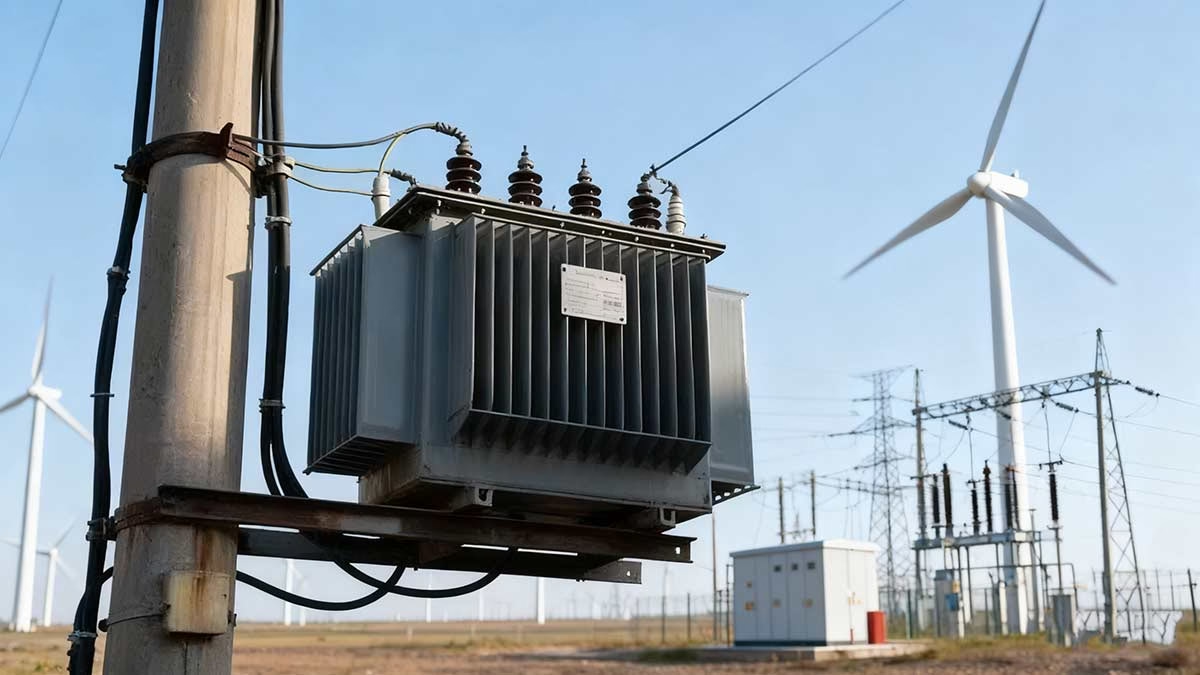
Specialized use cases—renewable energy integration (solar/wind farms), public transit systems, and emergency backup networks—feature custom-sized transformers. These units prioritize unique requirements: vibration resistance for light rail applications, bidirectional power flow for solar grids, or rapid load response for critical infrastructure.
| Application | Capacity Range (kVA) | Typical Secondary Voltage | Core Use Cases |
|---|---|---|---|
| Residential | 15–150 | 120/240V | Single-family homes, small apartments, townhouse clusters |
| Commercial | 150–2500 | 120/208V or 277/480V | Offices, malls, schools, and healthcare clinics |
| Industrial | 500–5000+ | Customizable | Factories, data centers, and manufacturing plants |
| Specialized | Custom | Application-Specific | Renewable energy grids, transit systems, and emergency backup |
In two decades of engineering pad mounted transformer solutions, I’ve witnessed how size aligns with real-world needs. For a suburban townhouse development, we deployed 80 kVA units—each serving 10 residences—to accommodate standard household loads plus future EV charging. The units operated at 65% capacity under normal conditions, striking a balance between cost and scalability.
At the industrial end, an automotive manufacturing plant required a 3200 kVA transformer to power robotic assembly lines and welding equipment. The unit’s robust design handled 30% short-term overloads during production surges, a critical feature for avoiding downtime. A notable trend: mid-range 300–750 kVA transformers are gaining traction in mixed-use developments (residential + retail + light industrial), as they adapt to fluctuating load profiles and support phased expansion.
Selecting the Right Pad Mounted Transformer Size: Matching Capacity to Load Dynamics
Choosing between a cost-effective smaller transformer and a future-ready larger unit is a decision that impacts your system for decades. The optimal size hinges on three core pillars: understanding current load demands, projecting future growth, and prioritizing efficiency across operating conditions.
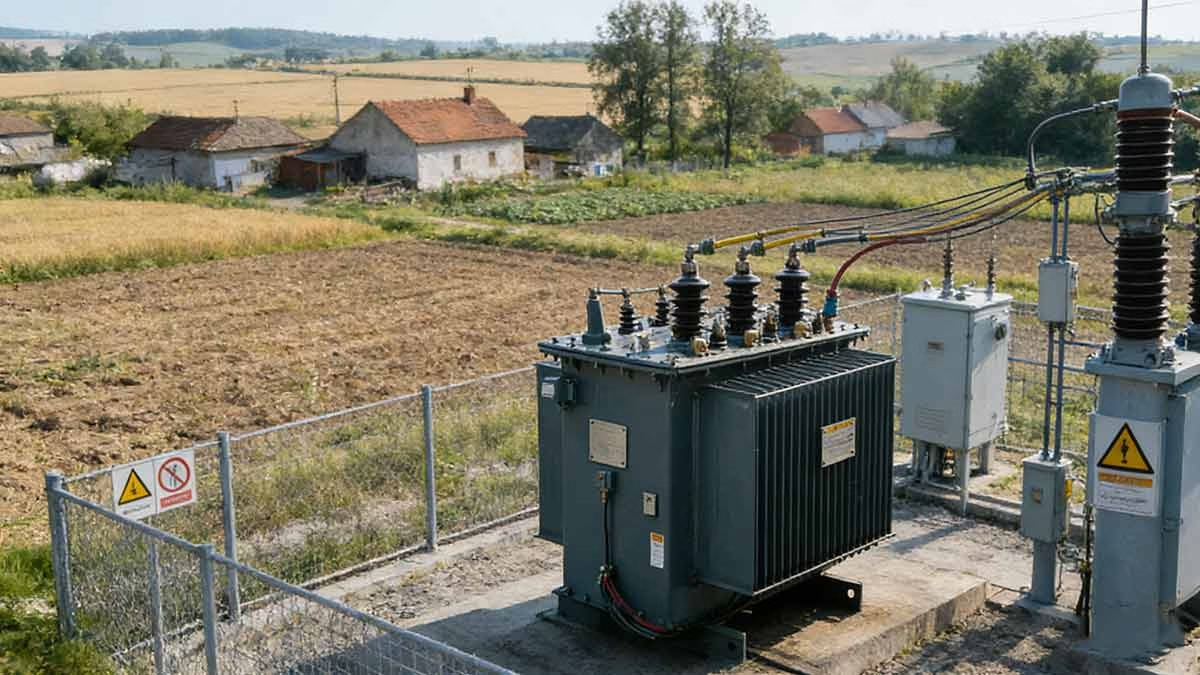
A well-sized transformer typically operates at 50–70% of its rated capacity during normal use. This buffer accommodates seasonal peaks (e.g., HVAC surges in summer) and short-term overloads, while maintaining peak efficiency—transformers lose the least energy when operating within this “sweet spot.”
Key steps in the sizing process include:
- Peak Load Analysis: Calculate maximum expected demand by mapping usage patterns (e.g., 9 AM–5 PM for offices, 7–10 PM for residential areas) and accounting for high-draw equipment (e.g., industrial motors, EV chargers).
- Load Growth Projection: Factor in 15–25% additional capacity for future expansion—new building wings, increased staff, or adoption of energy-intensive technologies.
- Efficiency Benchmarking: Compare efficiency curves across sizes; larger units often have lower core losses (energy wasted when idle) but higher upfront costs.
- Overload Resilience: Ensure the transformer can handle 20–30% short-term overloads for emergency scenarios or unexpected demand spikes.
- Environmental Adjustments: De-rate capacity by 1–2% per 10°C above 40°C ambient temperature, or 5–10% at altitudes above 1000 meters, to account for reduced cooling efficiency.
| Sizing Factor | Priority Level | Critical Considerations |
|---|---|---|
| Peak Load | Critical | Target 80–90% of rated capacity to avoid overloads |
| Load Growth | High | Allocate 15–25% buffer for 5–10 year expansion |
| Efficiency | Important | Opt for units with DOE Level 2 or higher efficiency ratings |
| Overload Capacity | Necessary | 20–30% short-term capability for emergency scenarios |
| Environmental Conditions | Situational | Adjust for temperature, altitude, and ventilation |
One project stands out: a tech company’s new office campus initially planned for a 750 kVA transformer based on current staff and equipment. Our load analysis revealed the campus would add 50% more employees and data center capacity within three years. We recommended a 1000 kVA unit—an upfront investment that avoided a costly replacement just two years later.
For a mixed-use development (apartments + retail + co-working space), load variability was the challenge. We used load profiling software to map daily fluctuations (low residential demand during work hours, peak retail demand in evenings) and selected a 1400 kVA transformer that operated efficiently across all scenarios. The result: 12% lower annual energy costs compared to a one-size-fits-all approach.
Environmental factors can’t be overlooked. For a high-altitude ski resort project (2200 meters above sea level), we upsized a 500 kVA transformer to 575 kVA to compensate for reduced cooling. This adjustment ensured reliable power during winter peak seasons, even in sub-zero temperatures.
How Transformer Size Impacts Performance, Efficiency, and Total Cost of Ownership
The size of your pad mounted transformer directly influences how your electrical system performs, how much energy it wastes, and how much it costs to operate over its lifespan. While larger units command higher upfront prices, they often deliver long-term savings—making size a balancing act between immediate budget constraints and future expenses.
Performance Impact
Larger transformers excel at handling load fluctuations. A 2000 kVA unit will maintain stable voltage during sudden demand spikes (e.g., a factory starting multiple motors simultaneously) better than a 1500 kVA unit operating near capacity. Smaller transformers, by contrast, may struggle with voltage sags or overheating when pushed beyond their limits, leading to equipment damage or downtime.
Efficiency Dynamics
Transformer efficiency follows a U-shaped curve: it’s lowest at very low loads (idle or light use) and very high loads (near capacity), and highest at 50–70% load. Larger transformers typically have lower core losses (energy wasted when not loaded) due to superior insulation and design, making them more efficient for continuous or variable-use applications. For example, a 2500 kVA transformer may have a core loss of 1.2 kW, while a 2000 kVA unit of the same brand has a core loss of 1.0 kW—but the larger unit’s load loss (energy wasted when loaded) is lower at higher demand levels.
Cost Breakdown
- Upfront Cost: Larger transformers cost 30–50% more than smaller units (e.g., a 1000 kVA unit may cost $50,000 vs. $35,000 for a 750 kVA unit).
- Operating Cost: Efficient larger units can save $2,000–$5,000 annually in energy bills, depending on usage.
- Maintenance Cost: Larger transformers often have longer lifespans (25–30 years vs. 15–20 years for undersized units) and lower maintenance needs, as they operate under less stress.
- Replacement Cost: Undersized transformers may need replacement in 10–15 years, costing 2–3 times the initial savings from choosing a smaller unit.
| Aspect | Larger Transformer Impact | Smaller Transformer Impact |
|---|---|---|
| Performance | Stable voltage under variable loads; better overload resilience | Risk of voltage sags or overheating at peak demand |
| Efficiency | Lower core losses; optimal at higher load ranges | Higher core losses relative to capacity; efficient only at specific loads |
| Upfront Cost | 30–50% higher initial investment | Lower immediate cost (30–40% savings) |
| Operating Cost | 10–20% lower annual energy bills | Higher energy waste; 15–25% higher operating costs |
| Lifespan | 25–30 years (when properly sized) | 15–20 years (due to frequent overloading) |
A case study illustrates this balance: a regional distribution center compared a 2000 kVA and 2500 kVA transformer. The 2000 kVA unit saved $18,000 upfront, but load analysis showed it would operate at 90% capacity during peak hours—reducing efficiency and increasing failure risk. The 2500 kVA unit, while $18,000 more expensive, operated at 72% capacity, cutting annual energy costs by $3,200. Over 20 years, the larger unit saved $46,000 in total ownership costs.
Undersizing has costly consequences. A food processing plant opted for a 1500 kVA transformer instead of the recommended 2000 kVA to save $22,000. Within two years, the unit experienced three overload-related failures, costing $15,000 in repairs and $40,000 in lost production. The plant eventually replaced the unit with a 2000 kVA model—spending $62,000 more than if they’d sized correctly initially.
Oversizing can also backfire. A small office building installed a 500 kVA transformer for a 300 kVA load. The unit operated at just 40% capacity, leading to higher core losses and 8% higher annual energy bills. Downsizing to a 350 kVA unit resolved the issue, saving $1,800 annually with no performance impact.
Sector-Specific Pad Mounted Transformer Sizing Strategies
Residential, commercial, and industrial applications have distinct power needs—so their transformer sizing strategies must be equally tailored. What works for a neighborhood won’t suffice for a manufacturing plant, and vice versa. Below are sector-specific approaches to ensure optimal sizing.
Residential Sector: Prioritize Diversity and Scalability
Residential loads are characterized by diversity—households don’t all use high-draw appliances (ovens, dryers, EV chargers) simultaneously. Sizing here relies on the “diversity factor”: the ratio of total actual peak demand to the sum of individual household peak demands. For most residential developments, this factor ranges from 0.4 to 0.6 (40–60% of theoretical maximum).
Key strategies:
- Apply a diversity factor of 0.4–0.6 for multi-home developments to avoid over-sizing.
- Allocate 20–30% extra capacity for EV charging and smart home technologies (e.g., solar inverters, battery storage).
- Use 15–75 kVA units for single-family homes, 75–150 kVA for small apartment complexes (8–12 units).
For a 200-home suburban development, we calculated individual household peak demand at 5 kW each (total theoretical demand: 1000 kW). Applying a 0.45 diversity factor, the actual peak demand was 450 kW—allowing us to use six 80 kVA transformers instead of ten 100 kVA units. This reduced upfront costs by 25% while maintaining reliability.
Commercial Sector: Balance Efficiency and Peak Load Management
Commercial loads are more consistent than residential but have distinct peaks (e.g., 9 AM–5 PM for offices, 10 AM–9 PM for malls). Sizing here focuses on efficiency during operating hours and managing peak demand to avoid utility surcharges.
Key strategies:
- Size for 80–85% of peak demand to maintain efficiency (50–70% load during off-peak hours).
- Incorporate smart load management systems to shed non-essential loads (e.g., decorative lighting) during peak times.
- Opt for 150–750 kVA units for small-to-medium commercial spaces, 750–2500 kVA for large malls or office campuses.
A shopping mall project required handling peak loads from HVAC, retail equipment, and holiday crowds. We selected a 2200 kVA transformer and paired it with a demand response system that reduced non-critical loads by 10% during peak hours. This allowed the mall to avoid utility demand charges—saving $25,000 annually—while the transformer operated at 70% capacity during peak periods.
Industrial Sector: Focus on Reliability and Load Profiles
Industrial loads are the most complex—featuring high inrush currents (from motor startups), continuous operation, and strict power quality requirements. Sizing here requires analyzing load profiles (steady-state vs. variable) and ensuring compatibility with specialized equipment.
Key strategies:
- Size for 75–85% of steady-state load, plus additional capacity for inrush currents (1.5–2x motor rated current).
- Prioritize units with low impedance to handle voltage sags during motor startups.
- Use 500–2000 kVA units for light industrial, 2000–5000+ kVA for heavy manufacturing or data centers.
A steel fabrication plant had a 1800 kVA steady-state load but required 3000 kVA to handle inrush currents from large welding machines. We installed a 3000 kVA transformer with low impedance (4%) to maintain voltage stability during startups. The unit operated at 60% capacity during steady production—balancing efficiency with reliability.
Specialized Applications: Customize for Unique Needs
Specialized sectors (data centers, hospitals, renewable energy) require tailored sizing to address critical requirements like redundancy, backup power, or bidirectional energy flow.
Key strategies:
- Data centers: Use N+1 redundancy (extra transformer for full load backup) and size for 60–70% capacity to accommodate server growth.
- Hospitals: Separate transformers for critical loads (operating rooms, life support) and non-critical loads; size critical units for 100% backup capacity.
- Renewable energy: Select units with bidirectional power flow capabilities and size for 120% of solar/wind farm rated output to handle variable generation.
A data center project implemented an N+1 strategy: two 1500 kVA transformers (one primary, one backup) for a 1200 kVA load. This ensured uninterrupted power in case of transformer failure, while each unit operated at 80% capacity—optimizing efficiency and reliability.
Future-Proofing Your Electrical System: Transformer Sizing for Long-Term Resilience
In an era of rapid electrification, renewable energy growth, and smart grid adoption, future-proofing your pad mounted transformer is essential to avoid obsolescence. Sizing for tomorrow’s needs means anticipating load growth, technological advancements, and changing energy landscapes—all while balancing upfront costs with long-term value.
Key Future-Proofing Considerations
- Load Growth Buffer: Allocate 15–25% extra capacity for 10–15 year growth, accounting for trends like EV adoption (projected to reach 30% of new car sales by 2030), smart city infrastructure, and electrified heating/cooking.
- Smart Grid Compatibility: Choose transformers with advanced monitoring (temperature, load, efficiency) and remote control capabilities to integrate with smart grids and enable predictive maintenance.
- Renewable Energy Readiness: Size for bidirectional power flow to accommodate solar/wind installations, and ensure compatibility with energy storage systems (batteries) for peak shaving.
- Modular Scalability: For large developments, use multiple smaller transformers instead of one large unit—allowing you to add capacity incrementally as demand grows.
- Regulatory Compliance: Anticipate stricter efficiency standards (e.g., DOE’s upcoming Level 3 standards) and size for compliance to avoid retrofits.
| Future-Proofing Factor | Impact on Sizing | Long-Term Benefit |
|---|---|---|
| Load Growth | 15–25% oversizing | Avoid early replacement; adapt to electrification trends |
| Smart Grid Integration | Add monitoring/control features | Reduce maintenance costs; improve system visibility |
| Renewable Readiness | Bidirectional power flow; 20% extra capacity | Seamlessly integrate solar/wind/storage |
| Modular Design | Multiple smaller units instead of one large unit | Scale incrementally; reduce downtime during expansion |
| Regulatory Compliance | Meet future efficiency standards | Avoid costly retrofits; lower energy bills |
A suburban community development serves as a prime example. We recommended 20% oversized transformers (e.g., 80 kVA instead of 65 kVA for townhouse clusters) to accommodate EV charging and solar adoption. Five years later, 35% of homes have EVs and 20% have solar panels—yet the transformers still operate below 80% capacity, with no need for upgrades.
For a commercial industrial park, we implemented a modular approach: four 1000 kVA transformers instead of one 4000 kVA unit. As new businesses moved in, we activated additional units—avoiding the inefficiency of a single oversized transformer and reducing upfront costs by 30%.
Smart grid integration proved invaluable for a university campus. Their transformers feature real-time load monitoring, which identified a 15% efficiency gap in a science building’s power system. The data allowed the university to optimize HVAC and lighting loads, saving $12,000 annually and extending the transformer’s lifespan by 5 years.
Conclusion
Sizing pad mounted transformers is a strategic decision that shapes your electrical system’s efficiency, reliability, and adaptability for decades. By understanding capacity ranges, analyzing load dynamics, applying sector-specific strategies, and future-proofing for emerging trends, you can build a power infrastructure that meets today’s needs while scaling for tomorrow’s challenges.
Whether you’re powering a residential neighborhood, a commercial complex, or an industrial facility, the right transformer size balances upfront costs with long-term value—minimizing energy waste, reducing downtime, and avoiding costly replacements. By partnering with experts who combine technical expertise with real-world experience, you can ensure your transformer investment delivers maximum returns for years to come.
More FAQ About Pad Mounted Transformer Sizes
Q: How does kVA rating affect pad-mounted transformer sizes?
A: kVA rating is the primary determinant of pad-mounted transformer size—higher kVA ratings correspond to larger physical dimensions to accommodate more winding material and cooling systems. For instance, a 75 kVA radial-type unit (25 kV primary, 480V secondary) measures approximately 1280×1085×1085 mm, while a 5000 kVA radial-type unit (13.8 kV primary, 4160V secondary) expands to 1900×2735×2500 mm. Core size and tank volume also increase with kVA: 75 kVA units have lower no-load losses (180 W) and smaller oil capacities, while 2500 kVA units have no-load losses of 2680 W and larger cooling chambers.
Q: What are the size differences between single-phase and three-phase pad-mounted transformers?
A: Single-phase pad-mounted transformers are smaller, with standard capacities ranging from 15 kVA to 250 kVA and dimensions as compact as 840×740×610 mm (15 kVA). They are designed for residential or light commercial use, requiring minimal installation space. Three-phase units, by contrast, span 45 kVA to 10,000 kVA, with larger footprints: a 1000 kVA three-phase unit (24.94 kV primary, 480V secondary) measures 1730×1350×1850 mm. Three-phase designs also feature additional bus compartments and cooling systems, increasing depth and height compared to single-phase equivalents.
Q: What size pad-mounted transformer is needed for residential subdivisions?
A: Residential subdivisions typically use 75 kVA to 225 kVA three-phase pad-mounted transformers. A 75 kVA unit (13.8 kV primary, 240/120V secondary) can power 15-20 homes, with dimensions of 1280×1085×1085 mm that fit compact residential lots. For larger subdivisions (50+ homes), 225 kVA units (14.4 kV primary, 480Y/277V secondary) are preferred, measuring 1480×1295×1750 mm. These sizes balance load capacity with space constraints, complying with utility requirements for residential underground distribution.
Q: What are the size requirements for industrial pad-mounted transformers?
A: Industrial applications demand larger pad-mounted transformers, with capacities from 500 kVA to 10,000 kVA. A 500 kVA unit (12.47 kV primary, 600Y/347V secondary) measures 1447×1800×1750 mm, suitable for small factories. Heavy industrial facilities (e.g., manufacturing plants) use 2500 kVA to 7500 kVA units: a 7500 kVA loop-feed unit (24.94 kV primary, 4.16 kV secondary) has dimensions of 2300×3200×2100 mm. These units require reinforced concrete pads and meet IEEE C57.12.34 standards for high-load durability .
Q: What are the compact pad-mounted transformer size options?
A: Compact pad-mounted transformers are designed for space-constrained areas (e.g., urban centers, telecom sites), with 100 kVA single-phase models measuring 1900×1650×1450 mm—saving 50% space vs. traditional units. Three-phase compact units (45 kVA to 300 kVA) have widths as low as 1280 mm and depths of 1085 mm. These designs use high-efficiency cores and FR3 oil-filled cooling systems to reduce size without compromising performance, operating in temperatures from -25°C to +50°C. They comply with CSA C227.5 standards for tamper resistance in public areas.
Q: Can pad-mounted transformer sizes be customized?
A: Yes, manufacturers offer custom sizes for specialized applications (e.g., renewable energy, industrial automation) . Custom capacities include 1250 kVA, 2550 kVA, 4000 kVA, and 7-10 MVA, with dimensions tailored to voltage requirements (up to 44 kV primary) and installation constraints. For example, a 2600 kVA loop-feed unit (34.5 kV primary, 416Y/240V secondary) can be customized to 1730×1695×2290 mm. Custom units meet ANSI/IEEE and CSA standards, with UL listing for North American markets.
Q: What are the size limits for pad-mounted transformers in renewable energy systems?
A: Renewable energy systems (solar/wind) use pad-mounted transformers sized for voltage stabilization, with 500 kVA to 2000 kVA three-phase units being common. A 1500 kVA loop-feed unit (4.16 kV primary, 600Y/347V secondary) measures 1730×1910×1965 mm, suitable for medium-scale solar farms. Size limits are governed by inverter output and grid connection requirements: utility-scale wind farms may use 5000 kVA to 10,000 kVA units (2800×3500×2560 mm). These units comply with IEEE C57.12.90 test standards for short-circuit resilience.
Q: How do temperature ratings influence pad-mounted transformer size?
A: Transformers rated for extreme temperatures (-40°C to 60°C) require larger cooling systems, increasing depth by 10-15%. For example, a standard 750 kVA unit (19″ depth) becomes 22″ deep when rated for -40°C operation. Cold-climate designs use thicker insulation and heated oil reservoirs, while high-temperature units feature enhanced finned tanks—both affecting overall dimensions. These adjustments ensure compliance with IEC and ANSI temperature rise limits (typically 65°C for liquid-immersed units).
Q: What size pad-mounted transformer is suitable for commercial buildings?
A: Commercial buildings (shopping centers, offices) use 300 kVA to 1000 kVA three-phase pad-mounted transformers. A 500 kVA unit (12.47 kV primary, 480Y/277V secondary) measures 1447×1800×1750 mm, powering medium-sized malls. Large commercial facilities (hospitals, high-rises) require 1000 kVA to 2500 kVA units: a 2000 kVA radial-feed unit (4.16 kV primary, 415Y/240V secondary) is 1730×1950×1810 mm. These sizes balance peak load demands (e.g., HVAC, lighting) with space availability.
Q: How does the cooling system type impact pad-mounted transformer size?
A: Oil-immersed cooling systems (standard for 75 kVA to 10,000 kVA) require larger tank volumes, increasing depth by 15-20% compared to dry-type units. For example, a 750 kVA oil-immersed unit is 1730 mm deep, while a dry-type equivalent is 1480 mm deep. FR3 oil-filled systems (used in compact models) reduce size by 10% vs. mineral oil, as they have better heat transfer properties. Dry-type pad-mounted transformers (rare for >500 kVA) are smaller but less suitable for outdoor use.
Q: What are the future trends in pad-mounted transformer sizing?
A: Future pad-mounted transformers will become smaller and more efficient, driven by renewable energy integration and urbanization. Advancements in amorphous core materials will reduce size by 15-20% for equivalent kVA, while smart monitoring systems (integrated into compact enclosures) will eliminate the need for separate control cabinets. High-voltage (up to 69 kV) compact units will emerge for utility-scale solar/wind, with sizes matching current 34.5 kV models. These trends align with global decarbonization goals, prioritizing space-saving and energy-efficient designs.