
Struggling to accurately budget for pad mounted transformers in 2025? You’re far from alone. Volatile market conditions, evolving technologies, and new regulatory requirements have made cost forecasting more complex than ever.
Pad mounted transformer pricing in 2025 hinges on five critical factors: global supply chain stability, capacity and feature specifications, updated efficiency regulations, hidden installation/maintenance costs, and long-term energy savings. Navigating these variables is key to avoiding budget overruns and maximizing return on investment (ROI).
With decades of experience in the power infrastructure industry, we’ve helped countless clients streamline their transformer budgeting process. Below, we break down the critical elements shaping costs this year—so you can make informed, cost-effective decisions.
Contents
hide
Global Supply Chain Trends: Reshaping Pad Mounted Transformer Prices in 2025
Feeling the pressure of rising transformer costs? It’s not a coincidence—global supply chain shifts are driving significant price fluctuations for pad mounted transformers in 2025. From raw material volatility to shipping challenges, these trends are reshaping how manufacturers price their products.
In 2025, pad mounted transformer prices are seeing swings of up to 20% year-over-year, largely driven by raw material costs, shipping expenses, and manufacturing location dynamics. Trade policies and global events further amplify these fluctuations, making proactive budgeting essential.
Key Supply Chain Drivers of 2025 Pricing
Raw Material Volatility:
Copper and steel—accounting for 40-50% of a transformer’s material cost—have seen dramatic price shifts: copper is up 30% since 2023, while steel has risen 15% over the same period. These increases stem from supply constraints in major mining regions and increased demand from renewable energy projects.
Insulating materials also play a role: mineral oil prices are up 10% due to petroleum market shifts, and cellulose demand (driven by packaging and construction industries) has pushed costs 5% higher.
Shipping and Logistics Challenges:
Global shipping rates continue to climb, with container costs more than doubling since 2023:
Year Average Container Shipping Cost (Trans-Pacific) 2023 $3,000 2024 $4,500 2025 $5,200 These increases hit imported transformers hardest, eroding the price advantage of overseas manufacturers. - Manufacturing Location Dynamics:
- China: Remains competitive, but tariffs and shipping costs have reduced its price edge by 12-15%.
- India: Emerges as a cost-effective alternative, with prices 10% lower than Western manufacturers for comparable units.
- North America: Higher labor costs are offset by shorter supply chains, reducing lead times and minimizing delay risks.
Global Event Impacts:
Trade tensions, natural disasters in key manufacturing hubs (e.g., Southeast Asia), and lingering pandemic-related supply chain fragility continue to cause sudden price spikes and stock shortages.
Strategies to Mitigate Supply Chain Risks
- Diversify suppliers across 2-3 geographic regions to avoid overreliance on a single market.
- Lock in long-term contracts (18-24 months) for core components to stabilize costs.
- Evaluate total cost of ownership (TCO)—not just upfront price—including shipping, tariffs, and lead time costs.
- Partner with manufacturers that maintain local inventory to reduce exposure to global shipping delays.
Capacity and Features: How Specifications Drive Pad Mounted Transformer Costs
Wondering why two pad mounted transformers with similar kVA ratings can have drastically different price tags? The answer lies in their specifications—capacity, efficiency features, monitoring systems, and environmental design all directly impact costs.
In 2025, pad mounted transformer prices can vary by 30-50% between basic and fully loaded models. Higher kVA ratings, smart technology integrations, and eco-friendly designs are the primary drivers of these price differences.
Capacity: The Foundation of Pricing
kVA rating is the single most significant cost factor, with prices scaling exponentially as capacity increases. Here’s how 2025 pricing trends break down (based on standard efficiency, no additional features):
| kVA Rating | Relative Price (vs. 100 kVA Baseline) |
|---|---|
| 100 kVA | 1x (Baseline: $15,000-$20,000) |
| 500 kVA | 2.5x ($37,500-$50,000) |
| 1000 kVA | 4x ($60,000-$80,000) |
| 2000 kVA | 7x ($105,000-$140,000) |
Higher capacity units cost more because they require:
- More raw materials (copper windings, steel cores)
- Advanced cooling systems to manage heat output
- Reinforced structural designs for durability
- Complex manufacturing processes to ensure performance at scale
Feature Add-Ons: Cost Multipliers to Consider
- Monitoring and Control Systems:
- Basic voltage/current monitoring: Adds 5-10% to base price
- SCADA integration for grid connectivity: Increases cost by 15-20%
- AI-powered predictive maintenance (e.g., temperature/load anomaly alerts): 25-30% premium
- Efficiency Upgrades:
- Standard efficiency (meets minimum DOE requirements): Baseline
- High efficiency (DOE 2016 compliant): 10-15% price increase
- Ultra-high efficiency (exceeds 2025 DOE standards): 20-25% price increase
- Environmental and Safety Features:
- Biodegradable insulating oil: Adds 5-10% to cost
- Dry-type design (no oil, ideal for indoor/eco-sensitive sites): 20-30% price increase
- Noise reduction (≤60dB for residential/commercial areas): 5-15% premium
Real-World Specification Example
A 1000 kVA pad mounted transformer with standard efficiency costs $65,000. Adding high-efficiency design ($9,750), advanced monitoring ($13,000), and biodegradable oil ($6,500) increases the total to $94,250—a 45% upgrade cost that delivers long-term energy savings and reliability.
Tips for Balancing Specifications and Budget
- Size for current needs with a 10-15% buffer for future growth (oversizing wastes money on upfront costs and energy).
- Prioritize features that align with your use case: e.g., predictive maintenance for remote sites, noise reduction for urban areas.
- Evaluate the ROI of premium features—high efficiency often pays for itself in 3-5 years.
Efficiency Standards: How 2025 Regulations Impact Pricing
Caught off guard by higher pad mounted transformer prices this year? New efficiency regulations are a key driver. As governments tighten standards to reduce energy waste, manufacturers are adopting advanced designs—raising upfront costs but delivering significant long-term savings.
In 2025, compliance with updated efficiency standards adds 15-25% to pad mounted transformer prices. These regulations mandate lower energy losses, requiring higher-grade materials and innovative engineering. However, the energy savings they enable typically offset the initial cost premium within 2-5 years.
Understanding 2025’s New Efficiency Benchmarks
The U.S. Department of Energy (DOE) and international bodies have updated minimum efficiency requirements for pad mounted transformers. Key changes include:
| Transformer Type | 2016 Efficiency Standard | 2025 Efficiency Standard |
|---|---|---|
| 15 kVA Single-Phase | 98.65% | 99.00% |
| 150 kVA Three-Phase | 99.16% | 99.40% |
| 1500 kVA Three-Phase | 99.48% | 99.60% |
While these percentage increases seem small, they require substantial design overhauls. To meet the 2025 standards, manufacturers are adopting:
- Advanced Core Materials: Amorphous metal cores (30-40% more expensive than traditional silicon steel) and grain-oriented electrical steel (15-20% premium) reduce core losses.
- Improved Winding Techniques: Foil windings and epoxy encapsulation minimize copper losses but add 10-15% to production costs.
- Enhanced Cooling Systems: High-performance oil blends (20-30% more costly) and forced-oil cooling systems (15-20% cost add) maintain efficiency at peak loads.
Cost-Benefit of Compliance
The higher upfront cost of compliant transformers is offset by long-term savings. For example:
- A standard 1000 kVA transformer (2016 standard): $60,000, annual energy loss = 8,760 kWh
- A 2025-compliant 1000 kVA transformer: $75,000, annual energy loss = 6,570 kWh
- At $0.12/kWh, annual savings = $262.80. With a 10-year lifespan, total energy savings = $2,628—plus reduced maintenance costs from higher-quality components.
Strategies to Manage Compliance Costs
- Factor efficiency into TCO calculations, not just upfront price.
- Explore bulk purchasing discounts: Manufacturers often offer 5-10% savings for orders of 5+ units.
- Check for utility rebates: Many providers offer $500-$5,000 rebates for high-efficiency transformers.
- Consider retrofitting existing units (when feasible) with efficiency upgrades—this can cost 30-40% less than full replacement.
Installation and Maintenance: Hidden Costs to Budget for in 2025
Focusing solely on the purchase price of a pad mounted transformer? You’re likely underestimating total costs. Installation and ongoing maintenance can add 30-50% to your TCO—costs that often catch buyers off guard.
In 2025, installation and maintenance expenses for pad mounted transformers range from 30-50% of the unit’s purchase price. These include site preparation, transportation, labor, routine upkeep, and unexpected repairs. Proper budgeting for these hidden costs is critical to avoiding financial surprises.
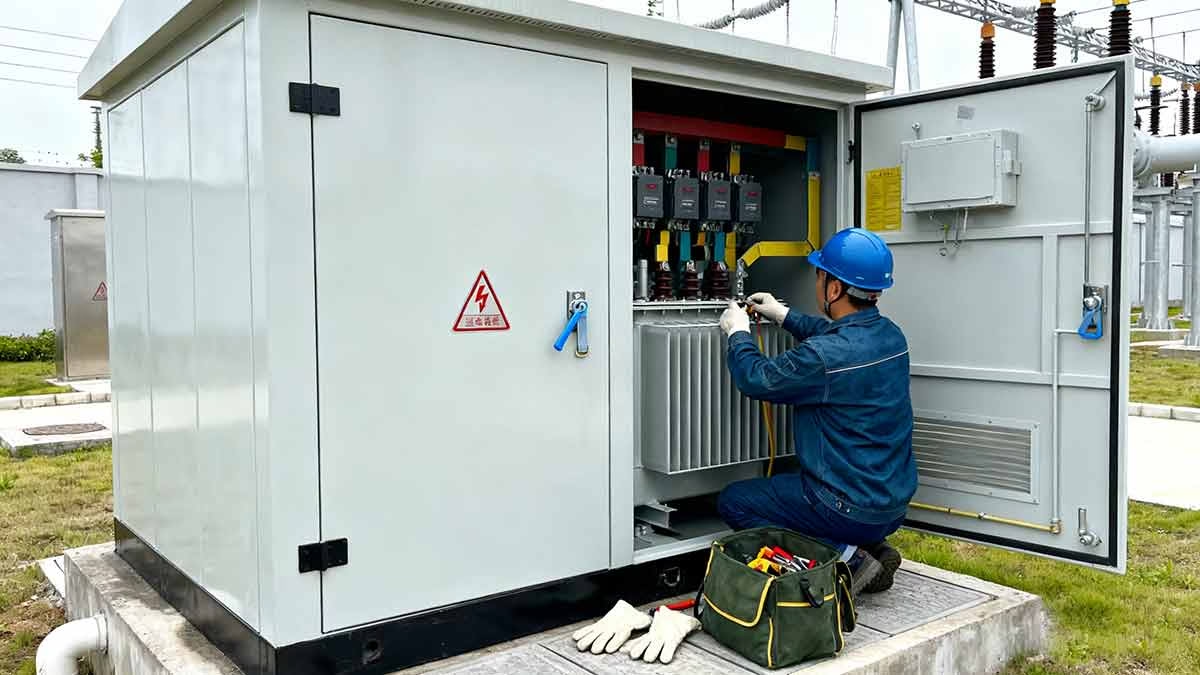
Installation Costs: Beyond the Transformer Itself
Installation expenses break down into three key categories:
- Site Preparation:
- Concrete pad (required for stability): $2,000-$5,000 (varies by size and location)
- Grounding system (safety compliance): $1,500-$3,000
- Trenching and conduit (for wiring): $50-$100 per linear foot
- Transportation and Handling:
- Local transport (within 50 miles): $500-$1,500
- Long-distance shipping (over 500 miles): $3,000-$7,000 (for large units)
- Crane rental (for placement): $500-$2,000 per day
- Labor:
- Licensed electricians: $75-$150 per hour
- Project management: $100-$200 per hour
- Typical installation timeline: 1-3 days (varies by complexity)
Maintenance: Ongoing Expenses to Plan For
Routine maintenance is essential to extend your transformer’s lifespan (15-25 years) and prevent costly failures. 2025 maintenance costs include:
| Maintenance Task | Frequency | Typical Cost Range |
|---|---|---|
| Visual Inspection | Annually | $200-$500 |
| Oil Testing (for oil-filled units) | Every 3-5 years | $300-$800 |
| Infrared Scanning (for hot spot detection) | Annually | $300-$700 |
| Bushing Replacement | Every 8-10 years | $1,500-$3,000 |
| Oil Leak Repair | As needed | $500-$2,000 |
Real-World TCO Example
A 1000 kVA pad mounted transformer with a $65,000 purchase price might have total first-year costs of:
- Purchase: $65,000
- Installation (site prep + transport + labor): $16,000
- First-year maintenance: $800
- Total first-year cost: $81,800 (26% above purchase price)
Tips to Control Installation and Maintenance Costs
- Conduct a comprehensive site assessment before purchasing to identify potential issues (e.g., difficult access, soil conditions) that could raise installation costs.
- Invest in preventive maintenance: Regular oil testing and inspections can catch small issues before they become $10,000+ overhauls.
- Partner with manufacturers that offer bundled installation/maintenance packages—these often save 10-15% compared to separate contracts.
ROI Analysis: Balancing Upfront Costs and Long-Term Savings
Struggling to justify the higher cost of a high-efficiency pad mounted transformer? The key is looking beyond upfront price tags to calculate total ROI. In 2025, the right transformer can deliver payback periods of 3-7 years—with decades of subsequent savings.
High-efficiency pad mounted transformers in 2025 offer 15-30% energy savings over standard models, translating to ROI periods of 3-7 years. The secret to maximizing returns lies in balancing upfront investment with long-term operational savings, maintenance reductions, and incentives.
Key Components of Transformer ROI
- Upfront Costs: Purchase price, installation, and any necessary infrastructure upgrades.
- Operational Savings: Reduced energy bills from lower efficiency losses.
- Maintenance Savings: Higher-quality components in efficient models reduce repair frequency and costs.
- Incentives: Utility rebates, tax credits, and green energy grants can offset upfront costs by 5-15%.
Step-by-Step ROI Calculation (2025 Example)
Let’s compare a standard vs. high-efficiency 1000 kVA pad mounted transformer:
| Factor | Standard Transformer | High-Efficiency Transformer |
|---|---|---|
| Purchase Price | $60,000 | $75,000 |
| Installation Cost | $15,000 | $15,000 |
| Total Upfront Cost | $75,000 | $90,000 |
| Annual Energy Loss | 8,760 kWh | 6,570 kWh |
| Annual Energy Savings (at $0.12/kWh) | — | $262.80 |
| Annual Maintenance Savings | — | $200 |
| Total Annual Savings | — | $462.80 |
Simple ROI Calculation:
Additional Upfront Cost = $15,000
Payback Period = $15,000 / $462.80 = 32.4 years
But this doesn’t tell the whole story—adjust for real-world factors:
- Load Factor: Most transformers operate at 50-75% load (not full capacity). At 60% load, annual savings jump to $793.37, cutting payback to 18.9 years.
- Rising Energy Costs: A 3% annual increase in electricity prices reduces payback to 15.2 years.
- Utility Rebate: A $3,000 rebate (common for high-efficiency units) drops payback to 15.3 years.
- Lifespan Extension: High-efficiency models last 20-25 years (vs. 15-20 for standard units), adding 5+ years of savings.
Maximizing Transformer ROI in 2025
- Right-Size Your Transformer: Oversized units waste energy and money. Use load analysis to match capacity to actual needs.
- Prioritize High-Load Applications: Transformers operating at 75%+ load see faster ROI from efficiency upgrades.
- Leverage Incentives: Research local utility rebates, federal tax credits (up to 10% for energy-efficient equipment), and green building certifications (e.g., LEED) that offer additional savings.
- Invest in Smart Monitoring: AI-powered systems identify inefficiencies early, boosting savings by 5-10%.
Conclusion
Budgeting for pad mounted transformers in 2025 requires a holistic approach—looking beyond upfront prices to consider supply chain trends, efficiency regulations, hidden installation/maintenance costs, and long-term ROI. By understanding these variables, you can avoid budget overruns and select a transformer that delivers value for decades.
The key takeaway? Don’t let sticker shock deter you from investing in high-efficiency, well-spec’d units. While they cost more initially, their energy savings, reduced maintenance, and compliance with 2025 regulations make them the most cost-effective choice in the long run.
Whether you’re a utility company, commercial developer, or industrial operator, aligning your transformer selection with your budget, operational needs, and sustainability goals will ensure a smart, future-proof investment.