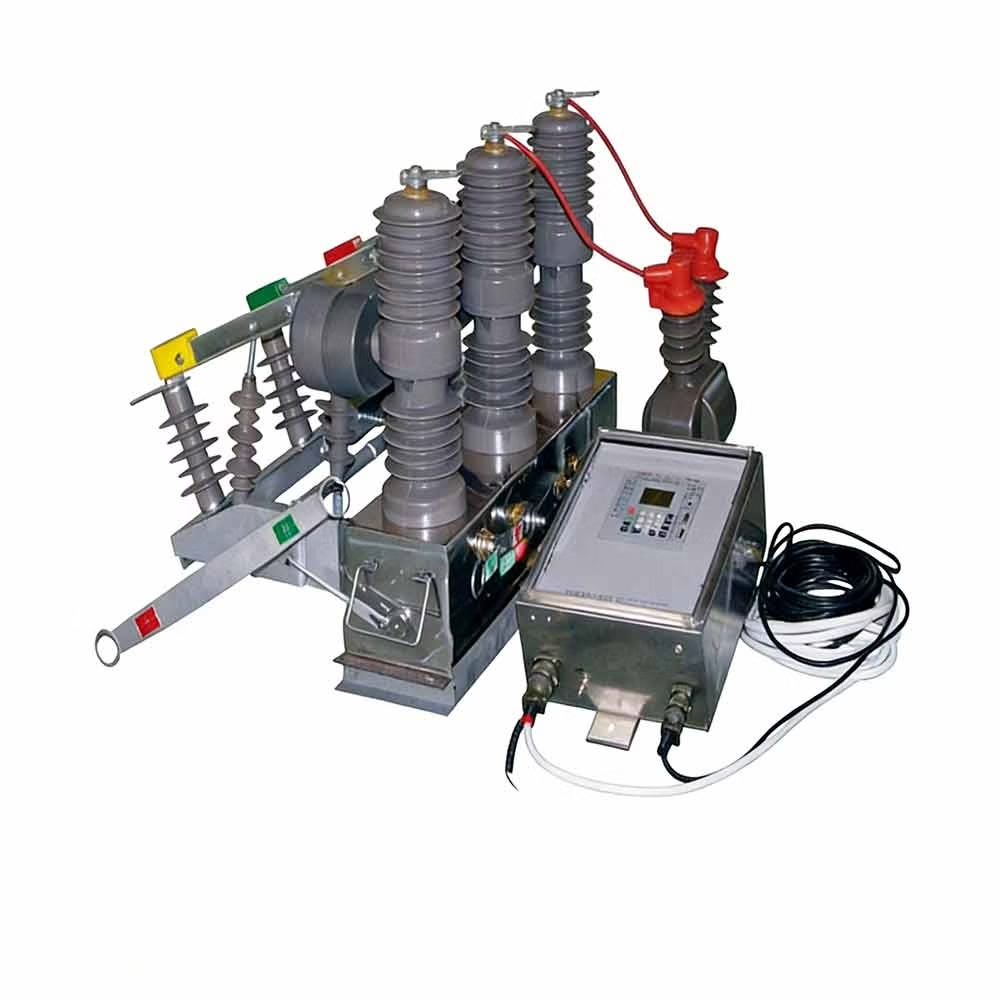


Description
Description of EV Fast Charging Stations

Core Functions: Safety, Convenience & Connectivity
- Smart Interaction & Payment: Equipped with human-machine interaction systems and card-swiping payment, making charging quick and hassle-free.
- Precise Metering & Security: Built-in metering and billing functions, plus data encryption and identity verification, ensuring transparent and safe transactions.
- Reliable Protection: Includes pile anti-theft design, emergency stop buttons, and excellent dustproof/waterproof performance, enabling safe outdoor operation in all weather.
Flexible Power & Wide Applications
- Bus depots and main road service areas
- Large parking lots (malls, airports, etc.)
- Inter-city transportation hubs
The stations are also easy to install, allowing flexible deployment across different locations.


Advanced Connectivity for Smart Management
Parameter of EV Fast Charging Stations
| Technical Indicators | YL-YT-0180-GB-102 | YL-YT-0240-GB-102 |
| Rated Input Voltage | AC 380V, Three-phase Five-wire System | AC 380V, Three-phase Five-wire System |
| Input Voltage Range | 380Vac ±20% | 380Vac ±20% |
| Rated Input Current | 295A | 390A |
| Operating Frequency | 50/60Hz | 50/60Hz |
| Output Voltage Range | 200-1000VDC | 200-1000VDC |
| Maximum Output Current per Gun | 250A | 250A |
| Rated Total Output Power | 180kW | 240kW |
| THDi (Total Harmonic Distortion of Input Current) | ≤5% (At input 380V, output 1000V, 50%~100% load) | ≤5% (At input 380V, output 1000V, 50%~100% load) |
| Input Inrush Current | ≤110% of rated input current | ≤110% of rated input current |
| Power Factor | ≥0.99 (At 50%~100% output power, rated input voltage and frequency) | ≥0.99 (At 50%~100% output power, rated input voltage and frequency) |
| ≥0.95 (At 20%~50% output power, rated input voltage and frequency) | ≥0.95 (At 20%~50% output power, rated input voltage and frequency) | |
| Voltage Regulation Accuracy | ≤±0.5% (-30℃~+55℃) | ≤±0.5% (-30℃~+55℃) |
| Current Regulation Accuracy | ≤±1% (-30℃~+55℃, 20%~100% load current) | ≤±1% (-30℃~+55℃, 20%~100% load current) |
| Output Voltage Ripple (Peak Ripple Coefficient) | ≤±1% (At input voltage of 85%, 100%, 115% respectively) | ≤±1% (At input voltage of 85%, 100%, 115% respectively) |
| Overall Efficiency | ≥96% (At 100% full-load output power) | ≥96% (At 100% full-load output power) |
| Standby Power Consumption | ≤15W | ≤15W |
| Heat Dissipation Method | Air Cooling | Air Cooling |
| Noise Level | < 80dB (At 1m distance) | < 80dB (At 1m distance) |
| Protection Functions | Input over/under voltage, input overcurrent, output overvoltage, output overcurrent, leakage current, emergency stop protection, etc. | Input over/under voltage, input overcurrent, output overvoltage, output overcurrent, leakage current, emergency stop protection, etc. |
| Relevant Standards | 1. Communication between charging equipment and electric vehicles complies with GB/T 27930-2015 | 1. Communication between charging equipment and electric vehicles complies with GB/T 27930-2015 |
| 2. Charging interface complies with GB/T 20234-2015 | 2. Charging interface complies with GB/T 20234-2015 | |
| 3. Technical requirements comply with GB/T 18487.1-2015 | 3. Technical requirements comply with GB/T 18487.1-2015 |
Feature of EV Fast Charging Stations
Maintenance for EV Fast Charging Stations


OUR CERTIFICATE


OUR PROJECTS


charging pile vs charging station
As two primary charging facilities for electric vehicles (EVs), EV charging piles and EV charging stations exhibit distinct differences across multiple dimensions. Below is a detailed analysis of their disparities:
1. Definition and Function
EV Charging Pile
An EV charging pile is a device that supplements power for EVs, similar to fuel dispensers at gas stations. It can be fixed on the ground or walls, and is typically installed in public buildings (e.g., shopping malls, public parking lots) and residential community parking areas.
The input end of a charging pile connects directly to the AC power grid, while the output end is equipped with a charging plug. It can adjust voltage and current according to different EV models to charge the vehicle. Generally, charging piles offer two charging modes: conventional charging (slow charging) and fast charging.
EV Charging Station
An EV charging station is a high-power charging facility designed to meet EV charging needs. It integrates functions such as parking spaces, charging equipment, and convenient services.
With a more powerful power supply capacity, charging stations can charge multiple battery packs simultaneously and are staffed with professionals to handle batteries of different specifications. Functionally, they are divided into four sub-modules:
- Power distribution system
- Charging system
- Battery dispatching system
- Charging station monitoring system
Charging stations feature functions including scheduled charging, full-charge alerts, computerized fast charging, password control, automatic voltage identification, multiple protections, and four-way output. They are also equipped with universal output interfaces, enabling fast charging for all types of EVs.
2. Installation and Layout
EV Charging Pile
Charging piles are relatively easy to install and can be flexibly arranged in locations like public buildings and residential parking lots. Most are unmanned public facilities; users can start charging via card swiping, QR code scanning, or other methods.
EV Charging Station
The installation and layout of charging stations are more complex, as they require consideration of multiple factors: power supply capacity, parking space planning, and charging equipment configuration. They are usually built in areas with high demand for fast charging, such as highway service areas, commercial centers, and large parking lots.
3. Charging Mode and Efficiency
EV Charging Pile
As mentioned, charging piles provide both conventional (slow) and fast charging modes:
- Conventional charging (slow charging): Longer charging time but lower cost.
- Fast charging: Shorter charging time but higher cost, and may have a certain impact on battery lifespan.
EV Charging Station
Charging stations primarily offer fast charging services to meet the demand for rapid power replenishment of EVs. By adopting high-efficiency charging technologies and equipment, they can fully charge an EV in a relatively short period.
4. Target Users and Application
EV Charging Pile
The main target users of charging piles are individual users and small-sized EVs. As a convenient charging facility in public areas or residential communities, it provides accessible charging services for EV owners.
EV Charging Station
Charging stations cater to a broader range of users, including individual EV owners, taxis, ride-hailing vehicles, and public buses. As a key infrastructure for EV charging, they play a crucial role in promoting the popularization and development of electric vehicles.
In summary, EV charging piles and EV charging stations differ significantly in terms of definition, function, installation, layout, charging mode, efficiency, target users, and application. When choosing a charging facility, users should weigh their actual needs and usage scenarios to make an appropriate selection.
If you need this content formatted into a comparison table for quicker reference (e.g., listing key differences side by side), I can help organize it. Would you like that?