
Electrical transformers leverage electromagnetic induction to transfer energy across multiple circuits, serving as the backbone of efficient power transmission and safe electricity use. By adjusting voltage levels, they bridge the gap between high-voltage power grids and the low-voltage needs of homes, businesses, and industrial equipment. This remarkable technology relies on precision-engineered components, fundamental physical laws, and optimized design—all working in harmony to deliver reliable power.
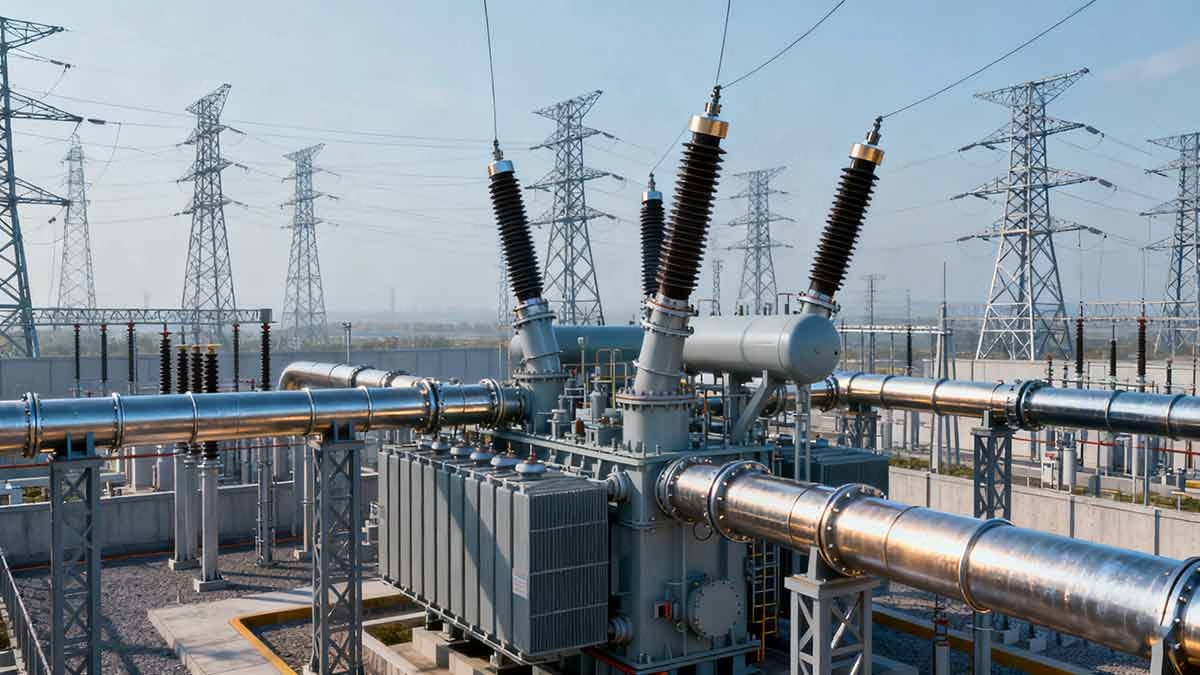
With years of expertise in the power industry, we’ve witnessed firsthand how transformers shape modern electrical systems. Below, we demystify their operation by answering five critical questions, blending technical depth with practical insights.
Contents
hide
The Fundamental Principle: How Electromagnetic Induction Powers Transformers
Curious about the science behind transformers’ voltage-changing abilities? It all boils down to electromagnetic induction—a groundbreaking discovery that revolutionized electricity as we know it.
Electromagnetic induction describes how a fluctuating magnetic field generates an electric current in a nearby conductor. For transformers, this principle enables contactless energy transfer between circuits, making voltage transformation both efficient and safe. Unlike direct electrical connections, induction eliminates the risk of short circuits while preserving power integrity.
The Science of Induction in Transformers
Michael Faraday’s 1831 discovery laid the groundwork for transformer technology, and its core logic remains unchanged:
- An alternating current (AC) passed through a conductor creates a constantly changing magnetic field.
- This dynamic magnetic field induces an electromotive force (EMF) in a second conductor placed nearby.
In transformers, this process is refined through three key steps:
- Primary Coil Activation: When AC power flows through the primary coil, it generates a fluctuating magnetic field.
- Magnetic Field Concentration: An iron core channels and amplifies this magnetic field, ensuring minimal energy loss.
- Secondary Coil Induction: The concentrated magnetic field cuts through the secondary coil, inducing a voltage proportional to the field’s rate of change.
Faraday’s Law: The Mathematical Backbone
Faraday’s Law quantifies this induction process, stating that the induced EMF in a coil is proportional to the number of turns and the rate of magnetic flux change:
EMF = -N * (dΦ/dt)EMF: Induced electromotive force (volts)N: Number of turns in the coildΦ/dt: Rate of change of magnetic flux (webers per second)
Practical Design Considerations
From an engineering perspective, optimizing induction requires careful choices:
- Core Material: High-permeability materials (e.g., grain-oriented silicon steel) enhance magnetic field strength.
- Coil Configuration: Tightly wound coils maximize magnetic coupling between primary and secondary windings.
- Frequency Alignment: Transformers are calibrated to match grid frequency (50Hz or 60Hz) for optimal flux change rates.
This principle—nearly 200 years old—still underpins every transformer in use today, from power grid substations to smartphone chargers.
Anatomy of a Transformer: Core Components and Their Functions
Transformers may appear simplistic from the outside, but their internal structure is a masterclass in precision engineering. Every component is designed to minimize energy loss, maximize efficiency, and ensure reliable voltage transformation.
At its core, a transformer consists of three essential parts: primary coil, secondary coil, and magnetic core. Complementary components like insulation, cooling systems, and tap changers further enhance performance and safety.
Key Components Explained
1. Primary Coil
- Function: Receives input voltage and generates the initial magnetic field.
- Construction: Insulated copper wire (or aluminum for cost-sensitive applications) wound around the core.
- Critical Design Factor: The number of turns dictates the transformer’s input voltage rating—more turns handle higher voltages.
2. Secondary Coil
- Function: Converts magnetic energy back to electrical energy, delivering the transformed output voltage.
- Construction: Similar to the primary coil but with a different number of turns (determining voltage ratio).
- Critical Design Factor: Wire gauge is sized to handle the expected output current, preventing overheating.
3. Magnetic Core
- Function: Acts as a “magnetic highway,” guiding flux between coils to minimize energy loss.
- Material: Laminated silicon steel (laminations reduce eddy current losses by 80–90% compared to solid iron).
- Types:
- Core-type: Coils wrapped around the core’s legs (common in power transformers).
- Shell-type: Core surrounds the coils (used in low-voltage, high-current applications).
4. Supplementary Components
| Component | Function | Material/Design Choice |
|---|---|---|
| Insulation | Prevents short circuits between windings | Fiberglass, paper, or epoxy resin |
| Cooling System | Dissipates heat from energy losses | Oil-immersed (power transformers) or air-cooled (small units) |
| Tap Changer | Adjusts the turns ratio for voltage fine-tuning | Automatic or manual (for grid stability) |
| Bushings | Insulates external connections | Ceramic or composite materials |
Engineering Insights from the Field
In practice, component synergy is critical:
- Core Size: Must balance magnetic flux capacity (avoiding saturation) with physical footprint.
- Insulation Integrity: Dielectric strength must withstand voltage spikes (e.g., lightning strikes in grid applications).
- Thermal Management: Overheating reduces efficiency—cooling systems are sized to handle both core and copper losses.
Every component works in tandem to deliver the transformer’s rated performance, highlighting why precision manufacturing is non-negotiable.
Voltage and Current Transformation: The Mathematics Behind the Magic
The ability to precisely adjust voltage and current is what makes transformers indispensable. This process follows simple yet powerful mathematical relationships, rooted in the conservation of energy.
Transformers operate on the principle that voltage and current are inversely proportional to the number of turns in their coils. This balance ensures that power (minus minimal losses) is preserved as it moves from primary to secondary circuits.
The Transformer Equation: Voltage Ratio
The foundational relationship between voltage and coil turns is defined by the transformer equation:
Vs / Vp = Ns / NpVs: Secondary voltage (output)Vp: Primary voltage (input)Ns: Number of turns in the secondary coilNp: Number of turns in the primary coil
This means:
- A step-up transformer (Ns > Np) increases voltage (e.g., 12kV → 230kV for long-distance transmission).
- A step-down transformer (Ns < Np) decreases voltage (e.g., 13kV → 240V for residential use).
- An isolation transformer (Ns = Np) preserves voltage while separating circuits for safety.
Current Transformation: Inverse Proportionality
Current follows the opposite relationship to voltage, ensuring power conservation:
Ip / Is = Ns / NpIp: Primary currentIs: Secondary current
Rearranged, this confirms power balance (for ideal transformers):
Vp * Ip = Vs * IsReal-World Applications of the Ratios
| Scenario | Turns Ratio (Ns/Np) | Voltage Outcome | Current Outcome |
|---|---|---|---|
| Grid Transmission | 20:1 | 12kV → 240kV (step-up) | 100A → 5A (current drop) |
| Residential Distribution | 1:50 | 12kV → 240V (step-down) | 2A → 100A (current rise) |
| Medical Equipment | 1:1 | 240V → 240V (isolation) | 10A → 10A (current same) |
Beyond Ideal Transformers
In real-world units, minor deviations occur due to:
- Copper Losses: Resistance in windings causes a voltage drop (proportional to I²R).
- Leakage Inductance: Some magnetic flux fails to link both coils, reducing coupling efficiency.
- Core Losses: Hysteresis and eddy currents dissipate small amounts of energy as heat.
These factors are accounted for in design—for example, using thicker copper wire to minimize resistance or optimizing core laminations to reduce losses.

Efficiency in Action: Factors Shaping Transformer Performance
Transformer efficiency isn’t just about energy savings—it’s about reliability, longevity, and cost-effectiveness. High-efficiency units minimize wasted power, reduce heat generation, and lower operational costs over their lifespan (typically 25–30 years).
Several key factors influence efficiency, from material selection to operating conditions. Engineering teams optimize these elements to strike a balance between performance, size, and cost.
Core Losses: Minimizing Magnetic Waste
Core losses (or iron losses) stem from the magnetic core’s interaction with alternating flux:
- Hysteresis Loss: Energy wasted as the core is repeatedly magnetized and demagnetized.
- Eddy Current Loss: Circulating currents induced in the core material, generating heat.
Mitigation Strategies:
- Use low-loss silicon steel or amorphous metal cores (amorphous cores reduce losses by 30–50%).
- Laminate the core into thin sheets (0.2–0.35mm thick) with insulation between layers to block eddy currents.
- Optimize core geometry to shorten magnetic paths and reduce flux density.
Copper Losses: Reducing Winding Resistance
Copper losses (I²R losses) occur when current flows through the resistive windings:
- Losses increase exponentially with current (doubling current quadruples losses).
Mitigation Strategies:
- Use larger-gauge copper wire (lower resistance) for high-current windings.
- Employ parallel winding strands to reduce skin effect (current concentration at wire surfaces).
- Minimize winding length and optimize coil layout to shorten current paths.
Temperature: The Silent Efficiency Killer
Elevated operating temperatures degrade efficiency by increasing winding resistance and accelerating insulation aging:
- Every 10°C rise above rated temperature can halve insulation lifespan.
Mitigation Strategies:
- Implement efficient cooling systems:
- Oil-immersed transformers: Oil circulates to absorb and dissipate heat (ideal for high-power units).
- Air-cooled transformers: Fans or natural convection for low-to-medium power applications.
- Design heat sinks and ventilation paths to maximize heat dissipation.
- Use temperature sensors to trigger cooling or alert operators to overheating.
Load Optimization: Finding the Efficiency “Sweet Spot”
Transformers achieve peak efficiency (97–99.5% for modern units) when loaded to 50–70% of their rated capacity. Both underloading and overloading reduce efficiency:
- Underloading: Core losses dominate, as they remain relatively constant regardless of load.
- Overloading: Copper losses spike, and overheating risks damage.
Optimization Tips:
- Size transformers to match the average load (not peak load, which is often temporary).
- Use load management systems to distribute power across multiple transformers.
- Incorporate tap changers to adjust voltage for varying load conditions.
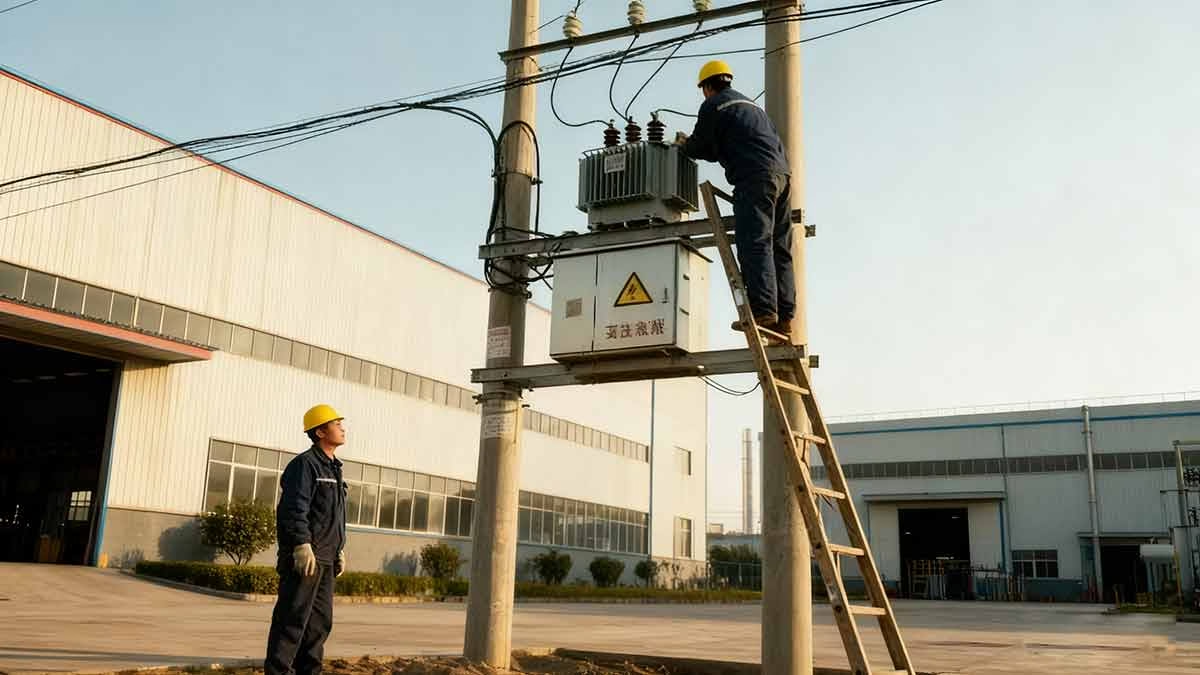
From Theory to Practice: Real-World Applications of Transformer Principles
Transformers are everywhere—powering everything from skyscrapers to smartphones. Their versatility stems from their ability to adapt voltage, isolate circuits, and transfer energy efficiently across diverse environments. Below are the most impactful applications, where theory meets real-world innovation.
Power Distribution: The Grid’s Backbone
Transformers are the unsung heroes of electrical grids, enabling long-distance power transmission and safe local distribution:
- Step-Up Transformers: Located at power plants, they boost voltage from 12kV to 765kV, reducing current and minimizing transmission losses (up to 90% less loss than low-voltage transmission).
- Substation Transformers: Step down 765kV → 13kV for regional distribution.
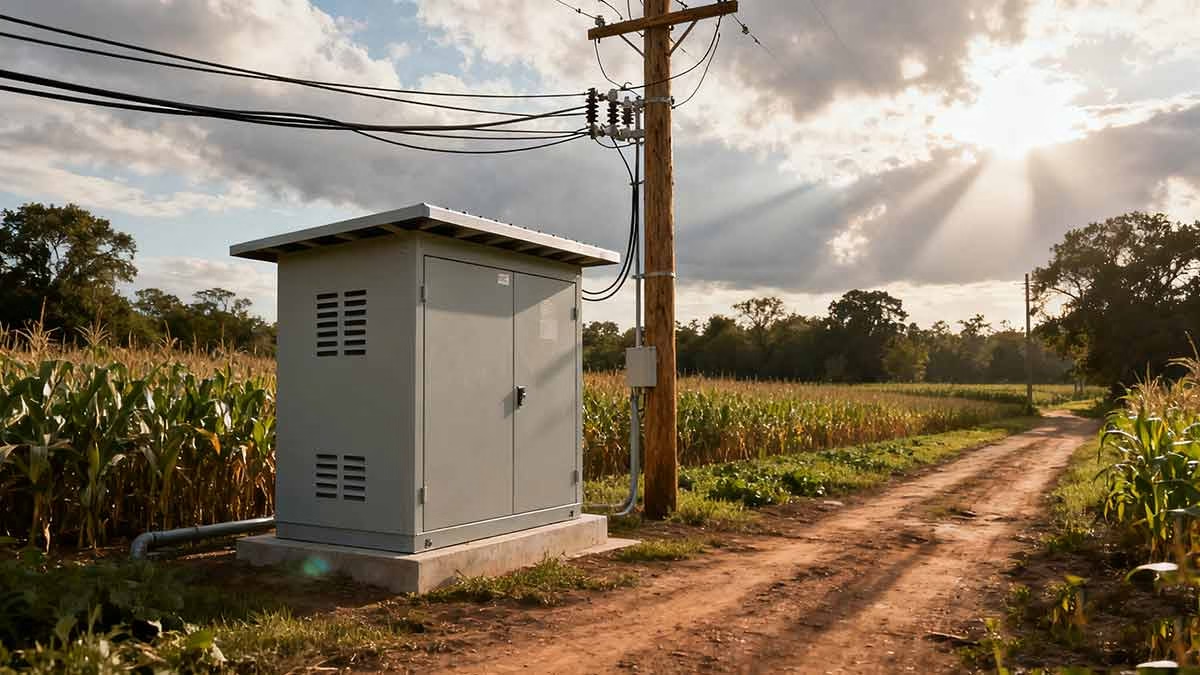
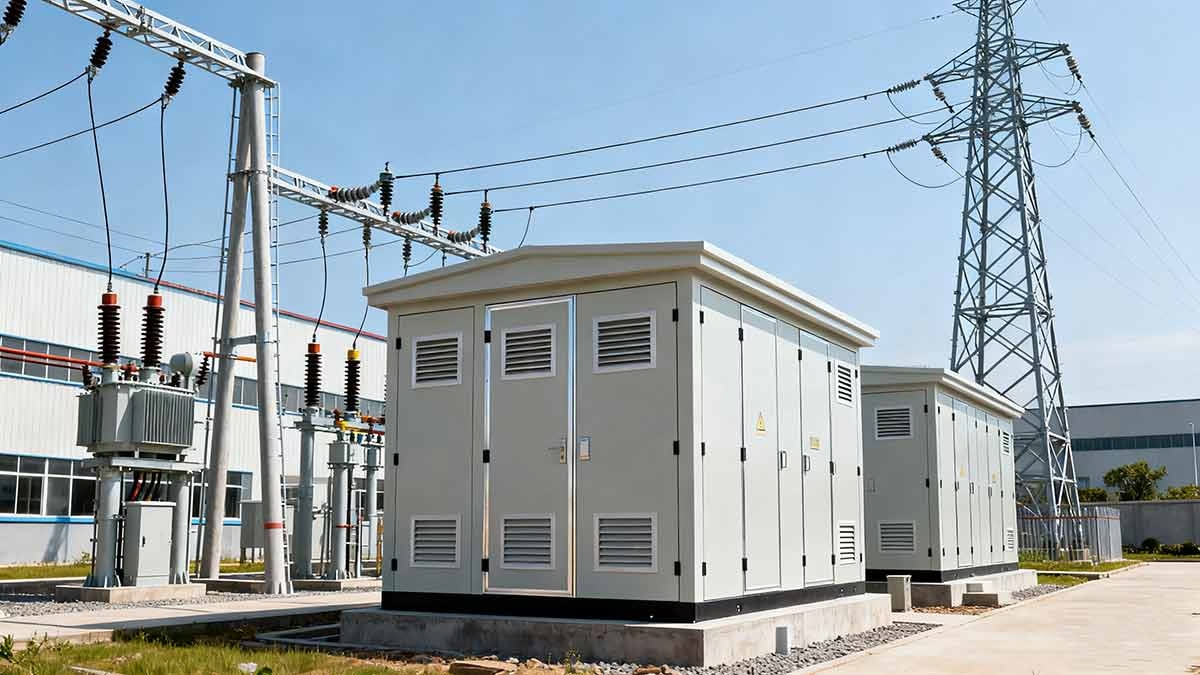
- Pad-Mounted/Pole-Mounted Transformers: Further reduce voltage to 240V (residential) or 480V (commercial), serving neighborhoods and business districts.
Electronics: Miniaturized Power Conversion
In consumer and industrial electronics, transformers are scaled down to fit compact designs:
- Switch-Mode Power Supplies (SMPS): Found in laptops, phones, and TVs, these high-frequency transformers (20kHz–1MHz) convert 240V AC to low-voltage DC (5V, 12V).
- Audio Transformers: Used in amplifiers and speakers to match impedance between components, enhancing sound quality.
- Isolation Transformers: Protect sensitive equipment (e.g., medical devices, lab instruments) from voltage spikes and ground loops.
Industrial Applications: Powering Manufacturing
Heavy industry relies on specialized transformers to handle high currents and harsh conditions:
- Welding Transformers: Deliver low voltage (20–40V) and high current (100–1000A) for arc welding.
- Induction Furnace Transformers: Supply high-frequency power to melt metals (steel, aluminum) in foundries.
- Variable Frequency Drive (VFD) Transformers: Adjust motor speed in pumps, conveyors, and HVAC systems, reducing energy use by 20–40%.
Renewable Energy: Integrating Clean Power
Transformers are critical to unlocking the potential of renewable energy sources:
- Wind Turbines: Step up voltage from 690V (turbine generators) to 34.5kV for grid connection.
- Solar Farms: Inverters use transformers to convert DC solar power to AC, matching grid voltage (12kV–34.5kV).
- Energy Storage Systems: Enable bidirectional power flow between batteries and the grid, supporting load balancing.
Emerging Applications: The Future of Transformers
As technology evolves, transformers are adapting to new challenges:
- Electric Vehicle (EV) Charging: Fast-charging stations use high-power transformers (50–350kW) to convert grid AC to DC for vehicle batteries.
- Solid-State Transformers (SST): Replace traditional iron cores with power electronics, enabling faster switching, smaller size, and grid-forming capabilities.
- Smart Grid Transformers: Equipped with IoT sensors and communication modules for real-time monitoring, load balancing, and predictive maintenance.
Key Challenges in Real-World Deployment
While transformers are highly reliable, real-world conditions present unique hurdles:
- Extreme Environments: Offshore wind turbines and desert solar farms require transformers resistant to salt, dust, and temperature extremes.
- Harmonic Distortion: Non-linear loads (e.g., LEDs, computers) generate harmonics—K-rated transformers are designed to handle these without overheating.
- Space Constraints: Urban areas and high-rises demand compact, low-noise transformers (pad-mounted or underground vaults).
Innovations like biodegradable cooling oils, digital twin monitoring, and advanced core materials are addressing these challenges, ensuring transformers remain central to the energy transition.
Conclusion
Electrical transformers are a testament to how fundamental physics can shape modern life. By harnessing electromagnetic induction, they enable efficient power transmission, safe voltage conversion, and the integration of renewable energy—all while operating quietly behind the scenes.
From the core components that minimize energy loss to the mathematical relationships that govern voltage transformation, every aspect of transformer design is optimized for performance. As the world shifts toward electrification and clean energy, transformers will continue to evolve—becoming smarter, more efficient, and more versatile.
Understanding their principles isn’t just for engineers; it’s for anyone who relies on reliable electricity. Whether powering a home, a factory, or a wind farm, transformers are the invisible infrastructure that keeps our world running.