
Box-type substations are categorized by the layout of their three core components (high-voltage switchgear, transformers, low-voltage power distribution devices)—primarily into combined type (European-style, IEC-compliant) and integrated type (American-style, ANSI-compliant) (assembled type is rarely used today). CHH Power offers customized products aligned with global standards to meet diverse grid and application needs. Below is a systematic breakdown of key structural features and differences.

Overview of Overall Layout Forms
Historically, box-type substations had three layout configurations, with two dominant types in current use:
Assembled Type (Obsolete)
- Structure: High-voltage/low-voltage complete sets and transformers are assembled into metal boxes separately.
- Drawbacks: Poor integrity, heavy assembly workload, large height and footprint.
- Status: Rarely adopted in modern projects due to inefficiency.
Combined Type (Mainstream)
- Structure: High-voltage/low-voltage control and protection equipment are directly installed in a single box (no prefabricated complete sets). Designed for maintenance-free operation, no internal operation corridors—significantly reducing overall volume.
- Core Advantage: Compact, integrated design with high compatibility for grid standards.
Integrated Type (Specialized)
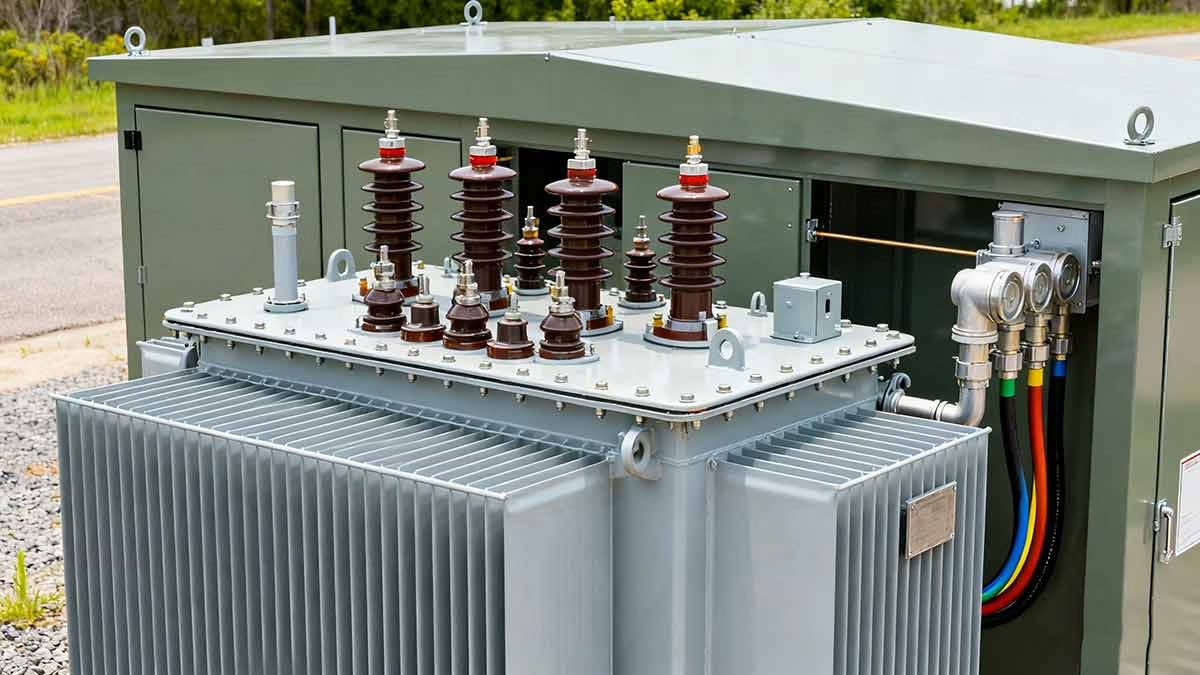
- Structure: Also known as American-style box-type transformers. Centered on the transformer, fuses and load switches are integrated into the transformer box to form a unified unit.
- Core Advantage: Ultra-compact volume—similar to a standard oil-immersed transformer of the same capacity, only ~1/3 the volume of a combined-type station with equal capacity.
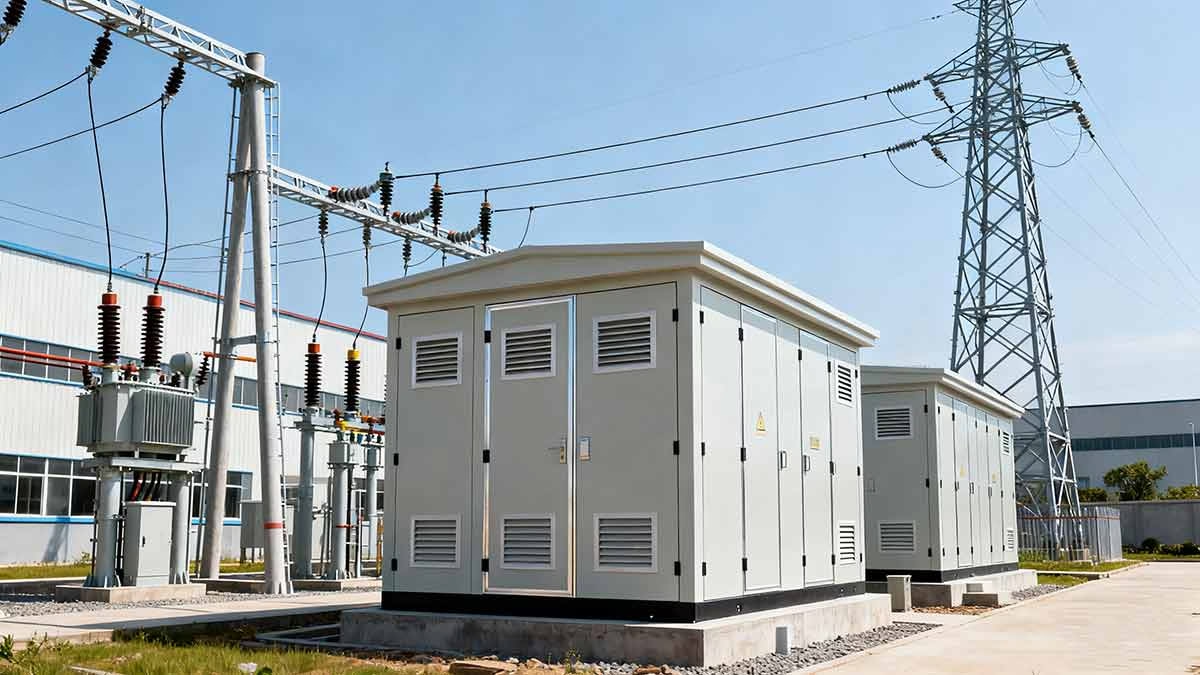
Combined Type (European-Style) Box-Type Substation
Core Characteristics
- Design Focus: System integration with no independent operation corridors, optimizing space utilization.
- Standard Compliance: Aligns with IEC 60330 (1st edition 1995-11)—the international standard for high-voltage/low-voltage prefabricated substations, which mandates a combined layout.
- Layout Subtypes: Divided into Type Ⅰ and Type Ⅱ (pin type) based on component arrangement, adapting to different installation spaces.
Application Scenarios
- Widely adopted in countries/regions implementing IEC standards (including China, CHH Power’s key market).
- Compatible with both neutral point direct grounding systems and neutral point indirect grounding systems—versatile for diverse grid structures.
Integrated Type (American-Style) Box-Type Substation
Core Characteristics
- Design Focus: Transformer-centric integration, minimizing redundant space by embedding switches/fuses into the transformer box.
- Standard Compliance: Follows ANSI standards, widely used in the United States.
- Key Limitation: Smaller volume comes with narrower grid adaptation.
Application Scenarios
- Suitable only for neutral point direct grounding systems—not compatible with indirect grounding systems.
- Ideal for scenarios prioritizing ultra-compact footprint (e.g., dense urban areas with limited installation space).
Core Differences Between Combined & Integrated Types
| Feature | Combined Type (European-Style) | Integrated Type (American-Style) |
|---|---|---|
| Compliance Standard | IEC 60330 | ANSI |
| Volume | Moderate (1x reference) | Ultra-compact (~1/3 of European-style) |
| Wiring Adaptation | Both direct/indirect neutral grounding | Only direct neutral grounding |
| Core Design | Equipment-centric integration | Transformer-centric integration |
| Main Application Region | China, Europe, and IEC-adopting countries | United States and ANSI-adopting regions |
| Component Arrangement | Separate functional zones (no corridors) | Fully integrated into transformer box |
CHH Power’s Product Advantages
- Combined-Type Focus: As a key supplier in IEC-adopting markets, CHH Power’s combined-type box-type substations are optimized for Chinese grid requirements—offering Type Ⅰ/Ⅱ layouts, compact volume, and high reliability.
- Customization Capability: Provides integrated-type (American-style) products for overseas ANSI-standard markets, ensuring compliance with local grid and installation needs.